“Whatever you would make habitual, practice it; and if you would not make a thing habitual, do not practice it, but accustom yourself to something else.”
Epictetus · Discourses, Book II, chapter 18
 quolira
.com
Epictetus said it, in Discourses, Book II, chapter 18.
Epictetus uses walking and running to show that capacity grows through use. The advice is so simple it feels almost insulting, which is exactly why people skip it. Open the book tonight.
From the collection: 23 Best Epictetus Quotes on Fear, Freedom, and Control · More Epictetus quotes
This quote means that reading and writing are learned by doing them, so anyone who wants to read or write well has to practice those skills rather than only admire them. Epictetus points to the most direct route to skill, which is regular and honest engagement with the activity itself. The advice is blunt, but it applies to almost any craft.
The line comes from the Discourses, a collection of talks Epictetus gave to students, which were recorded and edited by his pupil Arrian. In this passage Epictetus is concerned with moral and intellectual progress, and he uses ordinary skills such as reading and writing to show how improvement actually works. His point is that wanting to be good at something is not the same as doing the work, and that a teacher can show the way but cannot make a student practice.
Epictetus was a Stoic philosopher who taught in the first and second centuries CE. He was born into slavery, later gained his freedom, and went on to teach in Rome and later at Nicopolis in Epirus. He wrote nothing that survives under his own hand. His teachings are known through the Discourses and the Enchiridion, a short handbook of practical guidance compiled from his lessons.
“Whatever you would make habitual, practice it; and if you would not make a thing habitual, do not practice it, but accustom yourself to something else.”
Epictetus · Discourses, Book II, chapter 18
“Remember that you ought to behave in life as you would at a banquet.”
Epictetus · Enchiridion, section 15
“Show me someone who is ill and yet happy, in danger and yet happy, dying and yet happy, exiled and yet happy.”
Epictetus · Discourses, Book II, chapter 19
“Little is needed to ruin and upset everything, only a slight aberration from reason.”
Epictetus · Discourses, Book IV, chapter 3
“In a word, neither death, nor exile, nor pain, nor anything of this kind is the real cause of our doing or not doing any action, but our inward opinions and principles.”
Epictetus · Discourses, Book I, chapter 11
“It is not death or pain that is to be feared, but the fear of pain or death.”
Epictetus · Discourses, Book II, chapter 1
“Freedom is not acquired by satisfying yourself with what you desire, but by destroying your desire.”
Epictetus · Discourses, Book IV, chapter 1
“Know, first, who you are, and then adorn yourself accordingly.”
Epictetus · Discourses, Book III, chapter 1
“It is difficulties that show what men are.”
Epictetus · Discourses, Book I, chapter 24
“Remember that it is not he who gives abuse or blows who affronts, but the view we take of these things as insulting.”
Epictetus · Enchiridion, section 20
“Some things are in our control and others not.”
Epictetus · Enchiridion, section 1
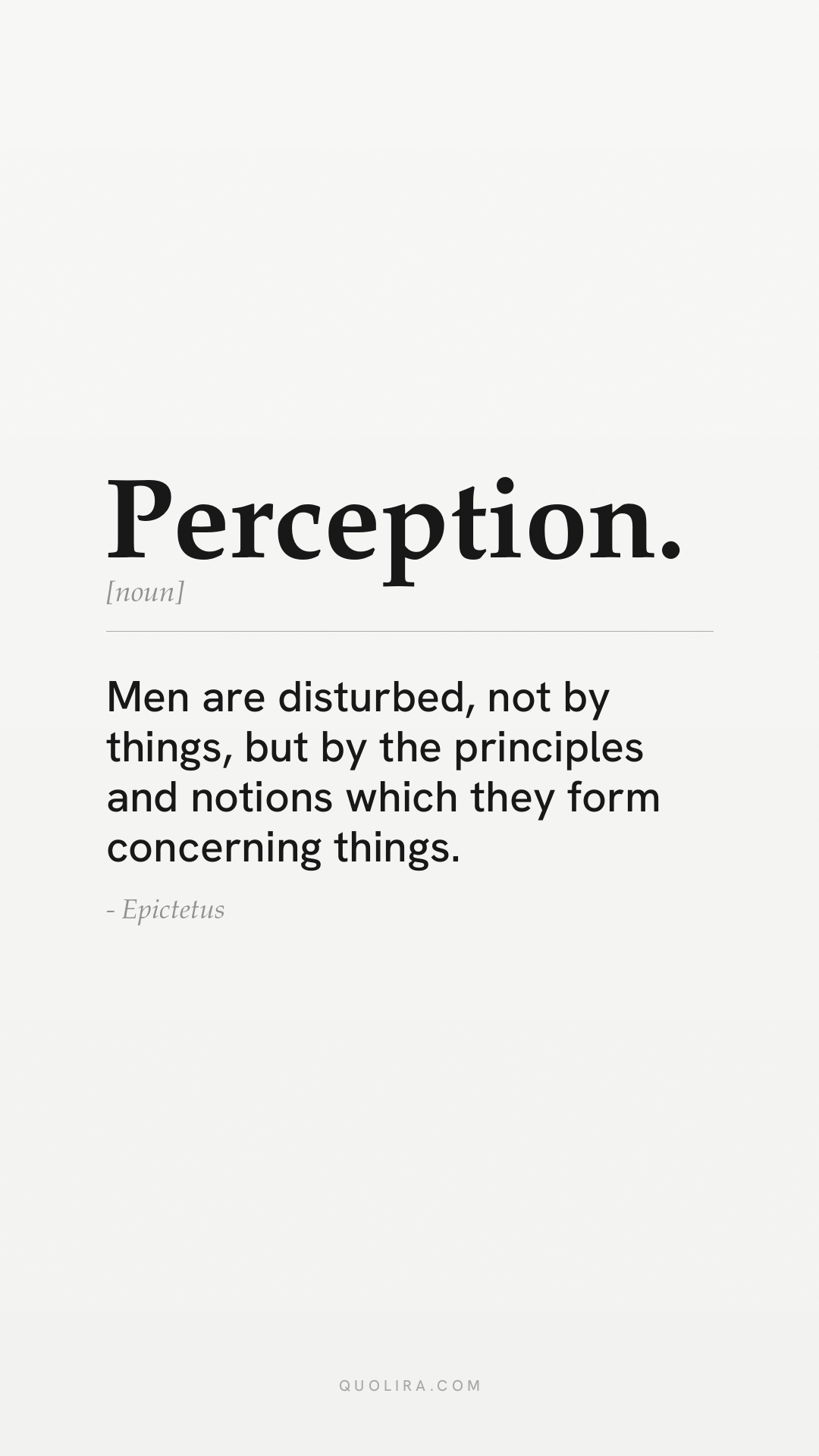
“Men are disturbed, not by things, but by the principles and notions which they form concerning things.”
Epictetus · Enchiridion, section 5