“Remember that you ought to behave in life as you would at a banquet.”
Epictetus · Enchiridion, section 15
 quolira
.com
Epictetus said it, in Discourses, Book II, chapter 18.
This is a practical formula for building habits. Repetition is how skills grow. If you want to be patient, practice small acts of patience every day, starting with the ones that annoy you most.
From the collection: 23 Best Epictetus Quotes on Fear, Freedom, and Control · More Epictetus quotes
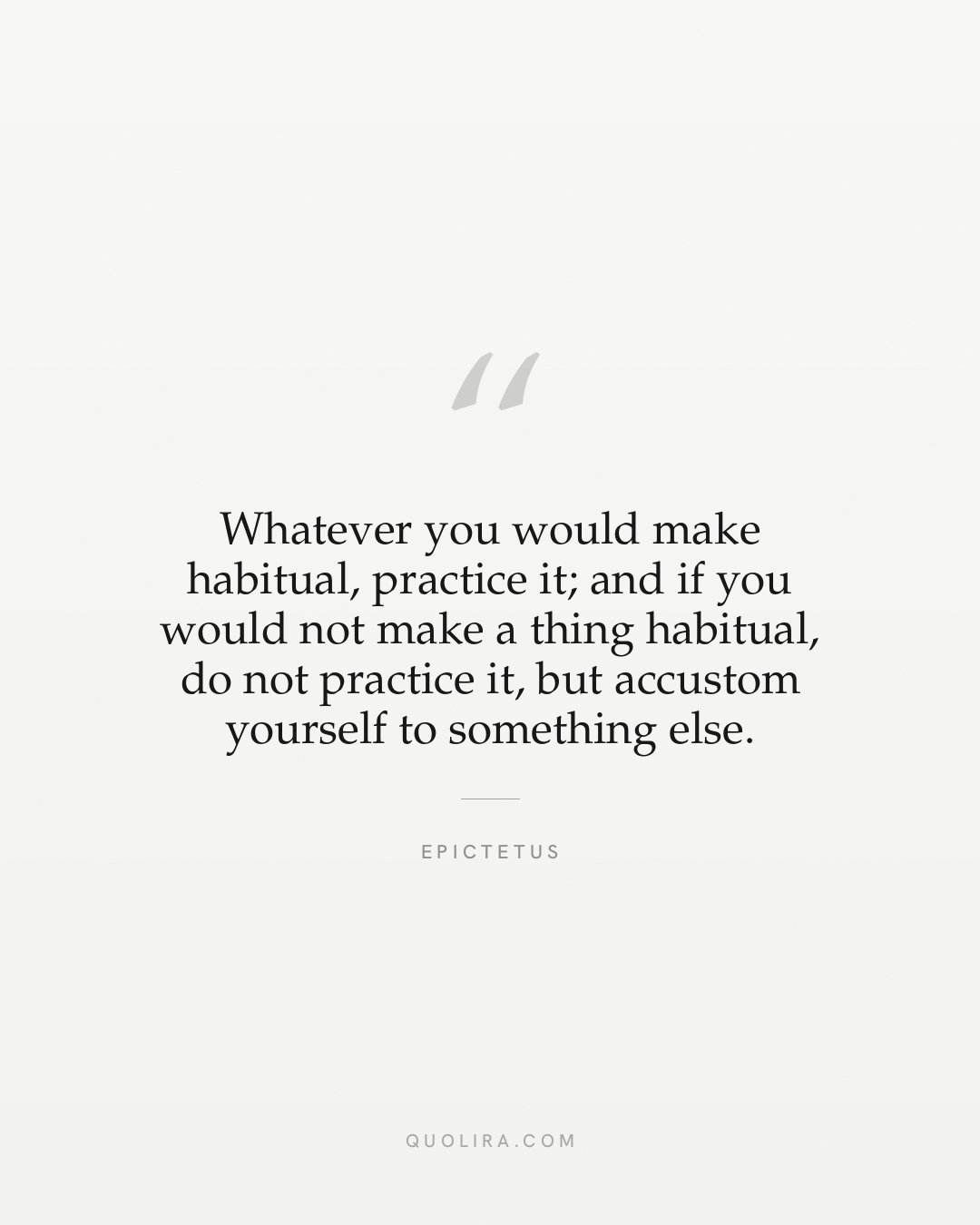
Epictetus says that whatever we repeat becomes habitual, so we should practice the qualities we want to have and stop rehearsing those we want to lose. Character, in his view, is shaped by what we train ourselves to do. The advice is simple but demanding, because it makes every ordinary day a form of training.
The passage appears in Book II of the Discourses, which Arrian recorded from his teacher's lectures. Epictetus often speaks about moral progress as a matter of exercise, comparing it to an athlete or student who improves through repeated effort. This particular teaching links habit with the larger Stoic goal of living in agreement with reason. It was meant for students who wanted practical methods for changing how they responded to the world.
Epictetus was born around 50 CE in Hierapolis, in the Roman province of Phrygia. He lived as an enslaved person in Rome for part of his youth, and later he gained his freedom and taught philosophy. He eventually established a school in Nicopolis, in western Greece. He left no writings of his own that survive. What remains of his teaching comes to us principally through the Discourses and the Enchiridion, both preserved by his student Arrian.
“Remember that you ought to behave in life as you would at a banquet.”
Epictetus · Enchiridion, section 15
“Show me someone who is ill and yet happy, in danger and yet happy, dying and yet happy, exiled and yet happy.”
Epictetus · Discourses, Book II, chapter 19
“Little is needed to ruin and upset everything, only a slight aberration from reason.”
Epictetus · Discourses, Book IV, chapter 3
“In a word, neither death, nor exile, nor pain, nor anything of this kind is the real cause of our doing or not doing any action, but our inward opinions and principles.”
Epictetus · Discourses, Book I, chapter 11
“It is not death or pain that is to be feared, but the fear of pain or death.”
Epictetus · Discourses, Book II, chapter 1
“Freedom is not acquired by satisfying yourself with what you desire, but by destroying your desire.”
Epictetus · Discourses, Book IV, chapter 1
“Know, first, who you are, and then adorn yourself accordingly.”
Epictetus · Discourses, Book III, chapter 1
“It is difficulties that show what men are.”
Epictetus · Discourses, Book I, chapter 24
“Remember that it is not he who gives abuse or blows who affronts, but the view we take of these things as insulting.”
Epictetus · Enchiridion, section 20
“Some things are in our control and others not.”
Epictetus · Enchiridion, section 1
“Men are disturbed, not by things, but by the principles and notions which they form concerning things.”
Epictetus · Enchiridion, section 5
“Every new beginning comes from some other beginning's end.”
Seneca