25 Albert Einstein Quotes on Science, Simplicity, and Doubt
Einstein on simplicity, faith, conscience, and the joy of asking questions, each traced to a documented source.
Albert Einstein quotes keep circulating because the best ones are short, plain, and still sound true more than a century later. Einstein was a German-born theoretical physicist whose theory of relativity reshaped how we think about space and time, but his letters, lectures, and interviews show a man who wrote just as sharply about simplicity, doubt, and conscience. This list pulls 25 of his reflective lines from documented sources, with the year or setting wherever the record gives one. It also flags a few popular lines he never said, so you know which ones to trust. Read in order, or jump to the section that fits your mood. Each quote comes with a short comment on what it asks of you today.
The Most Famous Albert Einstein Quotes
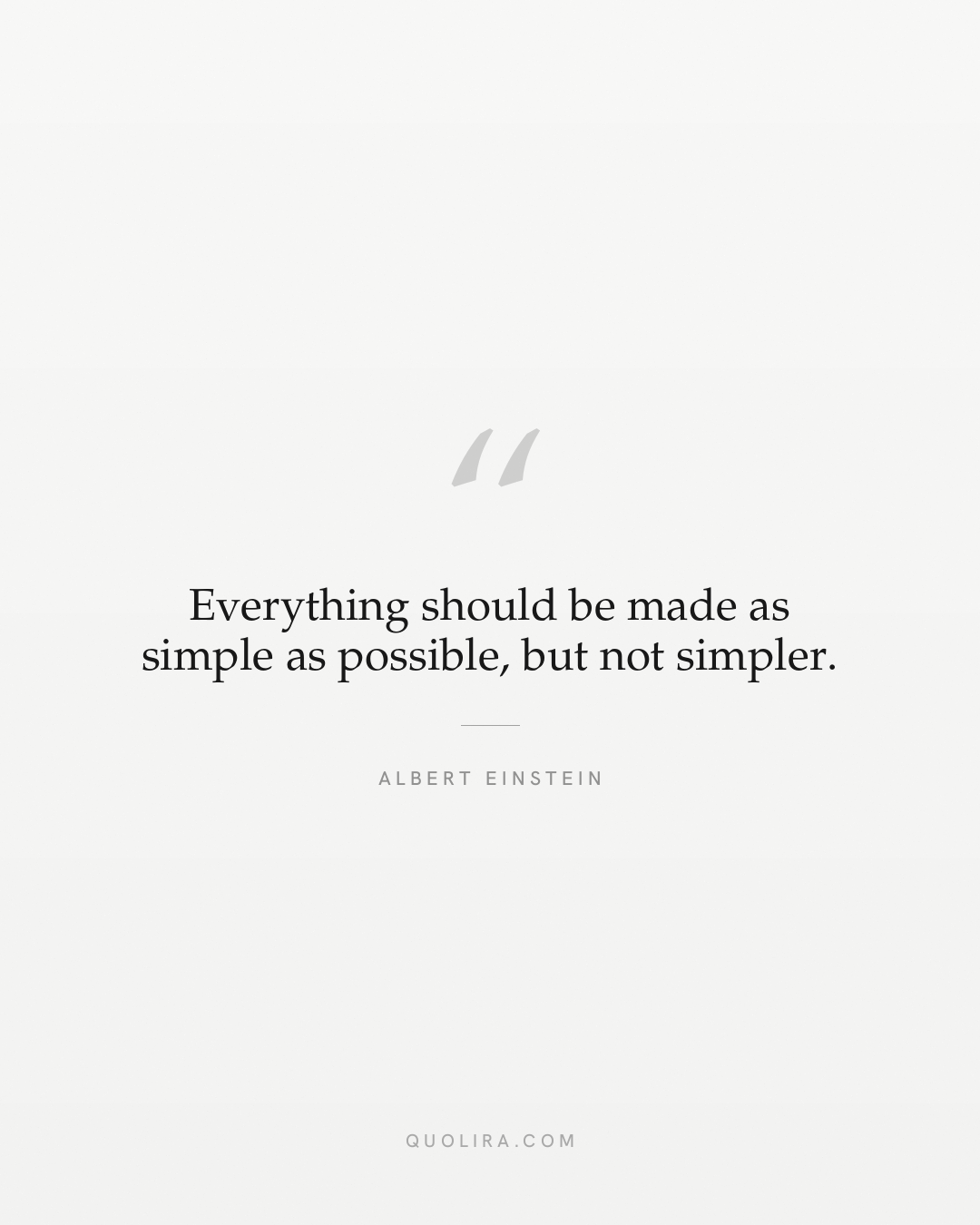
Everything should be made as simple as possible, but not simpler.
Albert Einstein Repeated in several forms throughout his life
Subtle is the Lord, but malicious He is not.
Albert Einstein Remark at Princeton University, 1921
He said this in 1921 after hearing that an experiment seemed to contradict his theory of gravitation. That result later proved false, which makes it a handy reminder that nature can be hard to read without being out to get you.

I, at any rate, am convinced that He does not throw dice.
Albert Einstein Letter to Max Born, 1926
Einstein wrote this while admitting quantum mechanics worked well. He still believed the universe runs on rules, even when those rules look random at the scale of atoms.

The mass of a body is a measure of its energy content.
Albert Einstein Annalen der Physik, 1905
This sentence comes from his 1905 paper on the inertia of a body, and it is the seed of E = mc². Physics has rarely packed so much into so few words.

Albert Einstein Quotes on Science and Ideas
The value of a college education is not the learning of many facts but the training of the mind to think.
Albert Einstein Response to the Edison Test, New York Times, 1921
Einstein said he didn't need to memorize the speed of sound because books could supply it. A good mind comes from practicing thought, and trivia is the easy part.

The only justification for our concepts and system of concepts is that they serve to represent the complex of our experiences; beyond this they have no legitimacy.
Albert Einstein Lecture at Princeton University, 1921 (The Meaning of Relativity, 1923)
Here Einstein argues that ideas earn their keep by matching what we observe. If a concept stops describing experience, it should go, however elegant it looks on the blackboard.

How can it be that mathematics, being, after all, a product of human thought which is independent of experience, is so admirably appropriate to the objects of reality?
Albert Einstein Geometry and Experience, 1921
Einstein kept returning to this puzzle: mathematics comes from the mind, yet it describes the physical world with uncanny accuracy. He left the question open, which is the honest move.

One reason why mathematics enjoys special esteem, above all other sciences, is that its laws are absolutely certain and indisputable, while those of other sciences are to some extent debatable and in constant danger of being overthrown by newly discovered facts.
Albert Einstein Sidelights on Relativity, 1922
Math is certain because it doesn't depend on facts, which is also why it can't describe the world alone. Physics takes that risk, and a single new measurement can overturn it.

The state of mind which enables a man to do work of this kind is akin to that of the religious worshiper or the lover; the daily effort comes from no deliberate intention or program, but straight from the heart.
Albert Einstein Principles of Research, 1918
Einstein describes real scientific work as devotion rather than a career plan. Anyone who has stayed up over a problem they couldn't drop will recognize the feeling.

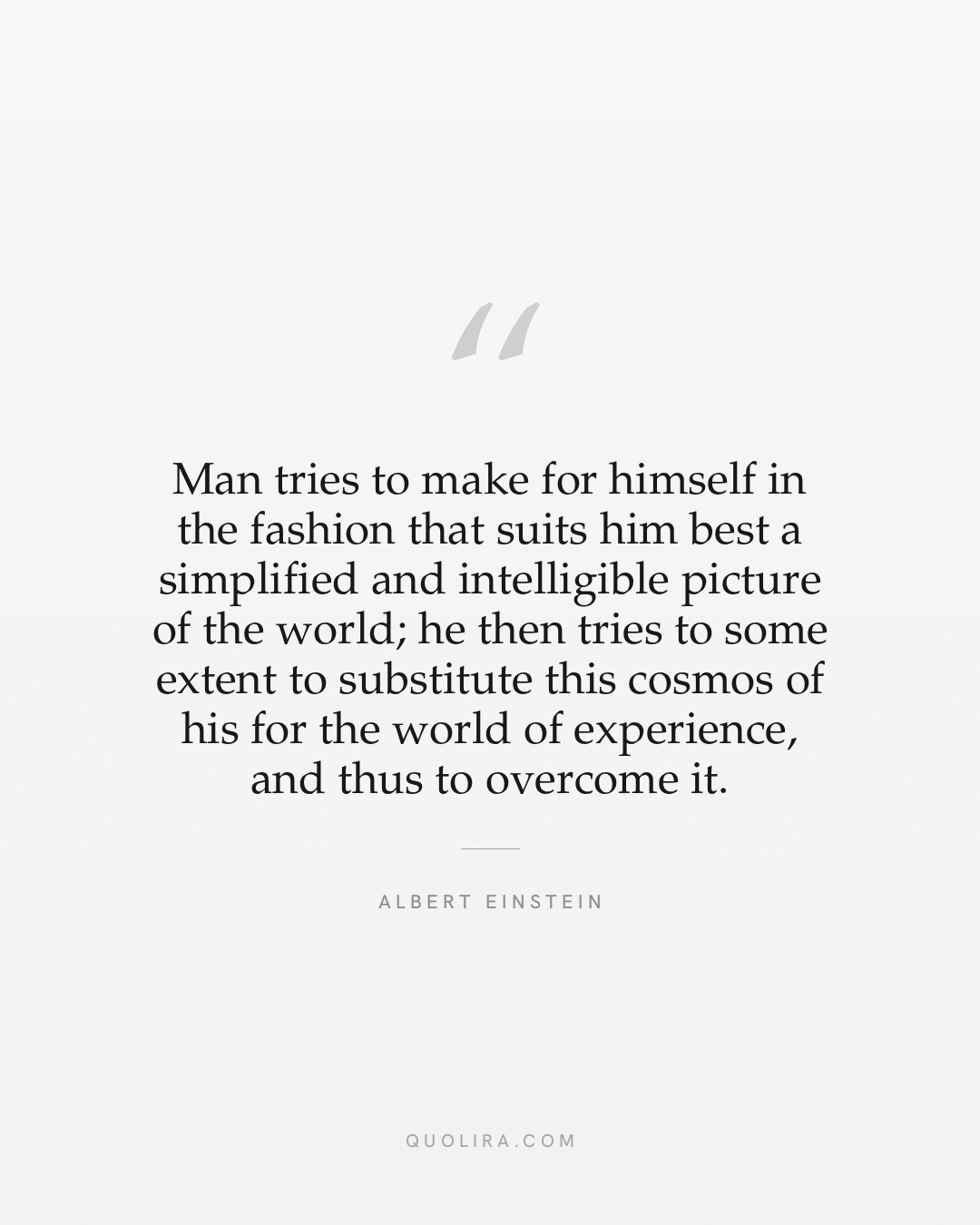
Man tries to make for himself in the fashion that suits him best a simplified and intelligible picture of the world; he then tries to some extent to substitute this cosmos of his for the world of experience, and thus to overcome it.
Albert Einstein Principles of Research, 1918
Einstein suggests painters, poets, philosophers, and scientists all build a simplified picture of the world. That makes a theory feel less like a cold tool and more like a home built on purpose.
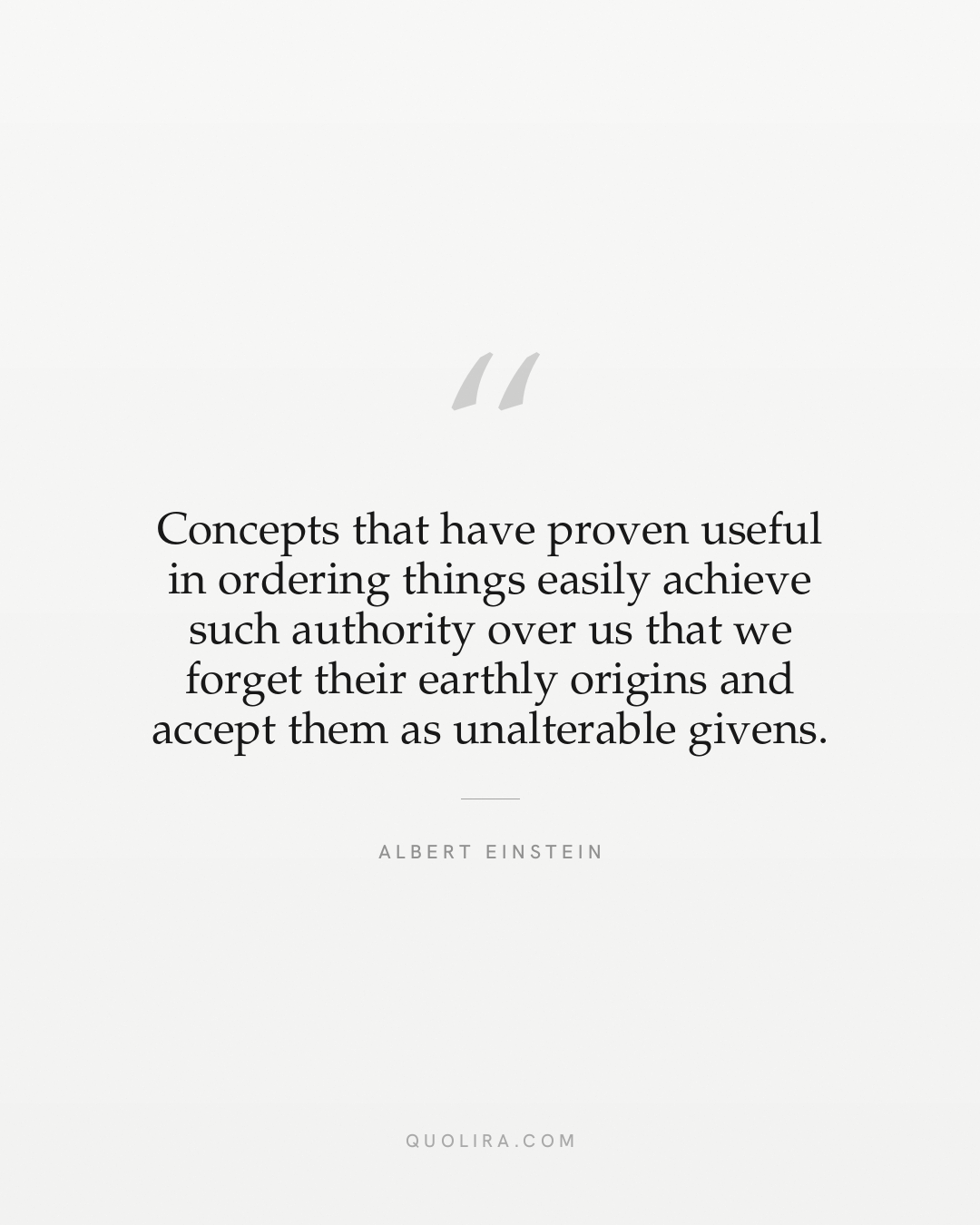
Concepts that have proven useful in ordering things easily achieve such authority over us that we forget their earthly origins and accept them as unalterable givens.
Albert Einstein Obituary for Ernst Mach, 1916
Einstein wrote this in his obituary for the physicist and philosopher Ernst Mach. His warning is that ideas we use every day can quietly harden into unquestioned facts.
The most beautiful fate of a physical theory is to point the way to the establishment of a more inclusive theory, in which it lives on as a limiting case.
Albert Einstein Relativity: The Special and General Theory, 1920
Einstein wrote this about how good theories get replaced: the old one survives as a special case of the new one. Newtonian mechanics still works at everyday speeds, which proves his point.
Albert Einstein Quotes on Faith and God
I believe in Spinoza's God, Who reveals Himself in the lawful harmony of the world, not in a God Who concerns Himself with the fate and the doings of mankind.
Albert Einstein Telegram to Rabbi Herbert S. Goldstein, The New York Times, 1929
Einstein answered a 50-word telegram with 27 German words, which is its own kind of wit. He rejected a God who intervenes in daily life and embraced the orderly universe he spent his life studying.
Veneration for this force beyond anything that we can comprehend is my religion. To that extent I am, in point of fact, religious.
Albert Einstein Response to Alfred Kerr, 1927
Einstein gave this answer to critic Alfred Kerr, who had heard he was religious and wanted to tease him about it. He defined faith as awe at the order of nature, which is easier to share with a skeptic than a creed.
Albert Einstein Quotes on Peace and Conscience
I should unconditionally refuse every direct or indirect war service and try to induce my friends to adopt the same attitude, irrespective of the general opinion of the causes of war.
Albert Einstein Council of War Resisters meeting, Zurich, 1929
He made this pledge when asked what he would do in another war. It does not depend on who started the fight, and it is a stance a person can take alone.
Our entire much-praised technological progress, and civilization generally, could be compared to an axe in the hand of a pathological criminal.
Albert Einstein Letter to Heinrich Zangger, 1917
Einstein wrote this during the First World War, when he watched science serve weapons more than people. His warning still applies to any tool that moves faster than our judgment.
Blind obedience to authority is the greatest enemy of truth.
Albert Einstein Letter to Jost Winteler, 1901
Einstein wrote this in 1901, at 22, while irritated that an editor had brushed off his criticisms. Check the argument before you check the name on it.
Albert Einstein Quotes on Life and Happiness
A happy man is too satisfied with the present to dwell too much on the future.
Albert Einstein Mes Projets d'Avenir, school essay, 1896
Einstein wrote this at 18 in a French essay about his own future plans, written for a school exam. It is a funny piece of advice from a young man already planning his life, and a good check on how much you fret over next year.
Nature shows us only the tail of the lion. But there is no doubt in my mind that the lion belongs with it even if he cannot reveal himself to the eye all at once because of his huge dimension.
Albert Einstein Letter to Heinrich Zangger, 1914
Einstein used this image to explain why we only ever see part of the truth. The lion is still there, even when all we can make out is the tail.
I have also considered many scientific plans during my pushing you around in your pram!
Albert Einstein Letter to his son Hans Albert Einstein, 1918
Einstein admitted, with a grin, that his thinking kept running while he pushed his baby son around. Big ideas often show up during ordinary chores, so keep a notebook near the stroller.
I lie on the beach like a crocodile and let myself be roasted by the sun. I never see a newspaper and don't give a damn for what is called the world.
Albert Einstein Letter to Max Born, 1918
Einstein sounds almost smug here, sunning himself with no newspapers and no interest in the fuss. It is a nice counterweight to the tortured-genius image, and a reminder that he had a sense of humor about himself.
If a person falls freely he will not feel his own weight.
Albert Einstein Kyoto University lecture, 1922
Einstein said this thought hit him while he sat in a patent office in Bern, and it pushed him toward a theory of gravitation. A simple observation can open an enormous door.

If I was not a physicist, I would probably be a musician. I often think in music. I live my daydreams in music.
Albert Einstein Interview with George Sylvester Viereck, 1929
Einstein said his violin gave him more joy than almost anything else. Hobbies that feel like daydreams may keep your mind fresh for the hard work.
Reading after a certain age diverts the mind too much from its creative pursuits. Any man who reads too much and uses his own brain too little falls into lazy habits of thinking.
Albert Einstein Interview with George Sylvester Viereck, 1929
Einstein was joking, though not entirely, that too much reading can make a person a passive thinker. Use a book to spark your own questions, then put it down and work through them.
I believe with Schopenhauer: We can do what we wish, but we can only wish what we must.
Albert Einstein Interview with George Sylvester Viereck, 1929
Einstein admits his own free will is limited, yet he still acts as if people are responsible for what they do. He calls that a practical necessity, which is blunt and honest.
Quotes often misattributed to Albert Einstein
- 'Compound interest is the most powerful force in the universe.' Variants date back to at least 1916, and the early versions were not credited to Einstein. Quote Investigator considers the attribution most likely false.
- 'Common sense is actually nothing more than a deposit of prejudices laid down in the mind prior to the age of eighteen.' Lincoln Barrett's 1948 Harper's article said 'as Einstein has pointed out' without a clear source. Alice Calaprice lists it as probably not by Einstein.
- 'There are only two ways to live your life. One is as though nothing is a miracle. The other is as though everything is.' Gilbert Fowler White quoted it in a book without saying he heard it from Einstein, so treat it as unverified.
- 'Fairy tales and more fairy tales.' This comes from a secondhand story about a mother asking Einstein for reading advice, told in a 1954 library bulletin. No primary record backs it up.
- 'It is high time the ideal of success should be replaced with the ideal of service.' No known source exists, and the earliest attribution appears in the Washington Afro-American in 1954. It reads like a paraphrase, not a quote.
Why Albert Einstein matters
Albert Einstein was a German-born theoretical physicist, born in 1879 and died in 1955. He is best known for developing the theory of relativity, and his formula E = mc² has been called 'the world's most famous equation.' He received the 1921 Nobel Prize in Physics 'for his services to theoretical physics, and especially for his discovery of the law of the photoelectric effect.'
Einstein also made important contributions to quantum theory, which is why his 1926 letter about dice still gets quoted in arguments about randomness. Many people know him as a symbol of genius, but his own words are more useful than the myth. They show a man who thought about ethics, religion, and education as carefully as he thought about light and gravity.
If the idea of thinking alone for long stretches appeals to you, 18 Thinking, Fast and Slow Quotes on Intuition, Doubt, and Hidden Bias explores how our minds jump to conclusions, which fits Einstein's warnings about lazy thinking. For a gentler read, 25 Quotes About Loneliness and Being Alone That Still Sting covers the quieter side of solitude.
What these Albert Einstein quotes have in common
The collection keeps returning to simplicity. 'Everything should be made as simple as possible, but not simpler' ties together his 1921 argument that concepts must earn their keep by representing experience and his 1918 picture of a simplified world that people build to find some peace. Both say a good idea is measured by what it explains, not by how impressive it sounds.
Faith and order form the second thread. Two quotes on God show that he rejected a personal deity who manages daily affairs. In the 1929 telegram he wrote that he believed in 'Spinoza's God, Who reveals Himself in the lawful harmony of the world.' His 1926 letter to Max Born says the same thing from a physicist's side: 'I, at any rate, am convinced that He does not throw dice.' Both show a man who saw the universe as lawful and worth studying closely.
Conscience and play form the third thread. The 1917 axe comparison and the 1929 pledge to refuse war service show that he judged science by how people used it. The 1901 letter on blind obedience makes the same point about authority. The 1918 letters about a pram and a sunny beach, plus the violin quote, show that the same man treated play as seriously as work.
How to use these quotes
Pick a quote for the job in front of you. Most of these land better with a date and setting attached, because the context is what gives them weight.
- Caption a classroom poster with the simplicity line, and note that Einstein repeated it in several forms.
- Open a talk on doubt with the 1901 letter about blind obedience.
- Write the 1921 'Subtle is the Lord' remark on a card for a colleague stuck on a hard problem.
- Use the 1918 pram and beach lines as a journaling prompt about where your best ideas actually show up.
- Pair the 1921 education quote with a lesson on memorizing facts versus reasoning through them.
- Add the 1929 war refusal to a civics or peace unit, with the date and the Zurich setting attached.
Sources
Einstein's words work best as prompts: save the ones that make you check your assumptions, and let the rest go.
Frequently asked questions
What is Albert Einstein's most famous quote?
Did Albert Einstein really say compound interest is the most powerful force in the universe?
Did Albert Einstein say that common sense is a deposit of prejudices?
What did Albert Einstein mean when he said God does not play dice?
Where can I find verified Albert Einstein quotes?
Keep reading

25 Atomic Habits Quotes That Show How Small Daily Actions Build Who You Are
James Clear's 2018 book argues that tiny, repeated actions shape identity more than big resolutions ever will.

25 Ralph Waldo Emerson Quotes on Self-Reliance, Nature, and Living Boldly
Emerson's sharpest lines on independence, nature, and the nerve to live on your own terms.


























25 Famous Kindness Quotes That Prove Small Acts Matter
Real lines from Shakespeare, the Dalai Lama, and Kurt Vonnegut explain why a small kind act never really disappears.
This is the line people search for most, and it works because it warns against cutting too far. Simplify until the idea is clear, then stop before you lose the part that makes it true.