quolira quolira.com

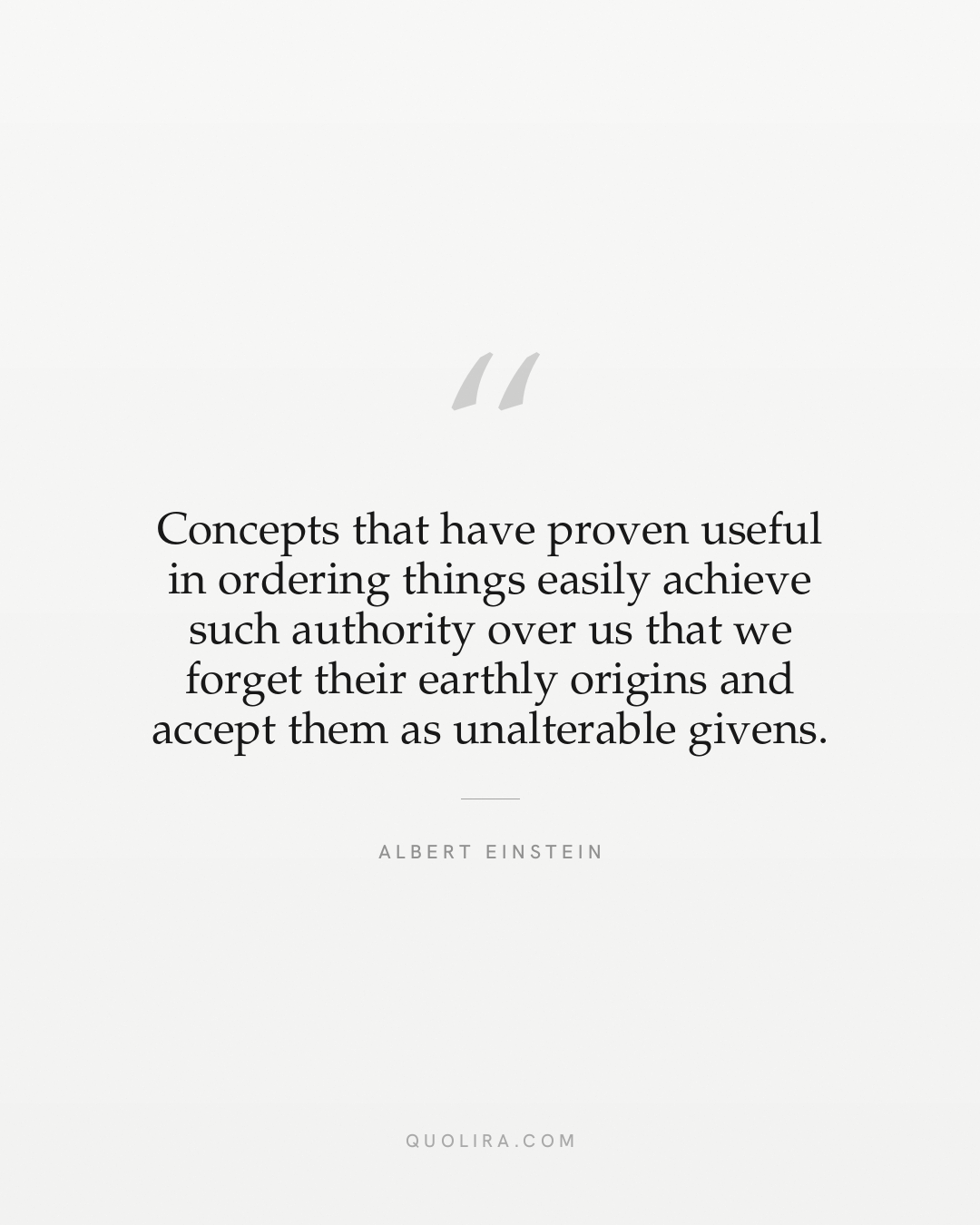
Concepts that have proven useful in ordering things easily achieve such authority over us that we forget their earthly origins and accept them as unalterable givens.

32 / 1924

Who said it?

Albert Einstein said it, in Obituary for Ernst Mach, 1916.

Einstein wrote this in his obituary for the physicist and philosopher Ernst Mach. His warning is that ideas we use every day can quietly harden into unquestioned facts.

From the collection: 25 Albert Einstein Quotes on Science, Simplicity, and Doubt · More Albert Einstein quotes

About this quote

Meaning

Ideas that prove practically useful become so familiar and authoritative that people forget they were human inventions and begin to treat them as fixed facts. Einstein warns that the convenience of a concept can hide its origins and limits. The quote is a reminder to keep questioning the tools we rely on to organize the world.

Context

This line comes from an obituary Einstein wrote for Ernst Mach, the Austrian physicist and philosopher of science who died in 1916. Mach had emphasized that scientific concepts should be understood as economical descriptions of experience rather than as absolute truths. Einstein's remark carries that thought forward, honoring Mach's critical approach while reflecting on how concepts that once served a purpose can harden into unquestioned assumptions.

About the author

Albert Einstein (1879 to 1955) was a German-born theoretical physicist best known for the theories of relativity. He received the Nobel Prize in Physics in 1922 for his explanation of the photoelectric effect. He later worked in Princeton, New Jersey, at the Institute for Advanced Study. Throughout his career he wrote about the philosophical foundations of physics, and his tributes to other thinkers, including this one on Mach, show his deep concern with how scientific ideas are formed and justified.

Frequently asked questions

Who said "Concepts that have proven useful in ordering things easily achieve su…"?
Albert Einstein said it, in Obituary for Ernst Mach, 1916.
What does "Concepts that have proven useful in ordering things easily achieve su…" mean?
Ideas that prove practically useful become so familiar and authoritative that people forget they were human inventions and begin to treat them as fixed facts.
Up next

“Man tries to make for himself in the fashion that suits him best a simplified and intelligible picture of the world; he then tries to some extent to substitute this cosmos of his for the world of experience, and thus to overcome it.”

Albert Einstein · Principles of Research, 1918

“The state of mind which enables a man to do work of this kind is akin to that of the religious worshiper or the lover; the daily effort comes from no deliberate intention or program, but straight from the heart.”

Albert Einstein · Principles of Research, 1918

“One reason why mathematics enjoys special esteem, above all other sciences, is that its laws are absolutely certain and indisputable, while those of other sciences are to some extent debatable and in constant danger of being overthrown by newly discovered facts.”

Albert Einstein · Sidelights on Relativity, 1922

“How can it be that mathematics, being, after all, a product of human thought which is independent of experience, is so admirably appropriate to the objects of reality?”

Albert Einstein · Geometry and Experience, 1921

“The only justification for our concepts and system of concepts is that they serve to represent the complex of our experiences; beyond this they have no legitimacy.”

Albert Einstein · Lecture at Princeton University, 1921 (The Meaning of Relativity, 1923)

“The value of a college education is not the learning of many facts but the training of the mind to think.”

Albert Einstein · Response to the Edison Test, New York Times, 1921

“The mass of a body is a measure of its energy content.”

Albert Einstein · Annalen der Physik, 1905

“I, at any rate, am convinced that He does not throw dice.”

Albert Einstein · Letter to Max Born, 1926

“Subtle is the Lord, but malicious He is not.”

Albert Einstein · Remark at Princeton University, 1921

“Everything should be made as simple as possible, but not simpler.”

Albert Einstein · Repeated in several forms throughout his life

“Every meeting is the only version of that meeting that will ever happen.”

Original

“Adam and Lilith in the Alphabet of Sirach.”

Nikola Tesla · Quoted in Nikola Tesla's Life & Work by István G. Kocsis, 2015