quolira quolira.com
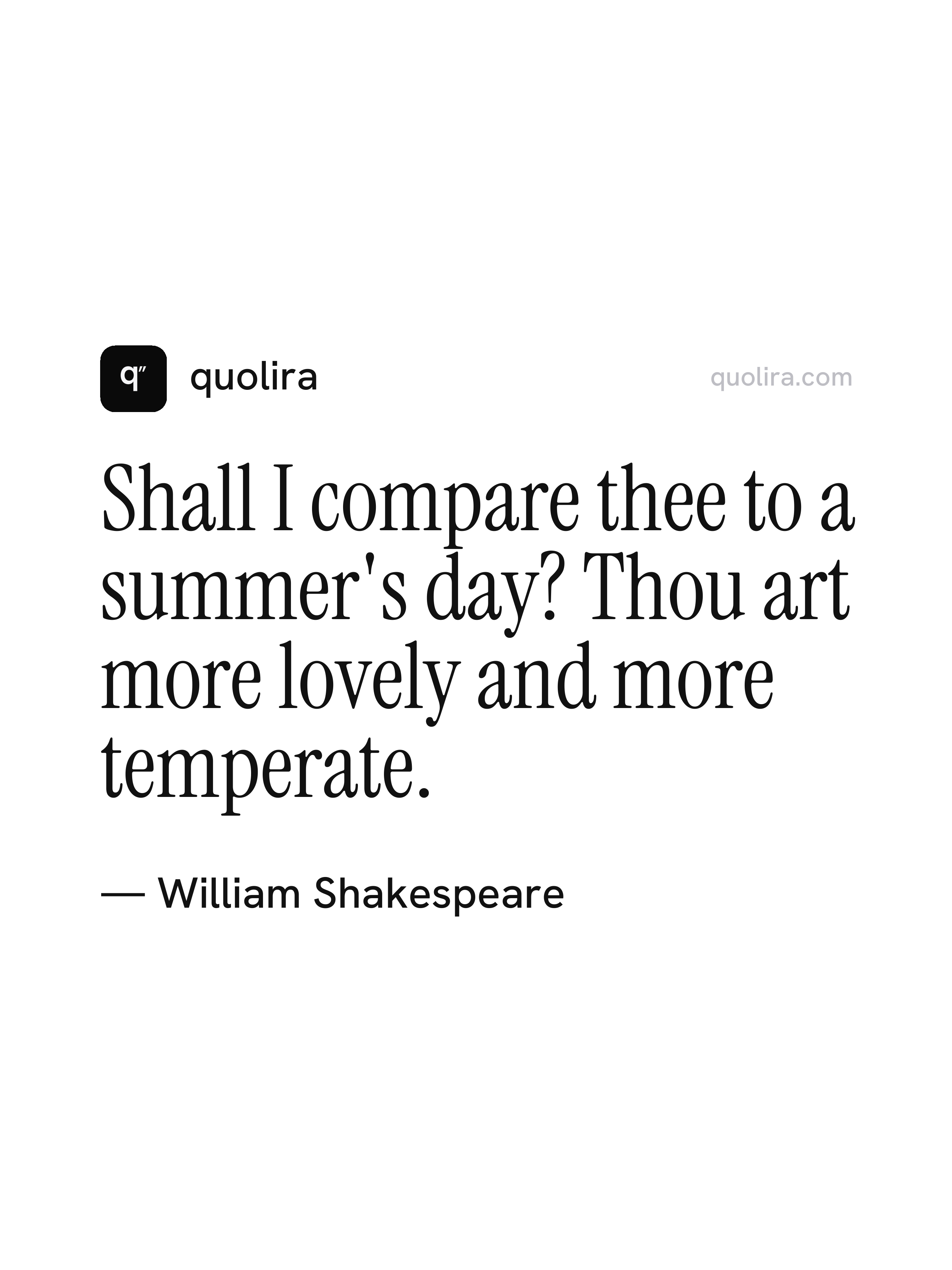
Shall I compare thee to a summer's day? Thou art more lovely and more temperate.
829 / 1172

About this quote

Meaning

The speaker opens by asking whether he could compare his beloved to a warm summer day, then immediately answers that she surpasses even that. Summer, for all its beauty, is inconsistent and fleeting, prone to wind and heat. The beloved, by contrast, is both more beautiful and more balanced in her qualities. The underlying idea is that human beauty, when truly seen, exceeds even nature's finest offerings.

Context

This is the opening couplet of one of the most recognized sonnets in the English language, written in the Elizabethan era. The poem goes on to argue that while summer fades and all natural things eventually die, the beloved's beauty will live on through the poem itself. It is a bold claim: that art preserves what time destroys. The sonnet follows the traditional fourteen-line structure Shakespeare used throughout his sequence, employing the form with characteristic ease and confidence.

About the author

William Shakespeare was an English playwright and poet working in the late sixteenth and early seventeenth centuries, widely regarded as one of the greatest writers in the history of the English language. In addition to his plays, he produced a sequence of sonnets exploring themes of love, time, beauty, and mortality. His work has influenced literature, language, and culture across the world for centuries, and his sonnets remain among the most studied and quoted poems ever written.

Up next

“I am nothing special, of this I am sure. I am a common man with common thoughts and I've led a common life. There are no monuments dedicated to me and my name will soon be forgotten, but I've loved another with all my heart and soul, and to me, this has always been enough.”

Nicholas Sparks · The Notebook, 1996

“You have bewitched me, body and soul, and I love, I love, I love you.”

Jane Austen · Pride and Prejudice, 1813

“I have waited for this opportunity for more than half a century, to repeat to you once again my vow of eternal fidelity and everlasting love.”

Gabriel Garcia Marquez · Love in the Time of Cholera, 1985

“If liberty and equality, as is thought by some, are chiefly to be found in democracy, they will be best attained when all persons alike share in government to the utmost.”

Aristotle · Politics, Book VI, c. 350 BC

“The cost of liberty is less than the price of repression.”

W.E.B. Du Bois · John Brown, 1909

“I prefer liberty with danger to peace with slavery.”

Jean-Jacques Rousseau · The Social Contract, 1762

“Liberty means responsibility. That is why most men dread it.”

George Bernard Shaw · Maxims for Revolutionists, 1903

“My God! How little do my countrymen know what precious blessings they are in possession of, and which no other people on earth enjoy!”

Thomas Jefferson · Letter to James Monroe, June 17, 1785

“For what avail the plough or sail, or land or life, if freedom fail?”

Ralph Waldo Emerson · "Boston," poem, 1830s

“In the truest sense, freedom cannot be bestowed; it must be achieved.”

Franklin D. Roosevelt · Speech on the Seventy-Fourth Anniversary of the Emancipation Proclamation, September 22, 1936

“We must be free not because we claim freedom, but because we practice it.”

William Faulkner · Essay "On Fear: Deep South in Labor," Harper's Magazine, June 1956

“America was not built on fear. America was built on courage, on imagination, and an unbeatable determination to do the job at hand.”

Harry S. Truman · Special Message to the Congress on the State of the Union, January 8, 1947