“Although life is a matter of indifference, the use which you make of it is not a matter of indifference.”
Epictetus · Discourses, Book II, chapter 6
 quolira
.com
Sun Tzu said it, in The Art of War, Chapter III: Attack by Stratagem.
This is the whole idea in one line. Sun Tzu does not promise victory, only freedom from the fear that comes from guessing.
From the collection: Know Your Enemy: Sun Tzu's Idea Still at Work · More Sun Tzu quotes
The quote means that someone who understands both their opponent and their own strengths and weaknesses can face a long series of conflicts with confidence rather than dread. Knowledge of the other side and honest self-assessment work together, so preparation replaces guesswork. The line is less about winning every fight than about reducing the surprises that make conflict dangerous.
The line comes from Chapter III, "Attack by Stratagem," of The Art of War, a short military treatise traditionally attributed to Sun Tzu. The chapter argues that the best outcome is to win without fighting, and that a commander should prefer to subdue an enemy through planning and diplomacy before resorting to battle. Knowing the enemy and knowing oneself is presented as the foundation of that approach, since a leader who misjudges either side is likely to waste troops and resources.
Sun Tzu is traditionally described as a military strategist of ancient China, and the Records of the Grand Historian by Sima Qian presents him as a general serving the state of Wu. Modern scholars, however, debate how much of this biography is historical and whether one person wrote the entire text, which seems to have been shaped over time by multiple hands. The discovery of bamboo strips containing related material in the 1970s helped scholars date parts of the tradition more carefully. What is clear is that the work has influenced military thought and business strategy for a very long time.
“Although life is a matter of indifference, the use which you make of it is not a matter of indifference.”
Epictetus · Discourses, Book II, chapter 6
“Materials are indifferent, but the use which we make of them is not a matter of indifference.”
Epictetus · Discourses, Book II, chapter 5
“Were I a nightingale, I would act the part of a nightingale; were I a swan, the part of a swan.”
Epictetus · Discourses, Book I, chapter 16
“Show that you know this only, how you may never either fail to get what you desire or fall into what you avoid.”
Epictetus · Discourses, Book II, chapter 1
“Let whatever appears to be the best be to you an inviolable law.”
Epictetus · Enchiridion, sections 50-51
“Everything has two handles, the one by which it may be carried, the other by which it cannot.”
Epictetus · Enchiridion, section 43
“Don't you know that a good and excellent person does nothing for the sake of appearances, but only for the sake of having acted right?”
Epictetus · Discourses, Book III, chapter 24
“Reason is not measured by size or height, but by principle.”
Epictetus · Discourses, Book I, chapter 12
“No thing great is created suddenly, any more than a bunch of grapes or a fig.”
Epictetus · Discourses, Book I, chapter 15
“Practice yourself, for heaven's sake, in little things; and thence proceed to greater.”
Epictetus · Discourses, Book I, chapter 18
“If you would be a good reader, read; if a writer, write.”
Epictetus · Discourses, Book II, chapter 18
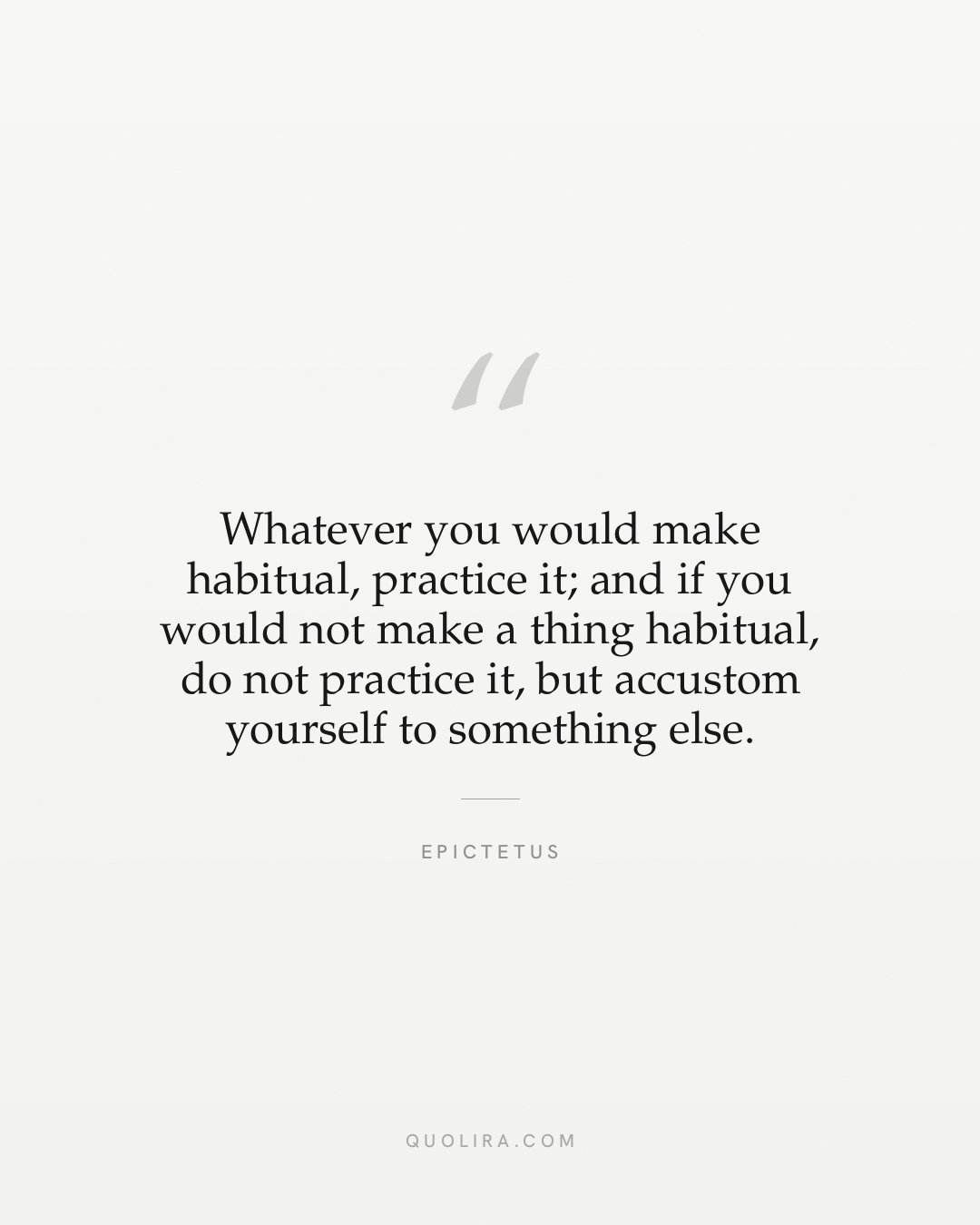
“Whatever you would make habitual, practice it; and if you would not make a thing habitual, do not practice it, but accustom yourself to something else.”
Epictetus · Discourses, Book II, chapter 18