“The world breaks everyone and afterward many are strong at the broken places.”
Ernest Hemingway · A Farewell to Arms, 1929
 quolira
.com
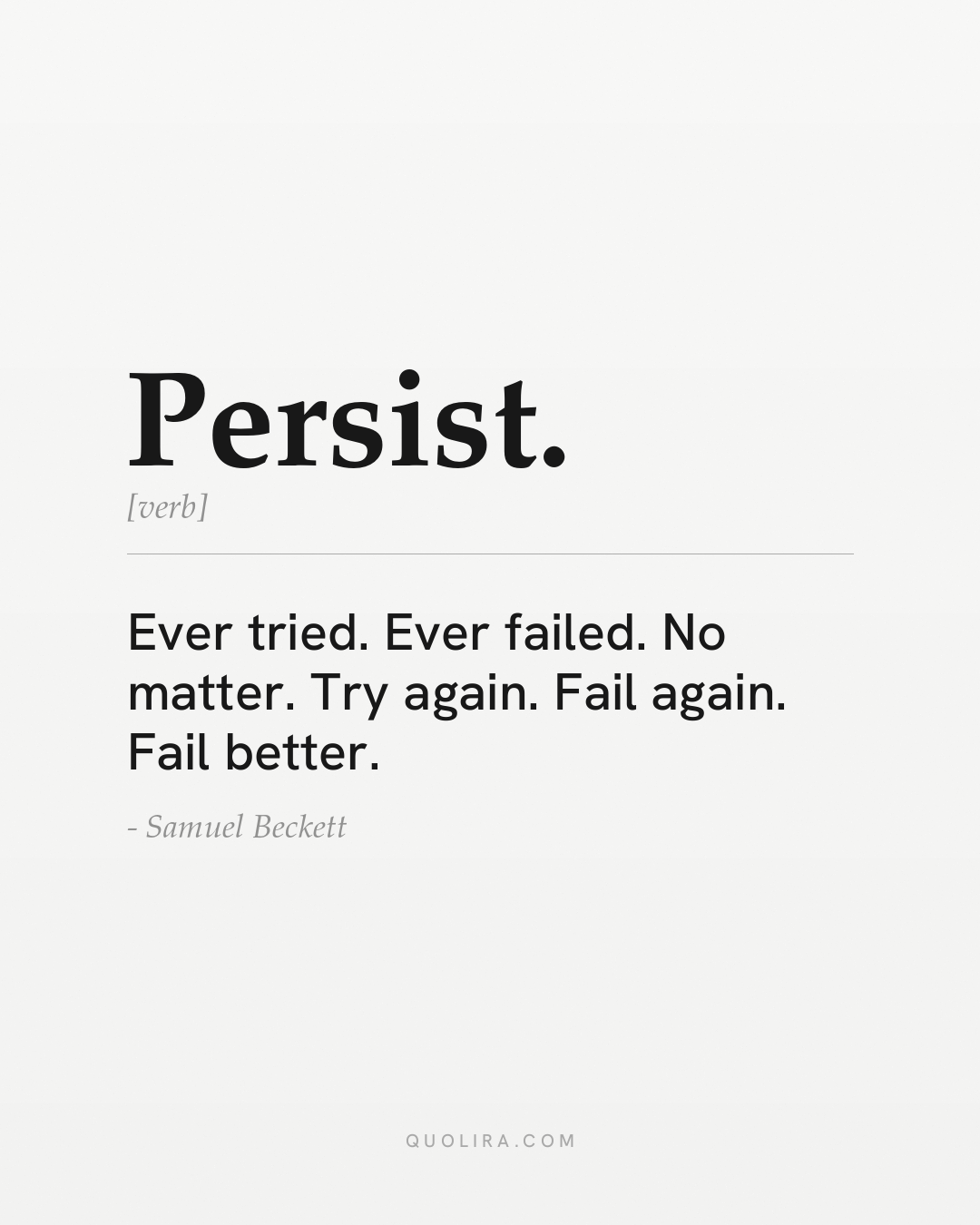
Samuel Beckett said it, in Worstward Ho, 1983.
This is from Worstward Ho (1983), one of Beckett's late prose works, and it reads like a dare. The repetition is the point: each failure becomes a rehearsal. Read it when you're tired of trying and you might laugh.
From the collection: 15 Quotes About Starting Over That Prove It's Never Too Late · More Samuel Beckett quotes
The quote means that failure is not the end of an effort, and that trying again, even with imperfect results, is a way of improving. Its central idea is that each attempt can be better than the last, so persistence matters more than a flawless outcome.
Samuel Beckett wrote this line in Worstward Ho, a short prose piece published in 1983. The work is spare and difficult, built from repeated phrases and stripped-down sentences that circle around failure and the effort to continue. The passage is widely quoted as a short statement about persistence, although in the original it is part of a bleak and experimental text rather than an inspirational message. Readers should understand that its hopeful reading is one interpretation, and that the surrounding work is far more austere and ambiguous than the line suggests when quoted alone.
Samuel Beckett (1906 to 1989) was an Irish writer who wrote in both English and French and became one of the most influential dramatists and novelists of the twentieth century. His play Waiting for Godot premiered in 1953 and helped define the theater of the absurd. He received the Nobel Prize in Literature in 1969. His later prose and drama often explored limitation, repetition, and the struggle to speak or act, which gives his work a sober and exacting character that differs from simple motivational writing.
“The world breaks everyone and afterward many are strong at the broken places.”
Ernest Hemingway · A Farewell to Arms, 1929
“The only way to do great work is to love what you do. If you haven't found it yet, keep looking. Don't settle.”
Steve Jobs · Stanford University commencement address, 2005
“The journey of a thousand miles begins with one step.”
Lao Tzu · Tao Te Ching
“Complaining too much only leads to misfortune. It is better to stay in the center of serenity.”
Lao Tzu · Tao Te Ching, chapter 5, translated by Yuhui Liang
“The good are not argumentative; the argumentative are not quite good.”
Lao Tzu · Tao Te Ching, chapter 81, translated by Yuhui Liang
“Truthful words are not fancy; fancy words are not truthful.”
Lao Tzu · Tao Te Ching, chapter 81, translated by Yuhui Liang
“Wise men don't need to prove their point; men who need to prove their point aren't wise.”
Lao Tzu · Tao Te Ching, chapter 81, Stephen Mitchell interpretation (1992)
“The Master has no possessions. The more he does for others, the happier he is.”
Lao Tzu · Tao Te Ching, chapter 81, Stephen Mitchell interpretation (1992)
“The sage wears coarse clothing over his shoulders, but carries jade within his bosom.”
Lao Tzu · Tao Te Ching, chapter 70, translated by Victor H. Lang
“It is because he does not contend that no one in the world can contend against him.”
Lao Tzu · Tao Te Ching, chapter 22, translated by Lin Yutang (1948)
“Thirty spokes unite at the single hub; it is the empty space which makes the wheel useful.”
Lao Tzu · Tao Te Ching, chapter 11
“A violent wind does not outlast the morning; a squall of rain does not outlast the day.”
Lao Tzu · Tao Te Ching, chapter 23, translated by Lionel Giles