The three wise monkeys: See No Evil, and What We Choose Not to Look At
The three wise monkeys were never about ignorance. They were about the daily work of guarding what goes in and out of you.
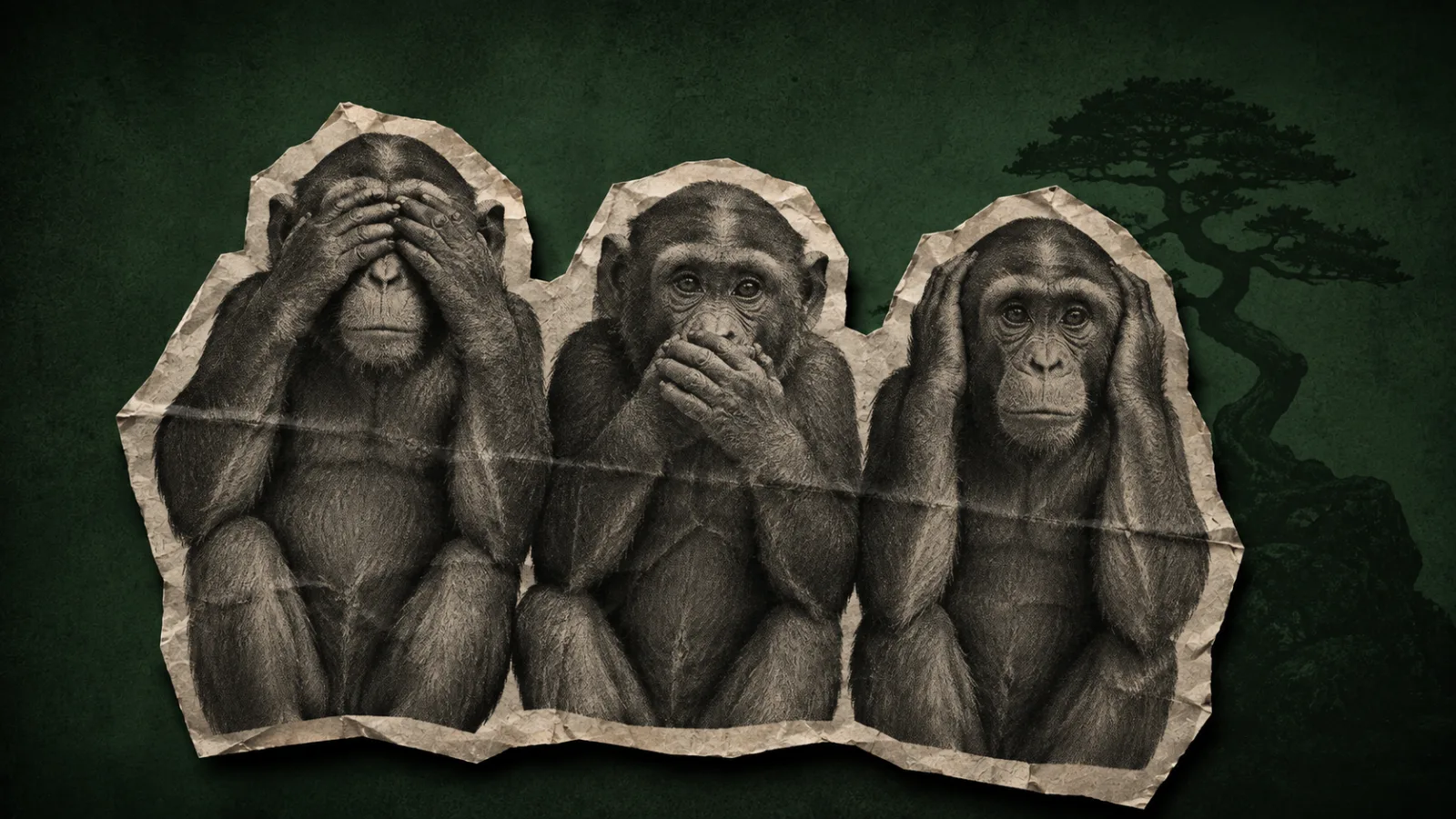
The three wise monkeys carved over the Tosho-gu shrine in Nikko, Japan have been misread for centuries. We treat them as a shrug, a way to duck responsibility, but the original maxim was a moral discipline about self-restraint. I keep coming back to those three small figures because they ask a hard question: what are you letting reach you, and what are you passing along?
The monkeys aren't blind. They're careful about what they agree to carry.
Most people see the three wise monkeys and read them as an excuse. Cover your eyes, plug your ears, keep your mouth shut, and pretend the ugly thing isn't happening. A cartoon of willful ignorance.
But that's a modern gloss, and a lazy one.
Where the monkeys actually come from
The carving everyone pictures sits above the Tosho-gu shrine in Nikko, Japan, dated to the early 1600s and credited to the sculptor Hidari Jingoro. Three monkeys in a row. One shields its eyes, one its ears, one its mouth.
Their names are the whole joke and the whole point. Mizaru, Kikazaru, Iwazaru. In Japanese the negative verb ending zaru sounds like saru, the word for monkey. So the phrase "see not, hear not, speak not" turns into a visual pun the moment you carve it as animals.
The idea behind it is older than the shrine. You can trace a version to the Analects of Confucius, where a student asks how to live rightly and gets an answer about not looking at, listening to, or saying anything that runs against what's proper.
The Book of Tea by Kakuzo Okakura
A discipline, not a dodge
Read that way, the monkeys flip on you.
They aren't telling you to be blind to cruelty. They're telling you to stop feeding on it. There's a difference between refusing to witness injustice and refusing to marinate in filth for entertainment.
I think about this every time I open my phone. The feed is built to make me see evil, hear evil, and repeat evil, and it rewards me for all three. Outrage in, outrage out. The monkeys would not have lasted a day.
Guarding your gates is not the same as locking your doors.
What you let in shapes what you become. That's not mystical. It's just true. Spend a year steeped in contempt and you'll speak contempt without noticing.
Confucius: The Analects
The one everyone forgets
There's sometimes a fourth monkey, Shizaru, with arms crossed over its belly. Do no evil. He tends to get dropped, maybe because three is a tidier number, maybe because the first three are about intake and he's about output.
He's the one I'd keep.
Because the point of watching what you see and hear was never self-protection. It was to make sure that when you finally do act, your hands are clean. The eyes and ears feed the mouth, and the mouth feeds the deed.
So the monkeys aren't cowards. They're editors. They decide what gets through.
And that decision, made a hundred small times a day, is most of what your character actually is.
What you let in becomes what you speak, and what you speak becomes what you do.
Covering your eyes, ears, and mouth isn't hiding from the world. It's choosing, on purpose, what you carry into it.
Frequently asked questions
Where do the three wise monkeys come from?
What do the three wise monkeys actually mean?
What are the monkeys' names?
Keep reading
Fish and Guests stink After Three Days
The old kitchen proverb about welcome, and the quiet math of how long we can lean on each other.
16 African Proverbs That Will Change How You See the World
Ancient wisdom from across a continent, distilled into lines that still cut clean.
What the Bamboo Knows
Japanese proverbs have been quietly teaching the same lessons for centuries. Here's why they still land.