“The only way to do great work is to love what you do. If you haven't found it yet, keep looking. Don't settle.”
Steve Jobs · Stanford University commencement address, 2005
 quolira
.com
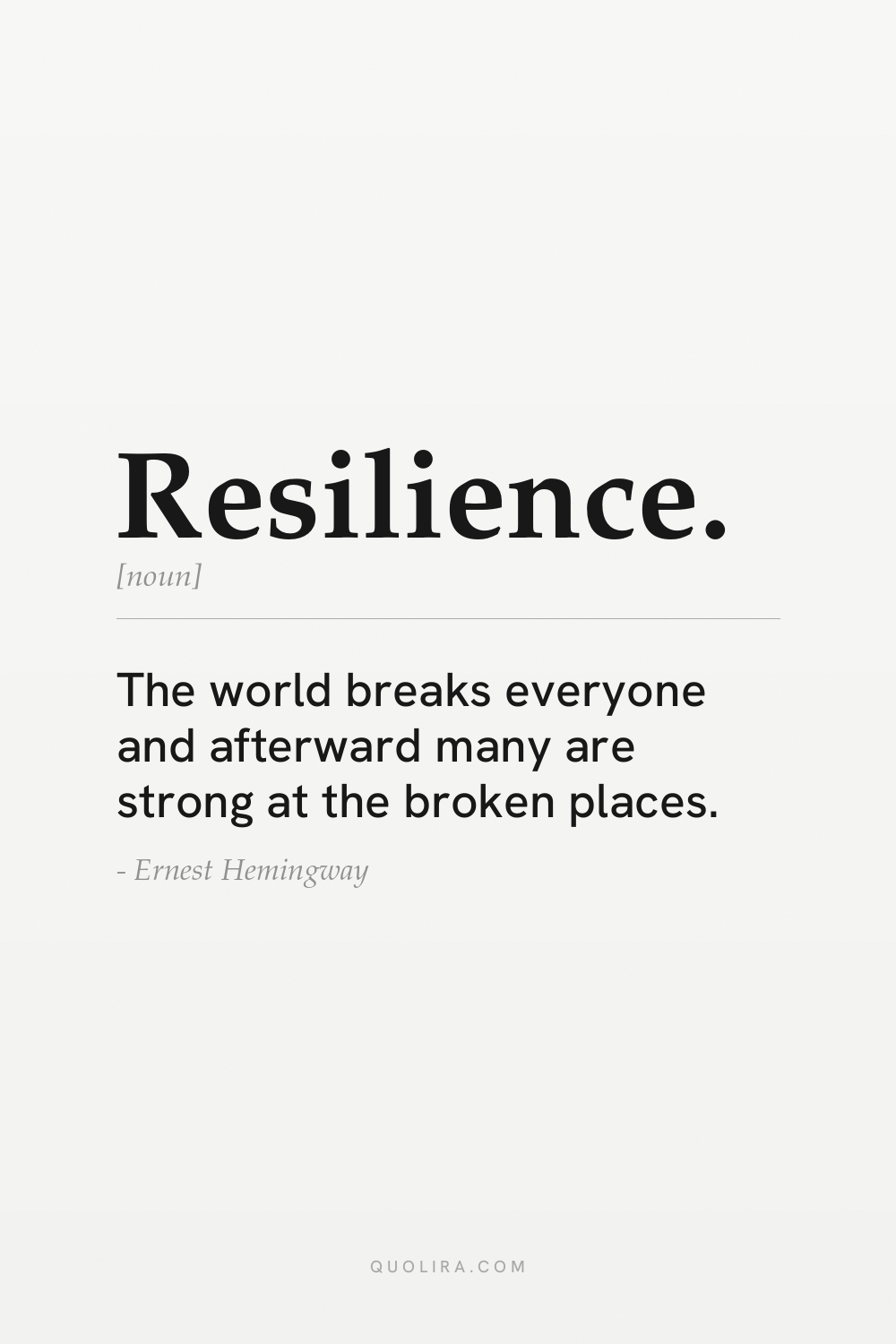
Ernest Hemingway said it, in A Farewell to Arms, 1929.
Hemingway wrote this in A Farewell to Arms (1929), and it is blunt about damage and honest about recovery. The strength he means is not untouched strength. It is the kind earned after the break.
From the collection: 15 Quotes About Starting Over That Prove It's Never Too Late · More Ernest Hemingway quotes
The quote means that hardship damages almost everyone, but those who survive it often become stronger in the places where they were hurt. It suggests that injury and resilience can exist side by side, and that recovery can leave a person more capable than before.
Ernest Hemingway wrote this line in A Farewell to Arms, his 1929 novel about an American ambulance driver serving in the Italian front during the First World War. The sentence comes near the book's closing pages, after the narrator has lost the woman he loves and is reflecting on loss and endurance. The novel is written in a spare, direct style, and this line is one of its best-known moments of reflection. Readers often quote it on its own, which gives it a more hopeful reading than the grief surrounding it in the story, though the original passage is shaded by real sorrow.
Ernest Hemingway (1899 to 1961) was an American novelist and short story writer known for a terse, understated prose style. His works include The Sun Also Rises, A Farewell to Arms, and The Old Man and the Sea, and he received the Nobel Prize in Literature in 1954. He served as an ambulance driver in Italy during the First World War, an experience that informed A Farewell to Arms. His writing shaped American fiction through its focus on physical experience, restraint, and the quiet weight of emotion.
“The only way to do great work is to love what you do. If you haven't found it yet, keep looking. Don't settle.”
Steve Jobs · Stanford University commencement address, 2005
“The journey of a thousand miles begins with one step.”
Lao Tzu · Tao Te Ching
“Complaining too much only leads to misfortune. It is better to stay in the center of serenity.”
Lao Tzu · Tao Te Ching, chapter 5, translated by Yuhui Liang
“The good are not argumentative; the argumentative are not quite good.”
Lao Tzu · Tao Te Ching, chapter 81, translated by Yuhui Liang
“Truthful words are not fancy; fancy words are not truthful.”
Lao Tzu · Tao Te Ching, chapter 81, translated by Yuhui Liang
“Wise men don't need to prove their point; men who need to prove their point aren't wise.”
Lao Tzu · Tao Te Ching, chapter 81, Stephen Mitchell interpretation (1992)
“The Master has no possessions. The more he does for others, the happier he is.”
Lao Tzu · Tao Te Ching, chapter 81, Stephen Mitchell interpretation (1992)
“The sage wears coarse clothing over his shoulders, but carries jade within his bosom.”
Lao Tzu · Tao Te Ching, chapter 70, translated by Victor H. Lang
“It is because he does not contend that no one in the world can contend against him.”
Lao Tzu · Tao Te Ching, chapter 22, translated by Lin Yutang (1948)
“Thirty spokes unite at the single hub; it is the empty space which makes the wheel useful.”
Lao Tzu · Tao Te Ching, chapter 11
“A violent wind does not outlast the morning; a squall of rain does not outlast the day.”
Lao Tzu · Tao Te Ching, chapter 23, translated by Lionel Giles
“By letting it go it all gets done. The world is won by those who let it go. But when you try and try, the world is beyond the winning.”
Lao Tzu · Tao Te Ching, chapter 48, translated by Raymond B. Blakney (1955)