“So lonely 'twas that God himself Scarce seemed there to be.”
Samuel Taylor Coleridge · The Rime of the Ancient Mariner, 1798
 quolira
.com
Henry David Thoreau said it, in Walden, 1854.
Thoreau wrote this from a cabin he built himself near Concord, Massachusetts, where he lived for about two years. He offers it as a preference and a discovery. Plenty of people find they like their own company far more than they expected.
From the collection: 25 Quotes About Loneliness and Being Alone That Still Sting · More Henry David Thoreau quotes
The quote means that Thoreau found solitude to be better company than most people, because being alone let him think clearly and enjoy his own mind. He is not describing loneliness as pain but as a kind of companionship with oneself and with nature.
The words come from Walden, published in 1854, which records Henry David Thoreau's experiment in living simply in a small cabin near Walden Pond in Concord, Massachusetts. He lived there from 1845 to 1847, and the book shapes those years into a reflective account rather than a diary. The passage belongs to a chapter about solitude, where Thoreau argues that he gained more from quiet days in the woods than from visits and conversation. Readers often quote it as a defense of time spent alone, though the book also values friendship and community.
Henry David Thoreau (1817 to 1862) was an American writer, naturalist, and philosopher from Concord, Massachusetts. He graduated from Harvard in 1837 and spent much of his life observing the local landscape, keeping detailed journals and writing essays on nature, civil disobedience, and self-reliance. Walden remains his best-known book, and it became influential in later discussions of simplicity and environmental thought. He was also a friend and associate of Ralph Waldo Emerson, whose ideas helped shape his independent outlook.
“So lonely 'twas that God himself Scarce seemed there to be.”
Samuel Taylor Coleridge · The Rime of the Ancient Mariner, 1798
“Alone, alone, all, all alone, Alone on a wide, wide sea.”
Samuel Taylor Coleridge · The Rime of the Ancient Mariner, 1798
“Most days, we'd rather be wrong with the crowd than be right by ourselves.”
James Clear · Atomic Habits, Chapter 9: The Role of Family and Friends in Shaping Your Habits
“Pain is an effective teacher.”
James Clear · Atomic Habits, Chapter 17: How an Accountability Partner Can Change Everything
“What is immediately rewarded is repeated. What is immediately punished is avoided.”
James Clear · Atomic Habits, Chapter 15: The Cardinal Rule of Behavior Change
“Positive emotions cultivate habits. Negative emotions destroy them.”
James Clear · Atomic Habits, Chapter 15: The Cardinal Rule of Behavior Change
“A habit is a behavior that has been repeated enough times to become automatic.”
James Clear · Atomic Habits, Chapter 3: How to Build Better Habits in 4 Simple Steps
“The ultimate purpose of habits is to solve the problems of life with as little energy and effort as possible.”
James Clear · Atomic Habits, Chapter 3: How to Build Better Habits in 4 Simple Steps
“Every goal is doomed to fail if it goes against the grain of human nature.”
James Clear · Atomic Habits, Chapter 3: How to Build Better Habits in 4 Simple Steps
“Redesign your life so the actions that matter most are also the actions that are easiest to do.”
James Clear · Atomic Habits, Chapter 12: The Law of Least Effort
“The greater the friction, the less likely the habit.”
James Clear · Atomic Habits, Chapter 12: The Law of Least Effort
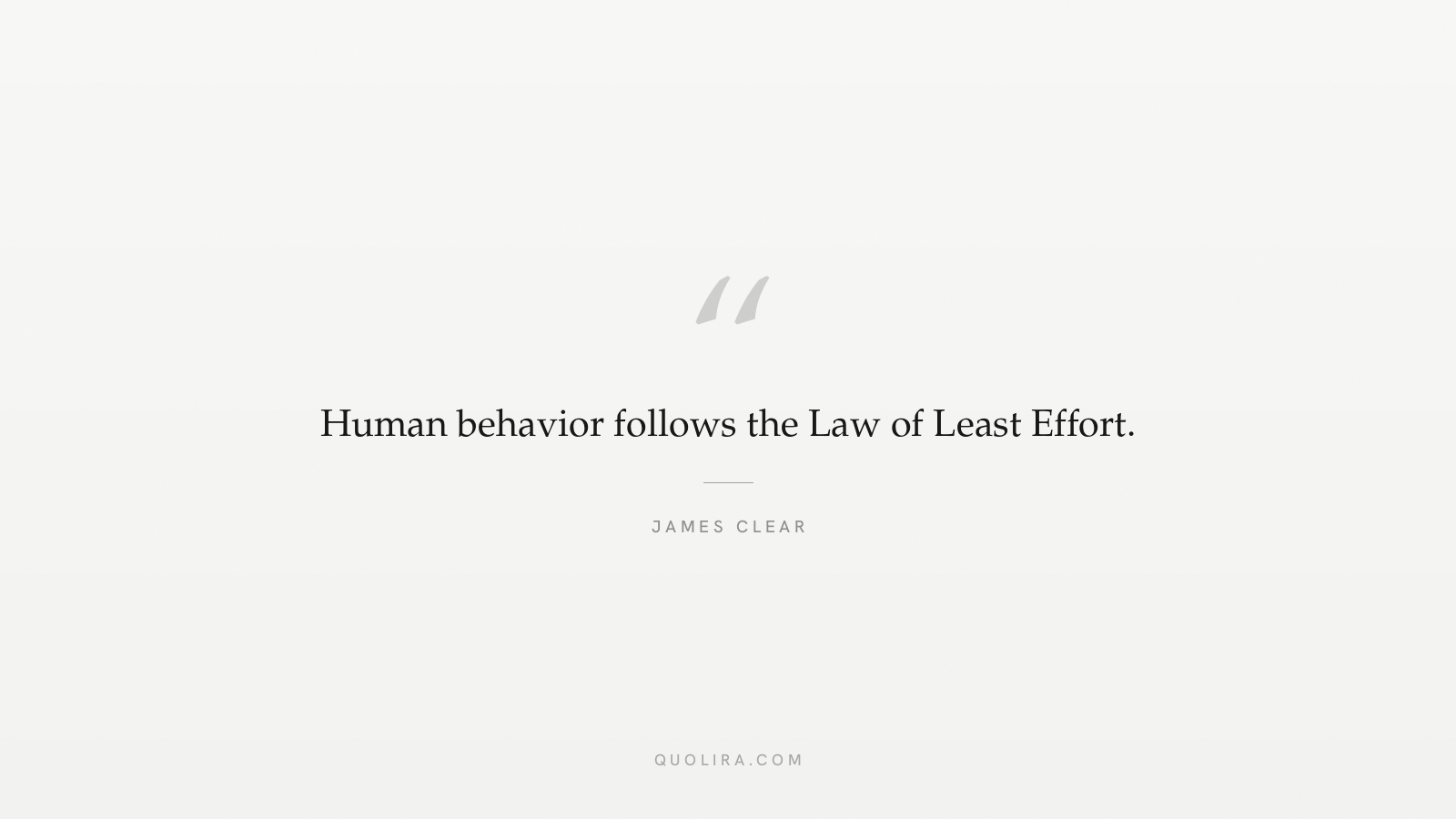
“Human behavior follows the Law of Least Effort.”
James Clear · Atomic Habits, Chapter 12: The Law of Least Effort