“It is no small task, and yet it is the work that all of us must do at one point or another.”
Brianna Wiest · The Mountain Is You, Chapter 1: The Mountain Is You
 quolira
.com
Brianna Wiest said it, in The Mountain Is You, Chapter 1: The Mountain Is You.
This is the working definition that makes the rest of chapter one click. The behavior is doing a job for you, even when it looks like it's hurting you.
From the collection: 20 The Mountain Is You Quotes That Expose Self-Sabotage and Make You Act · More Brianna Wiest quotes
This quote means that self-sabotage persists because it serves some hidden purpose, such as protecting a person from pain, fear, or disappointment. The behavior is not random, since it meets a need the person may not consciously recognize. Understanding that need is presented as the starting point for changing the behavior.
The line is found in Chapter 1 of The Mountain Is You, where Brianna Wiest defines self-sabotage in psychological terms. Rather than treating it as laziness or weakness, she describes it as a pattern driven by unmet needs that operate below awareness. The sentence sets up the book's larger argument that real change begins with identifying what the sabotaging behavior is accomplishing.
Brianna Wiest is a writer whose essays on mental health, relationships, and self-development attracted a large online audience before her books were published. Her best known book, The Mountain Is You, came out in 2020 and examines how people hold themselves back and why those patterns feel familiar. Her approach blends accessible language with reflective questions, making her work appealing to readers who are exploring emotional habits and personal growth.
“It is no small task, and yet it is the work that all of us must do at one point or another.”
Brianna Wiest · The Mountain Is You, Chapter 1: The Mountain Is You
“There is nothing holding you back in life more than yourself.”
Brianna Wiest · The Mountain Is You, Chapter 1: The Mountain Is You
“Guide them by example, subdue them by courtesy; they will learn shame, and come to be good.”
Confucius · The Analects, Book II, Chapter III
“The wise find pleasure in water; the virtuous find pleasure in hills.”
Confucius · The Analects, Book VI, Chapter XXIII
“Only after Winter comes do we know that the pine and the cypress are the last to fade.”
Confucius · The Analects, Book IX, Chapter XXVIII
“When the archer misses the center of the target, he turns round and seeks for the cause of his failure in himself.”
Confucius · The Doctrine of the Mean, Chapter XIV
“When we see men of worth, we should think of equaling them; when we see men of a contrary character, we should turn inwards and examine ourselves.”
Confucius · The Analects, Book IV, Chapter XVII
“I am not bothered by the fact that I am not understood. I am bothered when I do not know others.”
Confucius · The Analects, Book I, Chapter XVI
“When making a mistake, do not be afraid to correct it.”
Confucius · The Analects, Book I, Chapter VIII
“If names be not correct, language is not in accordance with the truth of things.”
Confucius · The Analects, Book XIII, Chapter III
“It is not truth that makes man great, but man that makes truth great.”
Confucius · The Importance of Living (1937), as quoted by Lin Yutang
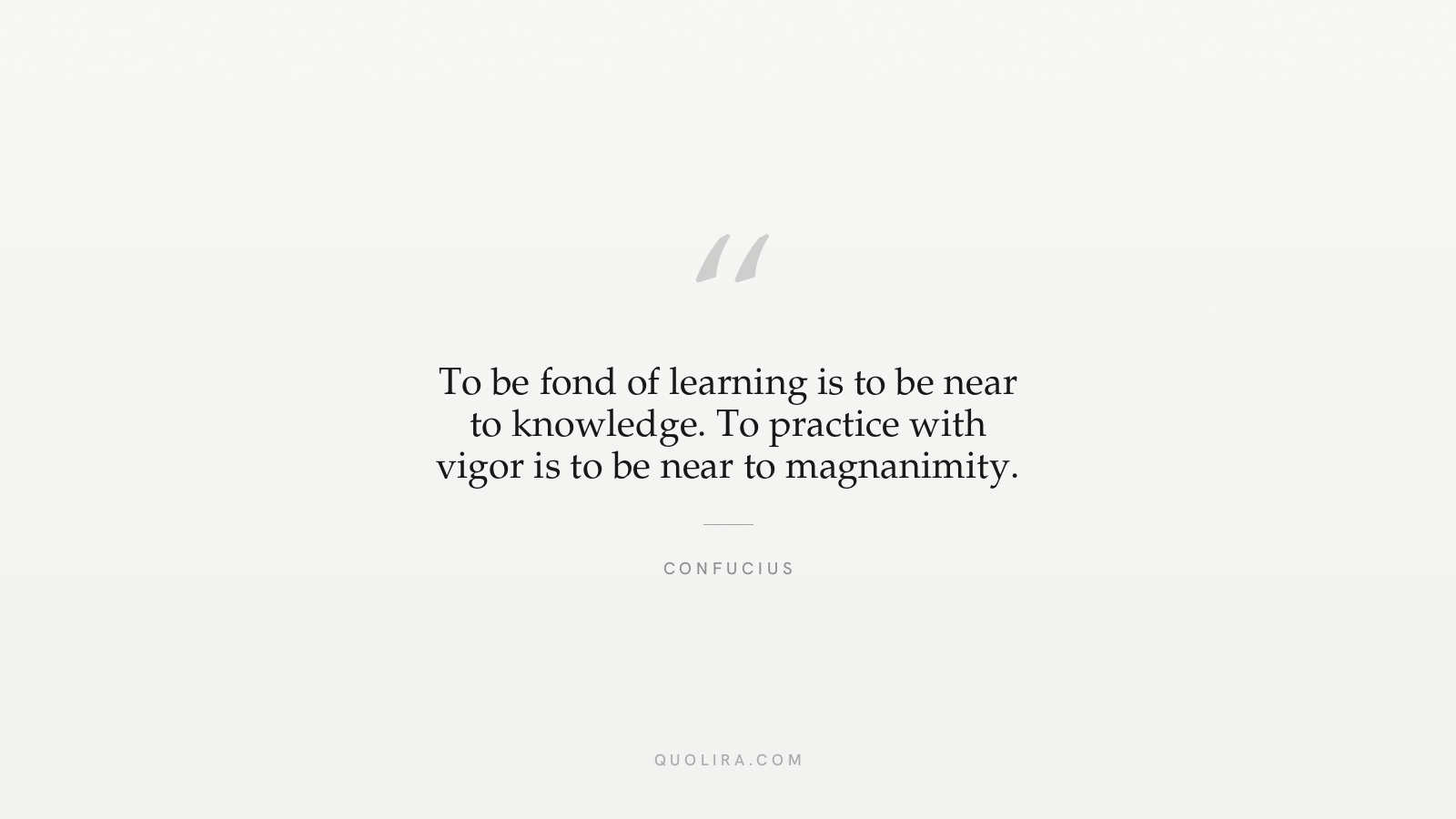
“To be fond of learning is to be near to knowledge. To practice with vigor is to be near to magnanimity.”
Confucius · The Doctrine of the Mean, Chapter XX