25 Quotes About Forgiveness: Famous Forgiveness Quotes That Free You
Real lines from Jesus, Alexander Pope, Desmond Tutu and others, each with a source you can check.

The most famous forgiveness quotes make one point plainly: letting go of a wrong frees the person who was hurt, and that freedom matters more than whether the other person earns an apology. I went through the sourced lines on this topic, and the names that keep coming back are Jesus, Alexander Pope, and Desmond Tutu. These famous forgiveness quotes span roughly two thousand years, from the Gospel of Luke to a 1997 book by Eckhart Tolle, and they agree more than you might expect.
Some of them are about letting go, the release that happens when you stop replaying an insult. Others turn inward and treat self-forgiveness as the harder task, the one you need to finish before anyone else's apology means much. Each quote below comes with its documented source, so you can check the wording and context before you share it.
Read them slowly. Most of these lines are short, and a few will sting a little, which usually means they're pointing at something real.
The Most Famous Forgiveness Quotes Everyone Shares
They who forgive most shall be most forgiven.
Good, to forgive; Best to forget.
Robert Browning La Saisiaz, Prologue
Browning's line is almost rude in how short it is. Forgiving is the first step, he says, and forgetting is the part most of us quietly fail. He has a point, since the old hurt keeps coming back when we forget to let it go.
Forgive your enemies, but never forget their names.
John F. Kennedy Quoted in Mayor (1984) by Ed Koch
The line is attributed to Kennedy through Ed Koch's 1984 book, and it's a joke with an edge. It's a useful reminder that forgiveness and memory can sit in the same head. Keep the names, and you can still be generous.

To err is human, to forgive divine.
Alexander Pope An Essay on Criticism (1711)
Pope wrote this in 1711, and it's the line almost everyone has heard in some form. Making mistakes is ordinary, and pardoning them is the part that asks more of us. Try it on one stubborn grudge this week.
There is no revenge so complete as forgiveness.
Josh Billings His Works, Complete (1873)
Billings was an American humorist, and this aphorism is tighter than most of his folksy lines. Revenge wants your attention every day. Forgiveness lets it go and still gets the last word.
Life, that ever needs forgiveness, has, for its first duty, to forgive.
Edward Bulwer-Lytton Zanoni (1842)
This comes from the 1842 novel Zanoni, and it puts forgiveness at the center of ordinary living. We keep needing it because we keep making mistakes. So the duty is to forgive again and again, not once.

Biblical Quotes About Forgiveness and Mercy
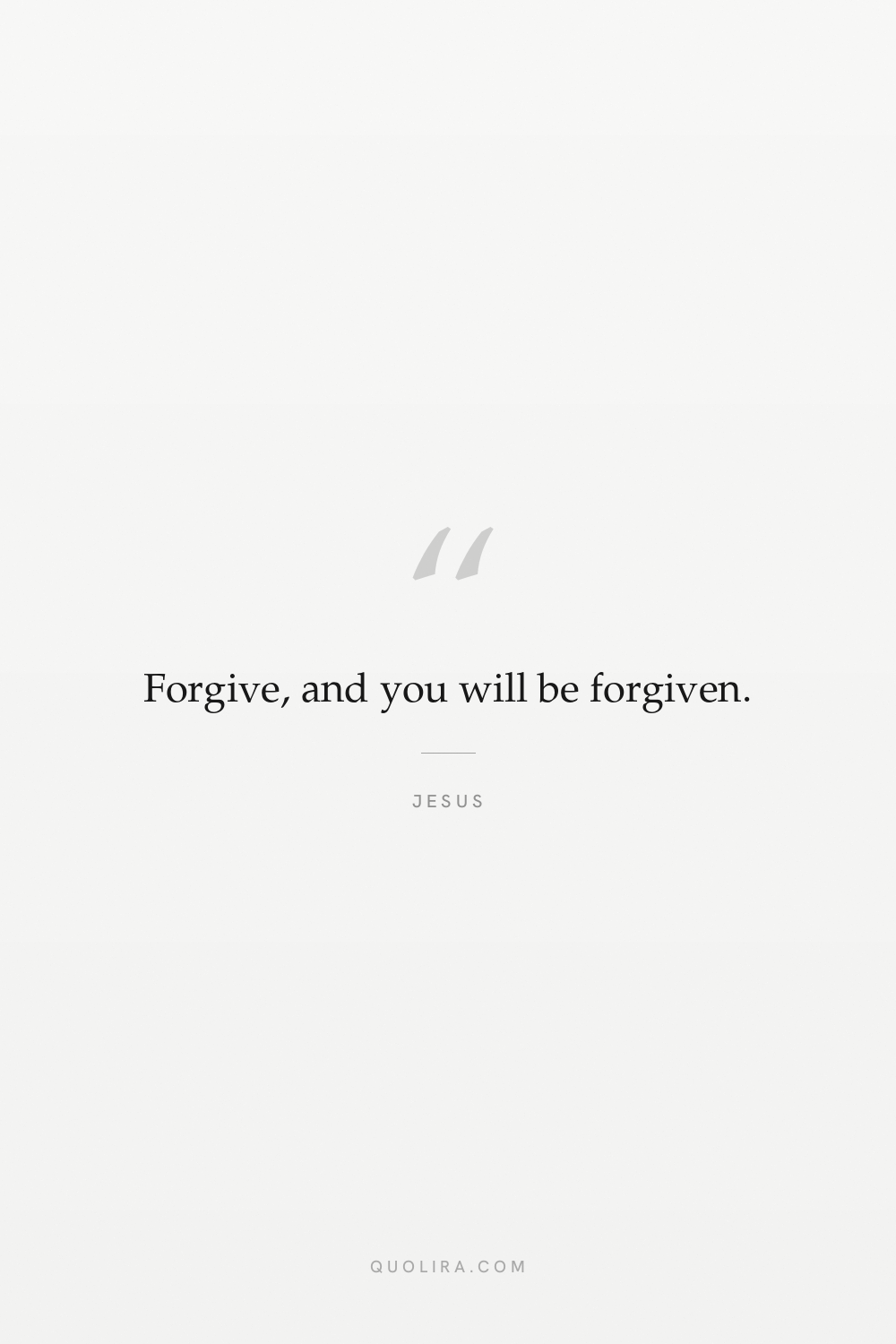
Forgive, and you will be forgiven.
Jesus says this in the Sermon on the Plain, and the sentence reads like a promise. Mercy you hand out tends to come back around, even if it doesn't arrive on your schedule. Many people find it the easiest verse to remember.

Father, forgive them, for they do not know what they are doing.
Jesus Luke 23:34 (NIV), spoken from the cross
According to Luke 23:34 (NIV), Jesus said this while being crucified. The people involved were soldiers and a crowd, and the speaker was in agony. It sets a hard bar, since forgiving people who don't understand the harm they cause is the most demanding kind.
I tell you, not seven times, but seventy-seven times.
Peter asked whether seven times was generous enough, and this is the answer. The number makes the point: there is no tally to finish. If you keep count, you'll probably quit before the third round.

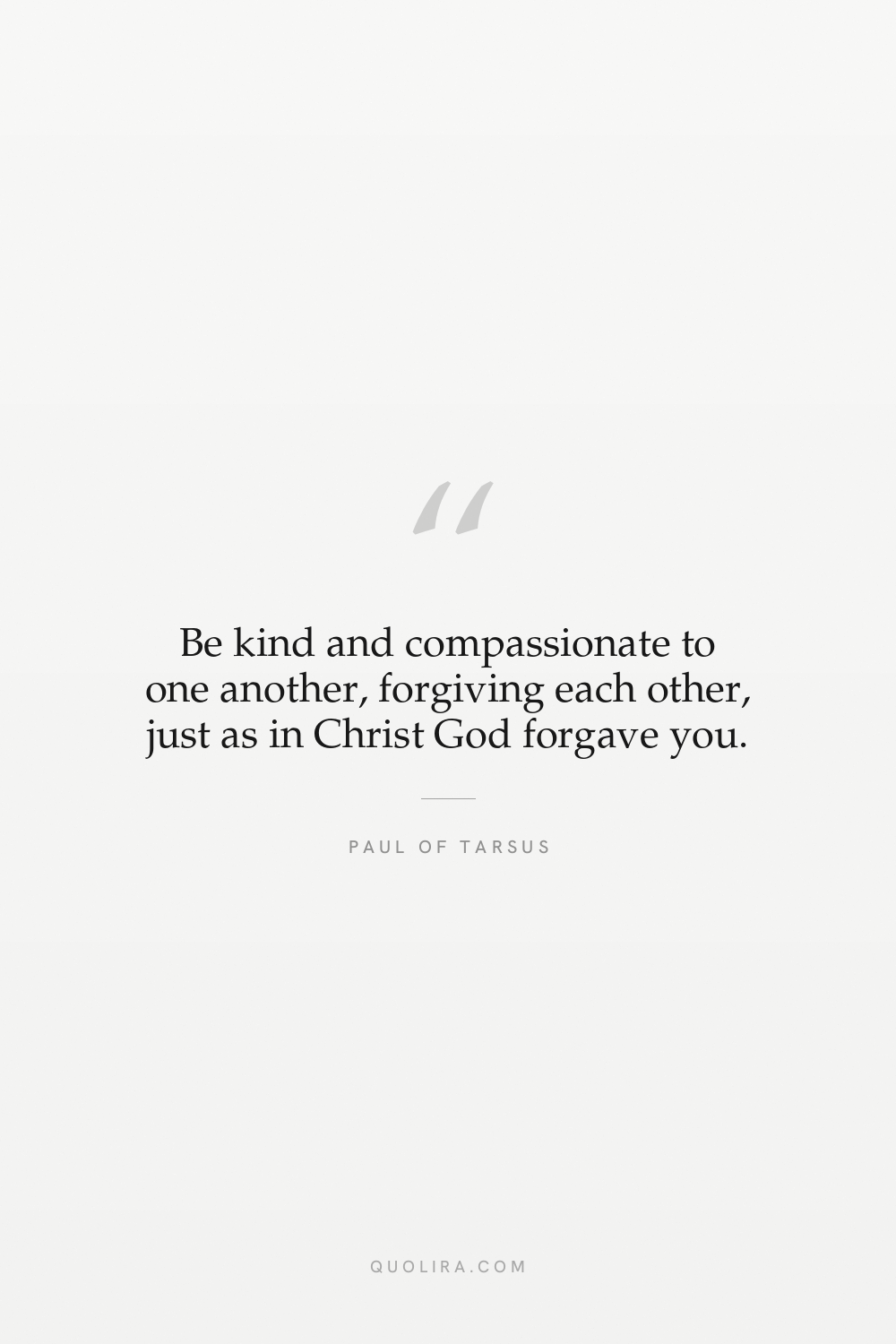
Be kind and compassionate to one another, forgiving each other, just as in Christ God forgave you.
Paul of Tarsus Ephesians 4:32 (NIV)
Paul writes this to the church at Ephesus, and tradition credits him with the letter. Kindness comes first, then forgiveness, and the model is what God did for you. It's a hard standard on a bad day, which is why it's worth repeating.
If your brother sins, rebuke him, and if he repents, forgive him.
Here Jesus pairs forgiveness with a rebuke, which surprises people who think forgiving means ignoring what happened. The order matters: speak up first, then release it when the other person repents. I'd keep that sequence in any hard conversation.
Writers and Thinkers on Forgiveness
Surely it is much more generous to forgive and remember, than to forgive and forget.
Maria Edgeworth An Essay on the Noble Science of Self-Justification
Edgeworth separates the two actions more cleanly than most writers do. Remembering keeps you honest about what happened, while forgetting can leave the wound open without your noticing. Choose the one you can live with.
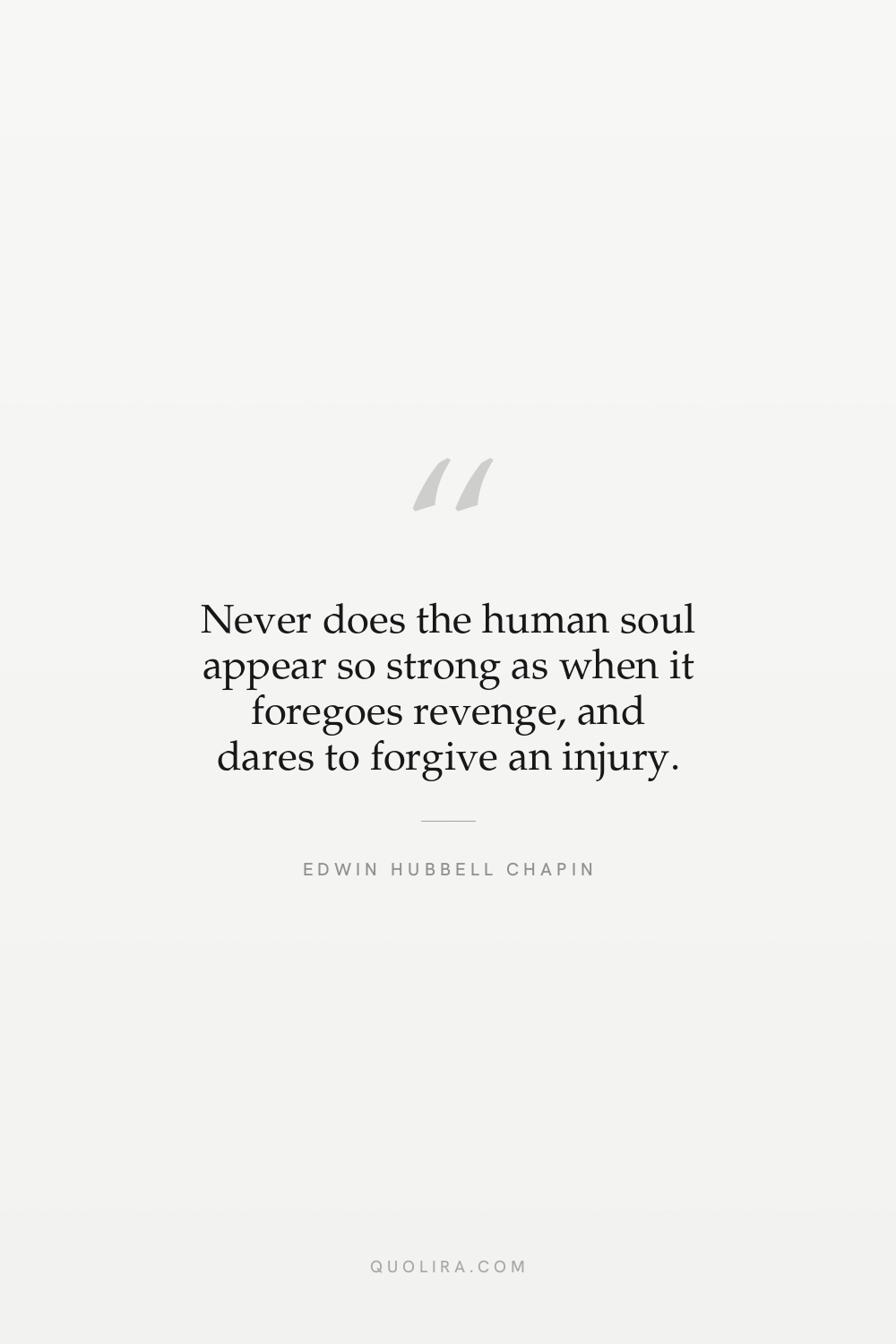
Never does the human soul appear so strong as when it foregoes revenge, and dares to forgive an injury.
Edwin Hubbell Chapin Quoted in Dictionary of Burning Words of Brilliant Writers (1895)
Chapin's line was already a classic by 1895, when it was collected in a dictionary of quotations. Restraint looks like weakness until you have tried it. Then it looks like strength.

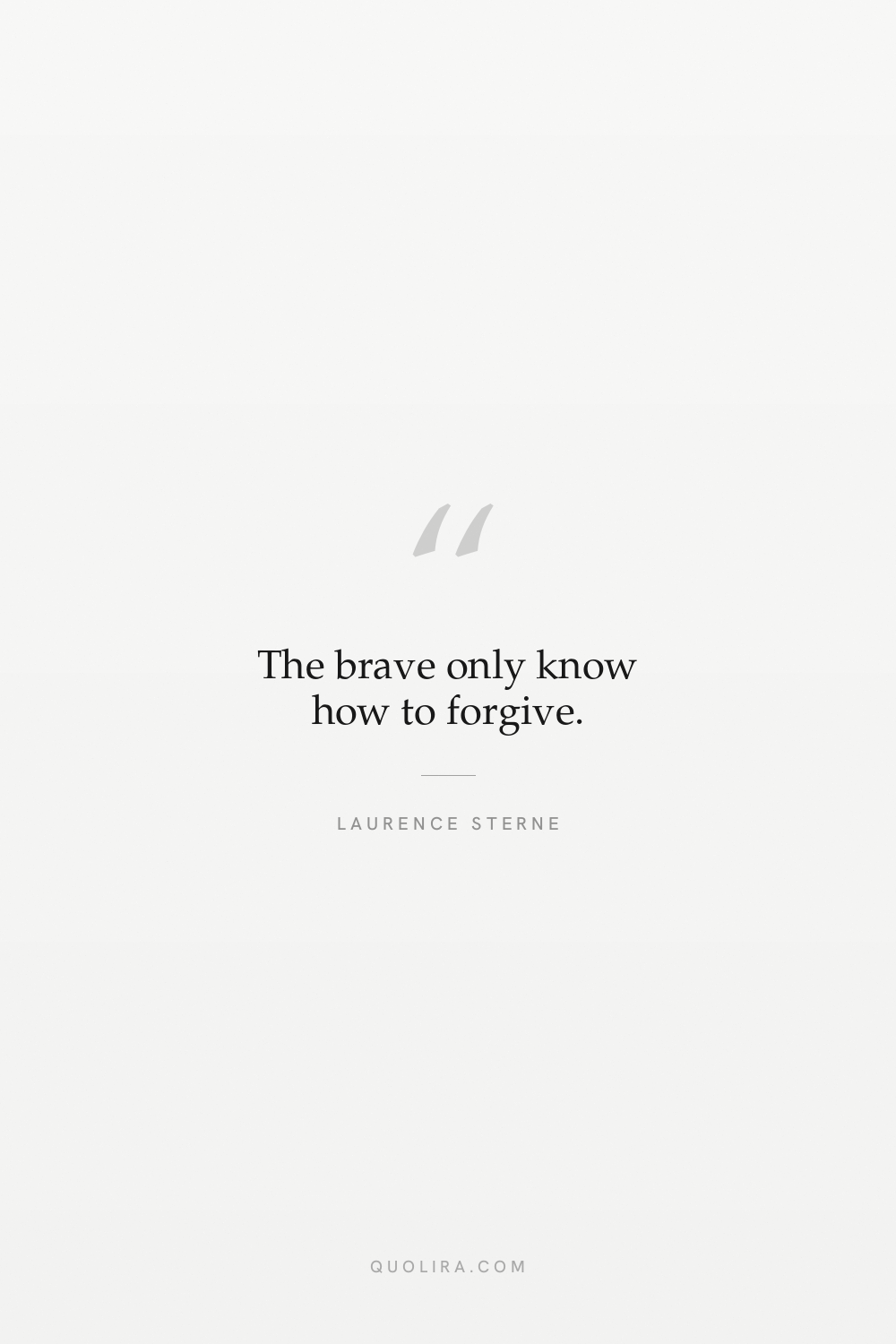
The brave only know how to forgive.
Laurence Sterne Sermon, Joseph's History Considered
Sterne put this line in a sermon, and it changes who you think is brave. Forgiving takes a steadiness that anger can't fake. Think of the last time you let something go and notice how it felt.
Forgiveness of the present is even more important than forgiveness of the past.
Eckhart Tolle The Power of Now (1997)
Tolle moves forgiveness out of the past and into the present moment. Most people keep an old injury alive by feeding it attention every day. Try letting today be what it is and see what's left.
Love scarce is love that never knows The sweetness of forgiving.
John Greenleaf Whittier Quoted in Dictionary of Burning Words of Brilliant Writers (1895)
Whittier's stanza treats forgiveness as part of what love is, not an extra. A love that never forgives has never been tested, he suggests. I find these lines stick better than most sermons do.
Forgiveness is an absolute necessity for continued human existence.
Desmond Tutu Quoted in Pastoral Care for Post-Traumatic Stress Disorder (2002) by Dalene Fuller Rogers and Harold G. Koenig
Tutu treats forgiveness as a survival tool, not a favor to the other person. He spent years working on reconciliation in South Africa, so the claim carries real weight. Read it on a hard day and you'll feel the stakes.
Anger destroys your own peace of mind.
The Dalai Lama The Wisdom of Forgiveness (2004) by the Dalai Lama and Victor Chan
In this passage, the Dalai Lama argues that anger hurts the person feeling it most. Anger brings uncomfortable feelings to yourself, he says. It's the most practical reason I know to put it down.

Quotes About Forgiveness When Revenge Tempts You
Forgiveness is better than revenge.
Pittacus of Mytilene As quoted by Diogenes Laërtius, Life of Pittacus
Pittacus reportedly said this when he freed his captured enemy Alcaeus, according to Diogenes Laërtius. It's one of the oldest recorded cases of choosing mercy over payback. Strong people can afford it, and so can you.

One should forgive one's enemies, but not before they are hanged.
Heinrich Heine Statement of 1848, as quoted in The Cynic's Lexicon (1984) by Jonathon Green
This line appears in a modern dictionary of cynical sayings, so the attribution to Heine is shaky. I still laugh at it, because the impulse it jokes about is one we all recognize. Forgiveness after a bit of revenge is the joke's whole target.

Bear and forbear.
Epictetus See Aulus Gellius, Attic Nights, Book XVII, chapter 6
Epictetus gives a two-word lesson that Aulus Gellius recorded in Book XVII of his Attic Nights. Bearing with people is the discipline, and forbearing is what you do when you choose not to strike back. It's the most useful forgiveness advice in this list.

There comes a day when, for someone who has persecuted us, we feel only indifference, a weariness at his stupidity. Then we forgive him.
Cesare Pavese This Business of Living
Pavese describes forgiveness arriving quietly, when you finally feel tired of the other person's nonsense. There's no triumph or grand speech in it. That plainness is why this line feels honest.
Quotes About Forgiveness for Yourself
Forgive others often, yourself never.
Publilius Syrus Maxims (Latin: Ignoscito sæpe alter, nunquam tibi)
Publilius Syrus gives us a Latin maxim that flips the usual order. Be generous to others, and keep yourself on a stricter ledger, which is how many of us already operate. I think the reverse is closer to the advice most of us need.
Let opinion be taken away, and no man will think himself wronged.
Marcus Aurelius Meditations, Book IV, section 7 (Casaubon translation)
In Meditations, Marcus Aurelius argues that a wrong only stings when we agree it's a wrong. Take away the judgment and the injury loses its grip. It's a Stoic argument in one breath, and it's harder to practice than it sounds.

I also am other than what I imagine myself to be. To know this is forgiveness.
Simone Weil Void and Compensation, in Gravity and Grace (1947)
Weil suggests that forgiveness begins with seeing yourself more clearly. You are more than the story you tell about yourself, and that gap is where mercy starts. I return to this line whenever I catch myself repeating an old judgment.

Why quotes about forgiveness matters
Forgiveness shows up in the Gospels, in Roman philosophy, in Shakespeare, and in a 1997 book on spiritual awakening. That spread is the main reason I trust these lines more than any single writer's take on the subject. A good quote is short enough to save, which is why these keep turning up on cards, walls, and wedding toasts.
Pope's line dates to 1711, from An Essay on Criticism, and it still circulates in nearly the same form. Bulwer-Lytton wrote in his 1842 novel Zanoni that life "ever needs forgiveness," which tells you the idea has been running through English writing for a long time.
To err is human, to forgive divine.
What these quotes have in common
Most of these lines treat forgiveness as something you do for your own sake as much as for the other person. Josh Billings puts it bluntly in His Works, Complete (1873): there is no revenge so complete as forgiveness. Tolle makes a related point from a different angle, arguing that holding on to the past keeps the injury alive in the present.
A second thread is that forgiveness costs something. Epictetus's "Bear and forbear" is about enduring, not about pretending nothing happened. Edgeworth separates the two actions directly: she calls it more generous to forgive and remember than to forgive and forget. Remembering, in her view, is the honest part of the deal.
The scriptural quotes carry a condition and a promise. Jesus says forgive, and you will be forgiven, and his answer to Peter sets no ceiling at seventy-seven. Pavese lands in a quieter place: a day arrives when the anger simply runs out of fuel, and forgiveness follows without drama. That gradual arrival is the most honest idea in the list, and it's why Pavese hits harder than the slogans.
How to use these quotes
These work best when you match the quote to the moment. A Luke line fits a card for a friend who messed up, while the Marcus Aurelius line suits private journaling when you're the one still replaying the hurt. If you want to go further on releasing your grip, the letting go quotes page pairs well with this list.
- Journal prompt: copy the Marcus Aurelius line and write down the one injury you keep replaying.
- Wedding or speech: Ephesians 4:32 works as a closing blessing.
- Card for a friend who apologized: pair Luke 17:3 with a handwritten note.
- Classroom discussion: ask whether Pittacus or Pope feels more true in everyday life.
- Photo caption: keep the Tolle line short and let the image do the rest.
- Hard grief context: if forgiveness is tangled up with loss, the grief quotes page covers that harder ground.
Common misunderstandings
The first misunderstanding is that forgiveness means calling the hurt fine. Edgeworth's line assumes the opposite. You can say the wrong happened, name it plainly, and still release your grip on it. Epictetus asks for the same thing when he says to bear and forbear, which describes endurance rather than denial.
The second is that forgiveness has a deadline. Many people feel they should be finished by a certain week or holiday. Pavese describes a slower process, where the anger wears out on its own schedule. When you force a fast release, the calm often feels thin, and the old anger returns the next time something small goes wrong.
The third is that forgiving someone means letting them back in. Jesus pairs forgiveness with a rebuke in Luke 17:3, and that order matters. You can release a grudge and still keep your distance from someone who keeps causing harm. Forgiveness changes how you carry the wound. It does not set the terms of your relationship.
The fourth is that forgiving others and forgiving yourself are the same task. Publilius Syrus draws a sharp line between the two in his maxim, and many people find their own harshest judgments are the hardest to release. If you can be patient with a friend's mistake but punish yourself for the same one, the work is still unfinished.
A simple way to practice
Start with one specific injury. Vague resentment is hard to release, so write one sentence that names what happened. Say a coworker took credit for your report in a meeting. Write that sentence down, then note what you still want from that person, whether an apology, a correction, or distance.
Next, choose one quote from this list and keep it nearby. Marcus Aurelius works well for the replay problem, because it asks whether the judgment that makes the wrong sting is one you want to keep. Tolle works well when your mind keeps returning to the past.
Finally, notice the moment the replay starts. You won't catch it every time. When you do, say the quote silently and return to the present task. Over weeks, the replay tends to get shorter, and that shift is the practice working.
Sources
Pick one quote and carry it for a week. If it still stings by Friday, that's useful information, and you can start again on Monday.
Frequently asked questions
What is the most famous forgiveness quote?
Did Jesus really say forgive and you will be forgiven?
Did JFK really say forgive your enemies but never forget their names?
How many times should you forgive someone?
What did Marcus Aurelius say about forgiveness?
Keep reading

Tsundoku Meaning: The Books We Buy in Hope
The Japanese word for the stack of books you bought with good intentions, and what that stack says about the person you hoped to become.

22 Quotes About Grief and Missing Someone Who Has Died That Help You Carry the Loss
Lewis, Didion, Shakespeare, and Tennyson on the fear, silence, and strange comfort of missing someone who is gone.






























25 Quotes on Patience That Teach You to Wait
From Milton's blind sonnet to Seneca's hard-won letters, these lines show that waiting is a skill you can practice.
Bailey wrote this in Festus, a long verse drama, and it reverses the usual math. The more you forgive, the more forgiveness comes back to you. I read it as a dare more than a rule, because forgiving people who never say sorry is the real test.