8 Luqman Quotes That Teach Timeless Wisdom on Life, Faith, and Character
The sage's words have outlasted empires. Here's why they still cut deep.

Luqman quotes carry a weight that few ancient sources can match. Luqman al-Hakim, the wise man whose counsel fills Surah Luqman (Chapter 31) of the Quran, spoke in plain sentences that landed like stones in still water. His wisdom literature addressed his son directly, covering gratitude and humility without flinching, and every line still reads as if written for this morning. Eight of his most enduring words are below.
Luqman al-Hakim on Faith and Accountability
O my son, do not associate anything with God. Associating others with Him is a tremendous wrong.
O my son, even if a deed were the weight of a mustard seed and hidden inside a rock or anywhere in the heavens or earth, God would bring it forth. God is all-subtle, all-aware.
Luqman Quran, Surah Luqman 31:16
A verse about accountability, but framed with extraordinary precision. The mustard seed, the rock, the depths of the earth: Luqman isn't being abstract. He's making sure his son understands there is nowhere small enough to hide a wrong.
O my son, keep up the prayer, command what is right, forbid what is wrong, and bear with patience whatever befalls you. These are matters of great determination.
Luqman Quran, Surah Luqman 31:17
Four instructions in one breath. What's striking is that patience comes last, paired directly with difficulty. Luqman doesn't promise the path will be easy. He just says bear it anyway.

Luqman al-Hakim on Humility and Gratitude
Do not turn your nose up at people, nor walk about the place arrogantly, for God does not love arrogant or boastful people.
Luqman Quran, Surah Luqman 31:18
The image of turning one's nose up is as vivid today as it was then. Luqman is specific about the gesture, not just the attitude, because arrogance always shows up in the body first.

Be modest in your bearing and lower your voice, for the ugliest of all voices is the braying of asses.
Luqman Quran, Surah Luqman 31:19
One of the most memorably blunt lines in any wisdom text. Luqman could have said 'speak softly and humbly.' Instead he picked the donkey. It works precisely because it stings a little.
We commanded man to be good to his parents. His mother carried him with increasing weakness, and his weaning takes 2 years. Be grateful to Me and to your parents.
Luqman Quran, Surah Luqman 31:14
This verse appears in Luqman's surah as context for his teachings. The specificity of '2 years' and 'increasing weakness' makes it feel less like scripture and more like someone who has actually watched a mother raise a child.
Attribution note: this verse is God's speech in the Quran, not the words of Luqman.

Luqman al-Hakim Wisdom on Silence and Peace
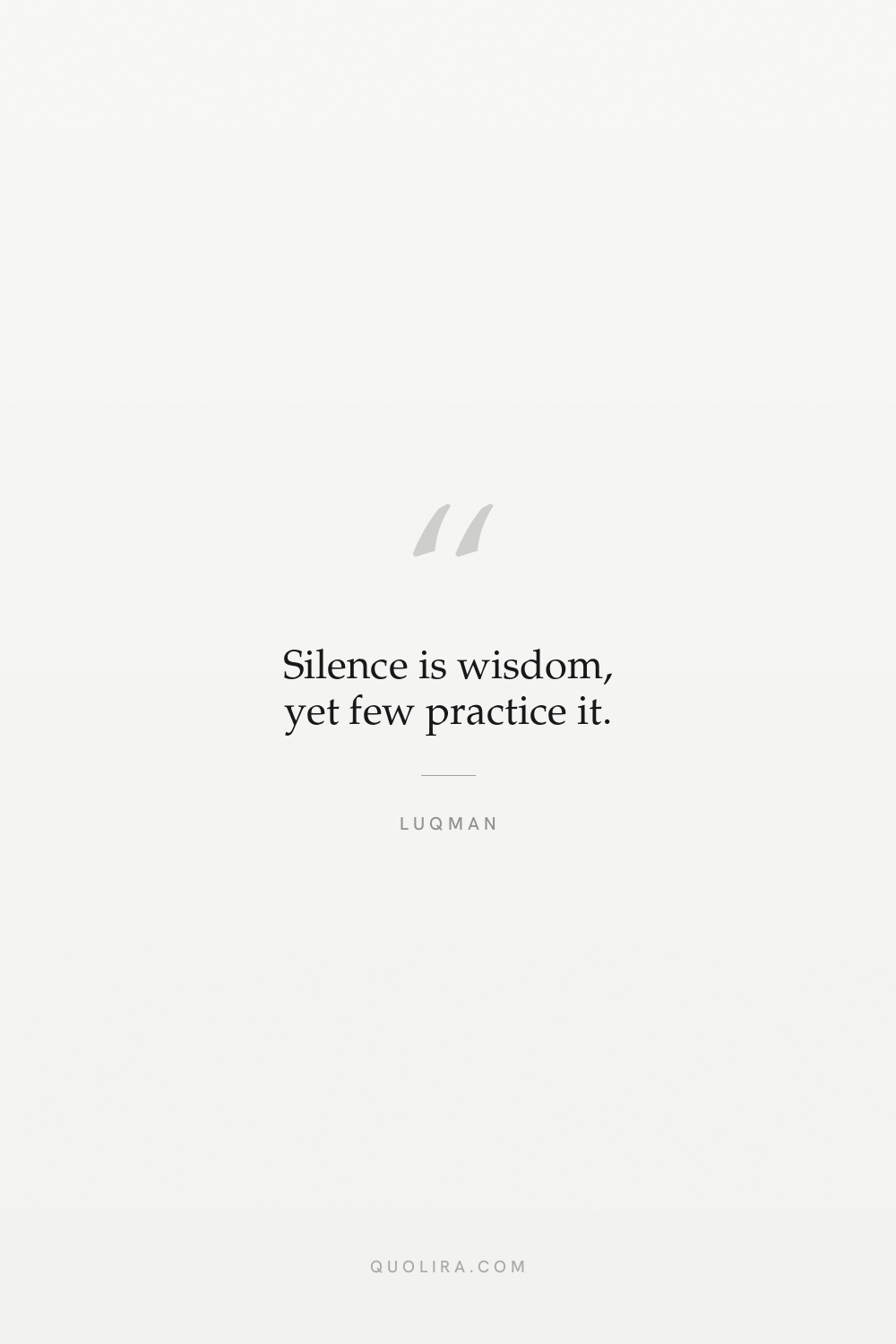
Silence is wisdom, yet few practice it.
Luqman Widely attributed in classical Arabic wisdom literature
Short enough to be dismissed, heavy enough to stay with you. Luqman's classical sayings frequently circle back to restraint, and this one is probably the most quoted of them all outside the Quran.

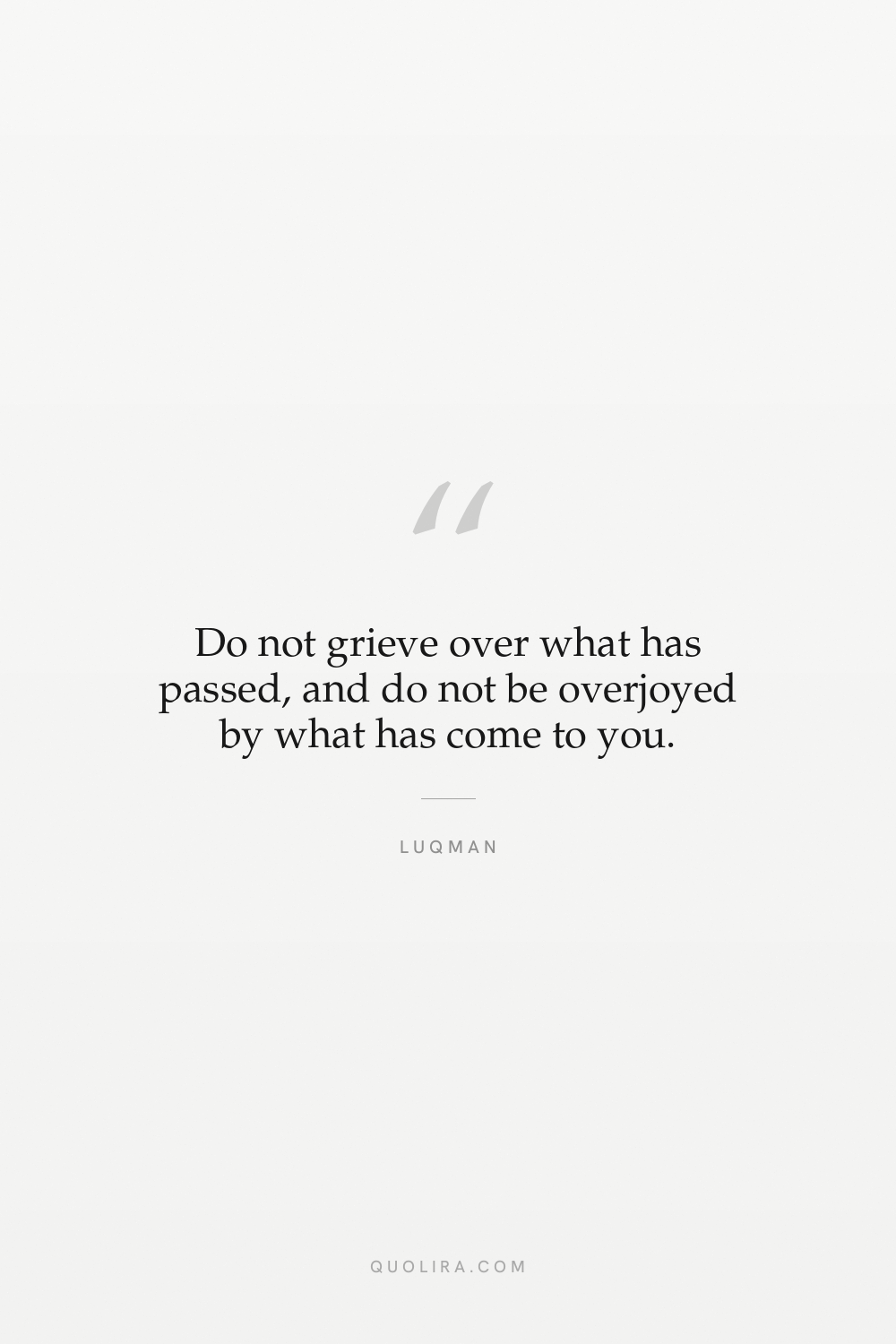
Do not grieve over what has passed, and do not be overjoyed by what has come to you.
Luqman Attributed in classical Arabic wisdom literature
A steady-handed take on equanimity that predates Stoic philosophy in the Western sense by centuries. Luqman isn't asking for emotional numbness. He's asking for proportion, which is harder and more useful.

Quotes often misattributed in this list
- "We commanded man to be good to his parents. His mother carried him with increasing weakness, and his weaning takes 2 years. Be grateful to Me and to your parents." This verse is God's speech in the Quran, not the words of Luqman.
Why these quotes matter
Luqman is a legendary sage in pre-Islamic Arab tradition. The 31st surah of the Quran is named after him and shows him as a monotheist and a father giving pious advice to his son. Many of the lines people quote from him come from that chapter, so reading the surah in context helps you tell his direct counsel apart from later sayings.
Beyond the Quran, a large number of proverbs were later attributed to Luqman. In the medieval era he was also linked with writing fables, and many stories once connected with Aesop were moved onto his name. That is why some quotes in circulation, such as the lines on silence and on not grieving over the past, come from classical Arabic wisdom literature rather than the scripture itself.
For more on reflective wording, see 25 Short Quotes About Life That Sit With You for a While and 13 Mason Wisdom Quotes That Will Make You Think Differently About Building a Life. For a related idea on acceptance, read Amor Fati: Loving Your Life, Not Just Living It.
Sources
Luqman's advice was given to one son in one conversation. Somehow it reached every generation since. That's what true wisdom does.
Frequently asked questions
Who was Luqman al-Hakim?
What is the most famous Luqman quote?
What does "Silence is wisdom, yet few practice it" mean?
What advice did Luqman give his son?
Are all Luqman quotes from the Quran?
Keep reading

25 Ralph Waldo Emerson Quotes on Self-Reliance, Nature, and Living Boldly
Emerson's sharpest lines on independence, nature, and the nerve to live on your own terms.

25 Famous Kindness Quotes That Prove Small Acts Matter
Real lines from Shakespeare, the Dalai Lama, and Kurt Vonnegut explain why a small kind act never really disappears.












21 Sun Tzu Quotes from The Art of War on Strategy, Terrain, and Spies
Sun Tzu wrote about winning before the first move, and most of these lines still work as advice for work, conflict, and planning.
This is the first thing Luqman says to his son in the Quran. He opens with the biggest thing, not a small lesson. That ordering tells you something about what he thought actually mattered.