“No man is free who is not master of himself.”
Epictetus · Fragments
 quolira
.com
quolira
quolira.com
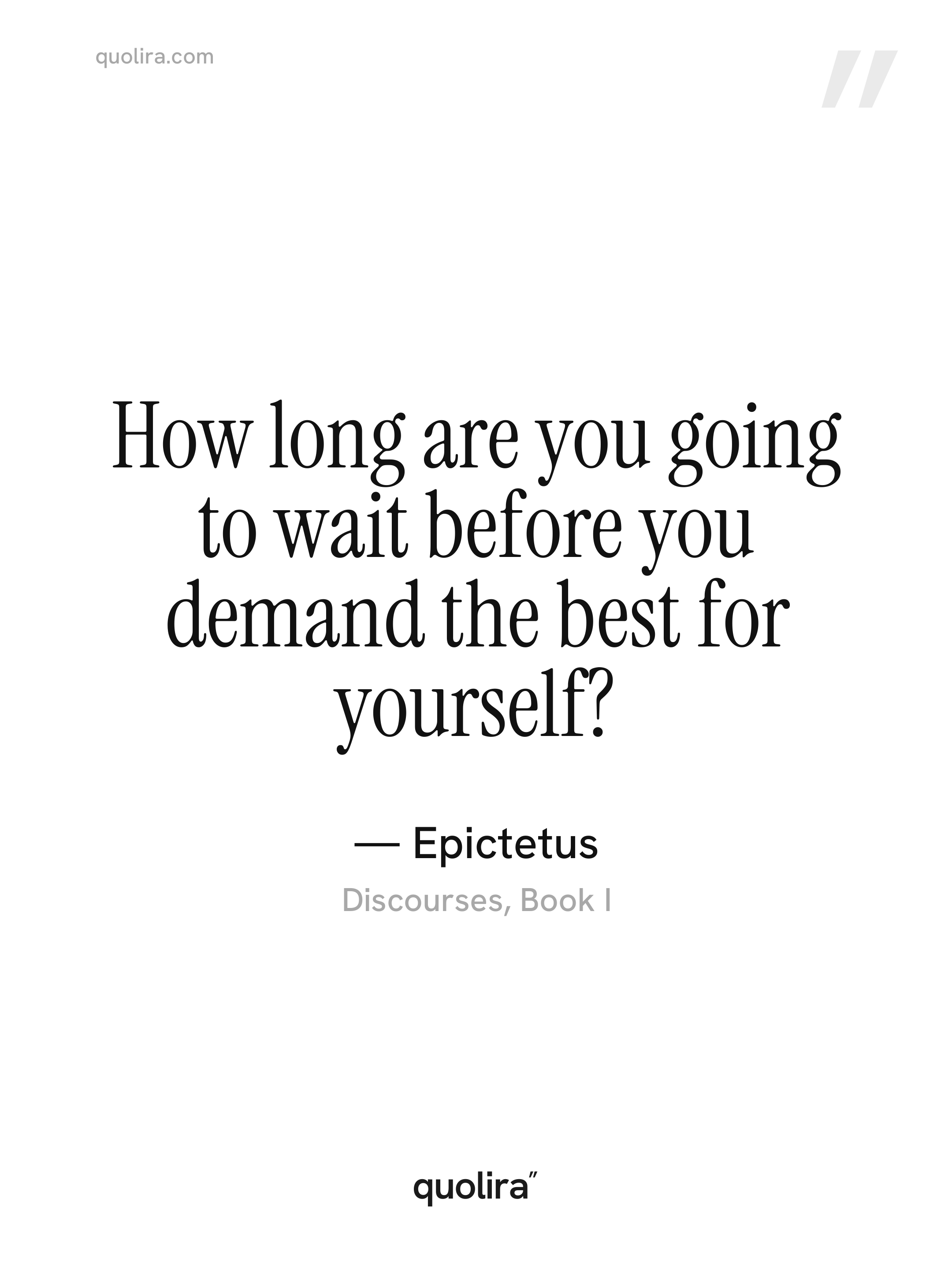
The question lands with a sense of quiet impatience. Epictetus is not asking about wealth or comfort; he is asking when a person will stop accepting a diminished version of themselves and start living up to their real potential. The word "demand" is important: this is not passive hoping but an active claim. The line challenges the habit of indefinite postponement, the assumption that there will always be a better moment later to start becoming who you are meant to be.
Book I of the Discourses covers a wide range of Epictetus's classroom exchanges, and a recurring theme is the student who understands Stoic principles in theory but delays putting them into practice. Epictetus had little patience for that gap between knowing and doing. He believed philosophy was not a body of knowledge to be admired but a set of tools to be used daily. This line reflects his insistence that the work of self-improvement cannot be scheduled for a more convenient time because that time rarely arrives on its own.
Epictetus taught and lived during the Roman Imperial period, probably from around the mid-first century into the early second century. Born a slave, he gained his freedom and went on to found a school of Stoic philosophy that attracted serious students from across the empire. He dictated no books himself; his teachings survive because his student Arrian recorded them. His background gave his words about self-mastery and human dignity an authority that purely theoretical philosophers could not easily match.
“No man is free who is not master of himself.”
Epictetus · Fragments
“First say to yourself what you would be; and then do what you have to do.”
Epictetus · Discourses, Book III
“Seek not the good in external things; seek it in yourselves.”
Epictetus · Discourses
“Men are disturbed not by the things which happen, but by the opinions about the things.”
Epictetus · Enchiridion, Chapter 5
“Make the best use of what is in your power, and take the rest as it happens.”
Epictetus · Enchiridion
“We suffer more often in imagination than in reality.”
Seneca · Letters to Lucilius
“Dum differtur vita transcurrit.”
Seneca · Letters to Lucilius, Letter I
“Omnia, Lucili, aliena sunt, tempus tantum nostrum est.”
Seneca · Letters to Lucilius, Letter I
“It is not that I'm so brave, but that those who yield to grief accomplish nothing.”
Seneca · Letters to Lucilius
“He who fears death will never do anything worthy of a man who is alive.”
Seneca · Letters to Lucilius
“If it is not right, do not do it; if it is not true, do not say it.”
Marcus Aurelius · Meditations, Book XII
“Waste no more time arguing about what a good man should be. Be one.”
Marcus Aurelius · Meditations, Book X