“Nothing is so much to be feared as fear.”
Henry David Thoreau · Journal, September 7, 1851
 quolira
.com
Henry David Thoreau said it, in Letter to Harrison Blake, November 16, 1857.
Thoreau sent this sharp question to his friend Harrison Blake in a November 1857 letter. He knew that busyness can pass for purpose. Pick one thing you're busy with this week and ask whether you'd still choose it if nobody were watching.
From the collection: 25 Henry David Thoreau Quotes on Simple Living, Freedom, and Paying Attention · More Henry David Thoreau quotes
This quote means that being busy is not the same as doing work that matters, and that effort should be judged by its purpose rather than its volume. Thoreau notes that industriousness alone is not a virtue, since even insects work constantly. The closing question asks the reader to consider what their energy is actually directed toward.
The passage comes from a letter Thoreau wrote to Harrison Blake, dated November 16, 1857. Blake was a correspondent and friend, and Thoreau's letters to him often discuss reading, nature, and the nature of a good life. Letters of this kind show Thoreau speaking more informally than in his published books, yet the central concern is the same. He was skeptical of work that filled time without advancing a meaningful goal.
Henry David Thoreau (1817 to 1862) was an American writer, naturalist, and philosopher born in Concord, Massachusetts. He is best known for Walden, which recounts his two years living simply near Walden Pond, and for the essay Civil Disobedience. He was a close associate of Ralph Waldo Emerson and a leading figure in transcendentalism. His writing repeatedly asks what a person's time and labor are truly for.
“Nothing is so much to be feared as fear.”
Henry David Thoreau · Journal, September 7, 1851
“Success usually comes to those who are too busy to be looking for it.”
Henry David Thoreau
“My life has been the poem I would have writ, but I could not both live and utter it.”
Henry David Thoreau · A Week on the Concord and Merrimack Rivers, 1849
“If you can speak what you will never hear, if you can write what you will never read, you have done rare things.”
Henry David Thoreau · A Week on the Concord and Merrimack Rivers, 1849
“The bluebird carries the sky on his back.”
Henry David Thoreau · Journal, April 3, 1852
“It is a great art to saunter.”
Henry David Thoreau · Journal, April 26, 1841
“Let us not underrate the value of a fact; it will one day flower in a truth.”
Henry David Thoreau · Natural History of Massachusetts, 1842
“Disobedience is the true foundation of liberty. The obedient must be slaves.”
Henry David Thoreau · Journal, 1847
“When will the world learn that a million men are of no importance compared with one man?”
Henry David Thoreau · Letter to Ralph Waldo Emerson, June 8, 1843
“The law will never make men free; it is men who have got to make the law free.”
Henry David Thoreau · Slavery in Massachusetts, 1854
“I came into this world, not chiefly to make this a good place to live in, but to live in it, be it good or bad.”
Henry David Thoreau · Civil Disobedience, 1849
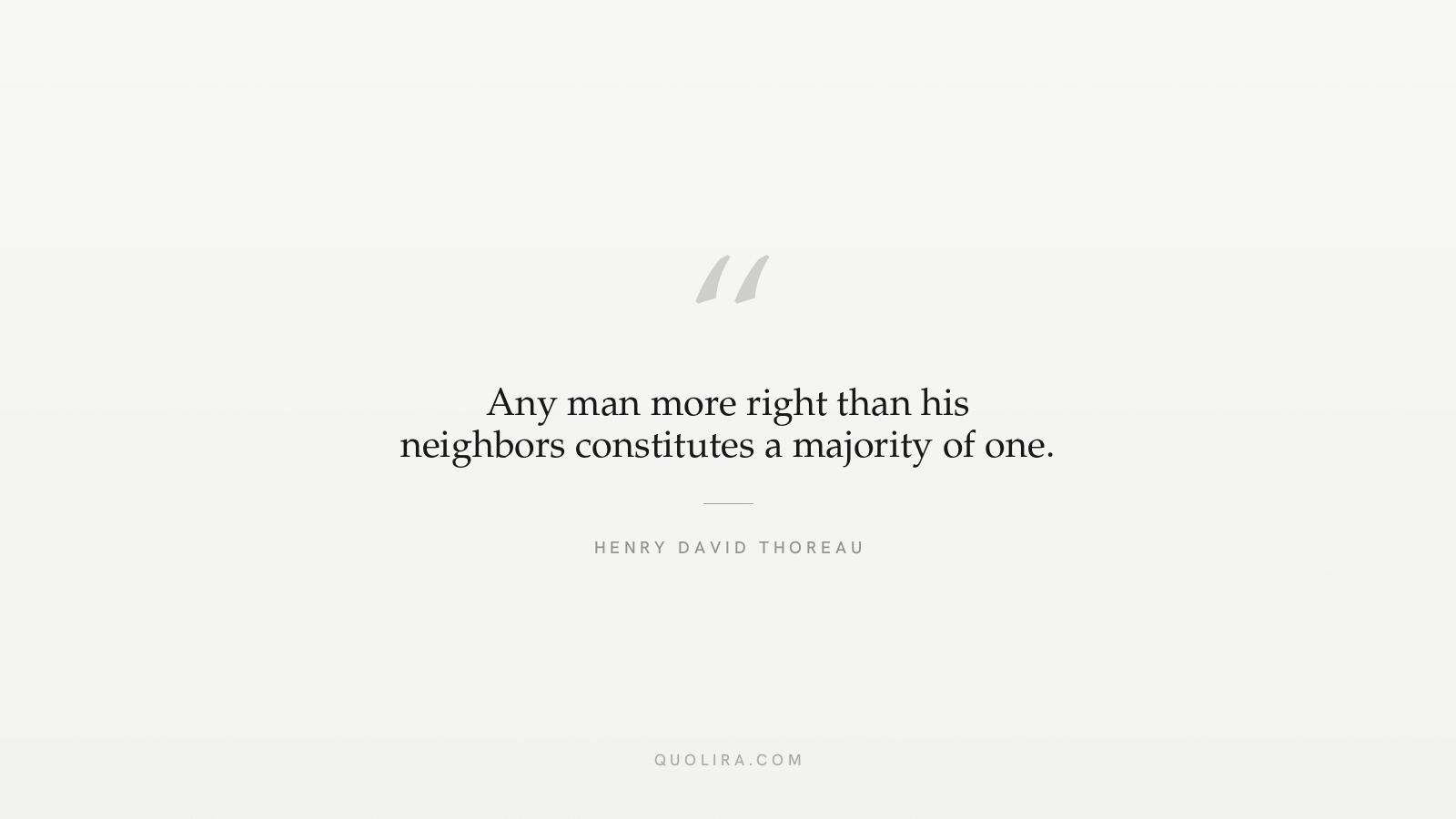
“Any man more right than his neighbors constitutes a majority of one.”
Henry David Thoreau · Civil Disobedience, 1849