“When will the world learn that a million men are of no importance compared with one man?”
Henry David Thoreau · Letter to Ralph Waldo Emerson, June 8, 1843
 quolira
.com
Henry David Thoreau said it, in Journal, 1847.
Thoreau wrote this in his journal in 1847. It sounds harsh, but he meant that blind obedience turns people into tools for whatever authority holds the whip. Use it as a prompt to ask questions before you comply.
From the collection: 25 Henry David Thoreau Quotes on Simple Living, Freedom, and Paying Attention · More Henry David Thoreau quotes
Thoreau is saying that freedom requires people willing to refuse orders they believe are wrong, and that a population trained only to obey will lose its liberty. Liberty is kept alive by a habit of independent judgment rather than by passive compliance.
This line comes from Thoreau's journal in 1847, a year in which he was living at Walden Pond and reflecting closely on the relationship between the individual and the state. Around that time he had been jailed briefly for refusing to pay a poll tax, an act that shaped his thinking about civil disobedience. The journal entry is short and compressed, reading more like a private conclusion than a finished argument. It expresses his conviction that obedience alone, however orderly it looks, leaves people dependent on whoever holds authority.
Henry David Thoreau (1817 to 1862) was an American writer and naturalist from Concord, Massachusetts. He is remembered for Walden, a reflective account of his life in a small cabin by the pond, and for the essay commonly titled Civil Disobedience, which argued that individuals have a duty to refuse participation in injustice. He kept a journal from the late 1830s until shortly before his death, and that journal became a major source for his later books. Thoreau's combination of close observation, moral seriousness, and independence continues to draw readers who value personal conscience.
“When will the world learn that a million men are of no importance compared with one man?”
Henry David Thoreau · Letter to Ralph Waldo Emerson, June 8, 1843
“The law will never make men free; it is men who have got to make the law free.”
Henry David Thoreau · Slavery in Massachusetts, 1854
“I came into this world, not chiefly to make this a good place to live in, but to live in it, be it good or bad.”
Henry David Thoreau · Civil Disobedience, 1849
“Any man more right than his neighbors constitutes a majority of one.”
Henry David Thoreau · Civil Disobedience, 1849
“Under a government which imprisons any unjustly, the true place for a just man is also a prison.”
Henry David Thoreau · Civil Disobedience, 1849
“I am as desirous of being a good neighbor as I am of being a bad subject.”
Henry David Thoreau · Civil Disobedience, 1849
“That man is the richest whose pleasures are the cheapest.”
Henry David Thoreau · Journal, March 11, 1856
“Most of the luxuries, and many of the so-called comforts of life, are not only not indispensable, but positive hindrances to the elevation of mankind.”
Henry David Thoreau · Walden, 1854
“Only that day dawns to which we are awake.”
Henry David Thoreau · Walden, 1854
“Money is not required to buy one necessity of the soul.”
Henry David Thoreau · Walden, 1854
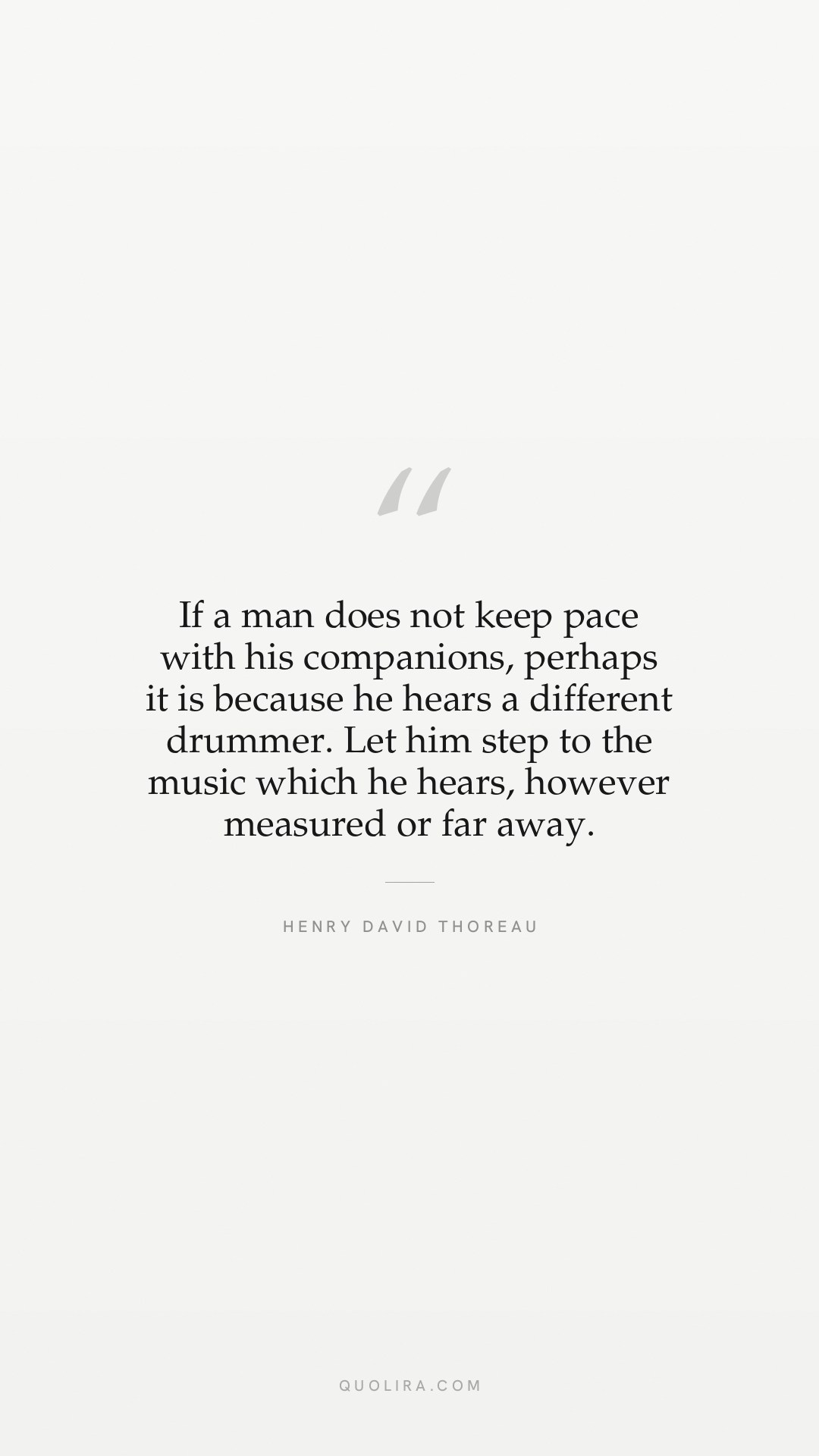
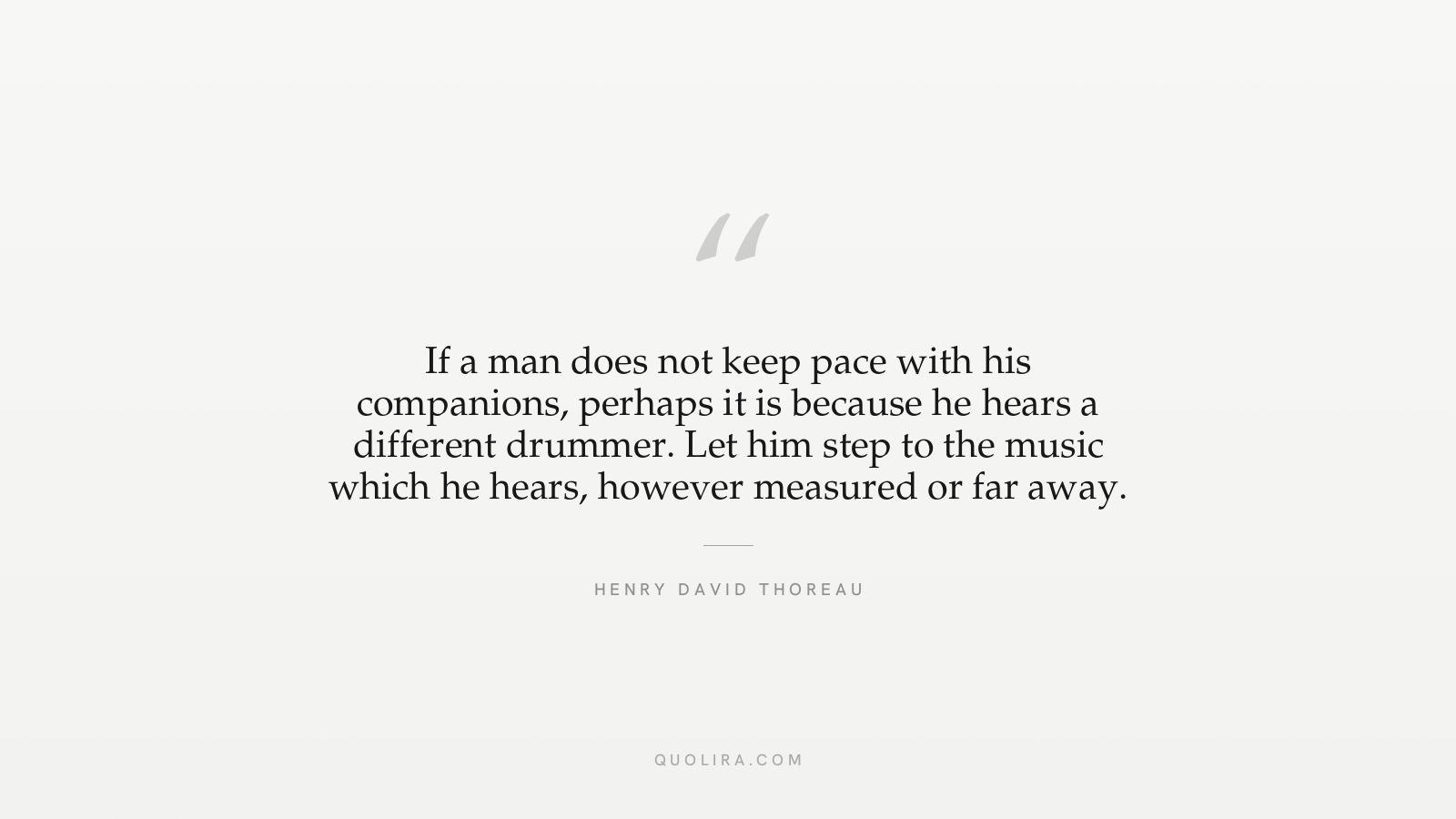
“If a man does not keep pace with his companions, perhaps it is because he hears a different drummer. Let him step to the music which he hears, however measured or far away.”
Henry David Thoreau · Walden, 1854
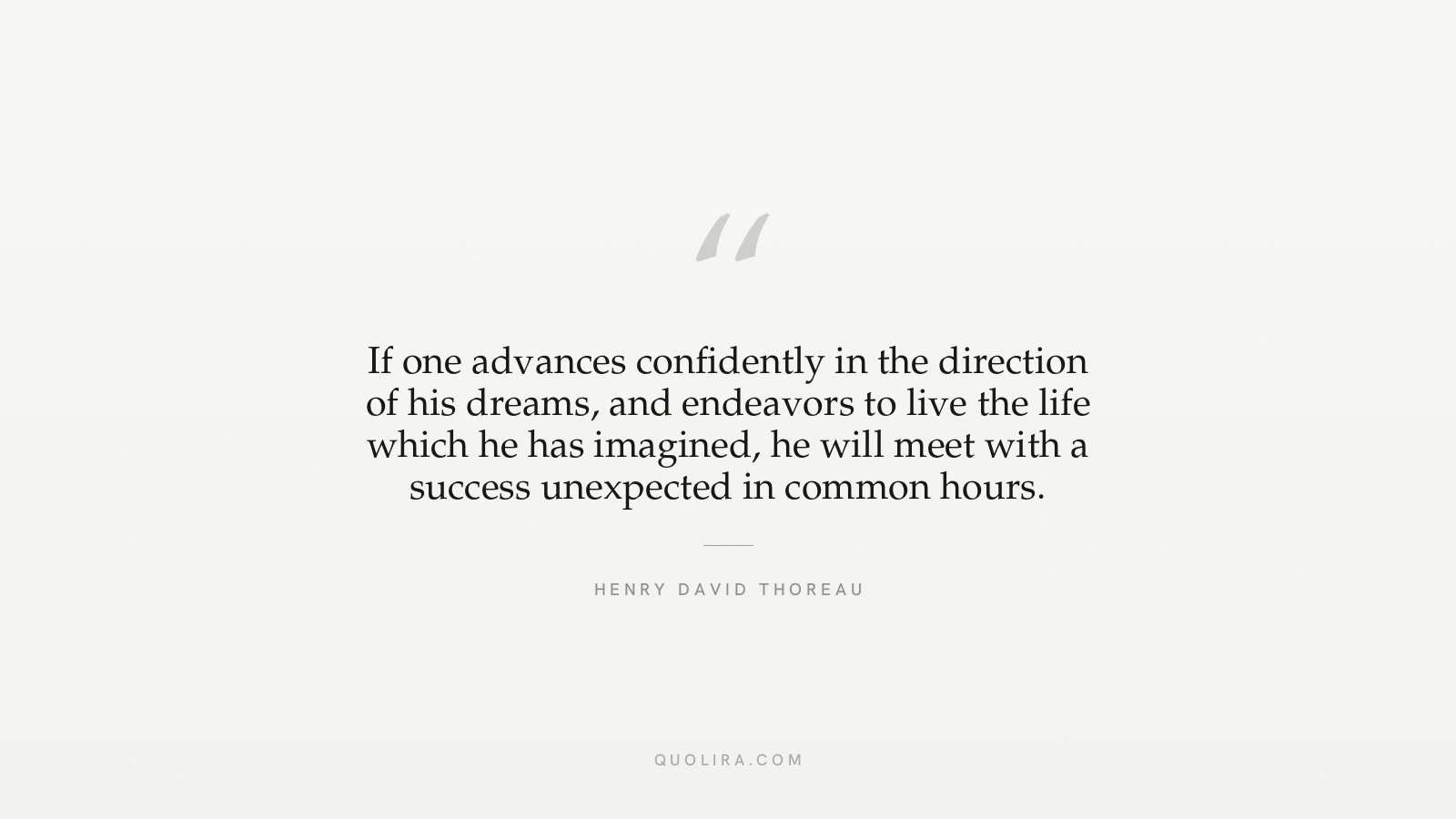
“If one advances confidently in the direction of his dreams, and endeavors to live the life which he has imagined, he will meet with a success unexpected in common hours.”
Henry David Thoreau · Walden, 1854