25 Bruce Lee Quotes on Discipline, Faith, and Self
Lines on water, faith, and training from his films, interviews, and notebooks, with the misattributed ones flagged so you know what to skip.

The most famous Bruce Lee quote is "Be water, my friend," a line from his short-lived role on the TV series Longstreet that he later recited in A Warrior's Journey (2000). These Bruce Lee quotes come from films, radio and TV interviews, and the notebooks he kept while developing Jeet Kune Do, his hybrid fighting philosophy. Lee framed his approach as a martial arts philosophy built on flexibility, not on a fixed set of moves. I picked 25 lines that stand on their own, and I flagged the ones that circulate under his name without a solid source. Most of them circle the same few ideas: know yourself, train with discipline, and keep moving instead of getting stuck. Read them as notes from someone still training, not a finished creed.
The Most Famous Bruce Lee Quotes
Be water, my friend.
Bruce Lee Lines from his role on the TV series Longstreet, recited in A Warrior's Journey (2000)

Boards don't hit back.
Bruce Lee Enter the Dragon (1973)
Lee's character says this after a rival breaks a board to intimidate him. Real opponents do hit back, so training against a stationary target only gets you so far.

Don't think, feel. It is like a finger pointing a way to the moon.
Bruce Lee Enter the Dragon (1973)
In the film, a temple student hears this during training. The technique is only a finger, and the goal is the moon. Stop staring at the finger long enough to see where it points.
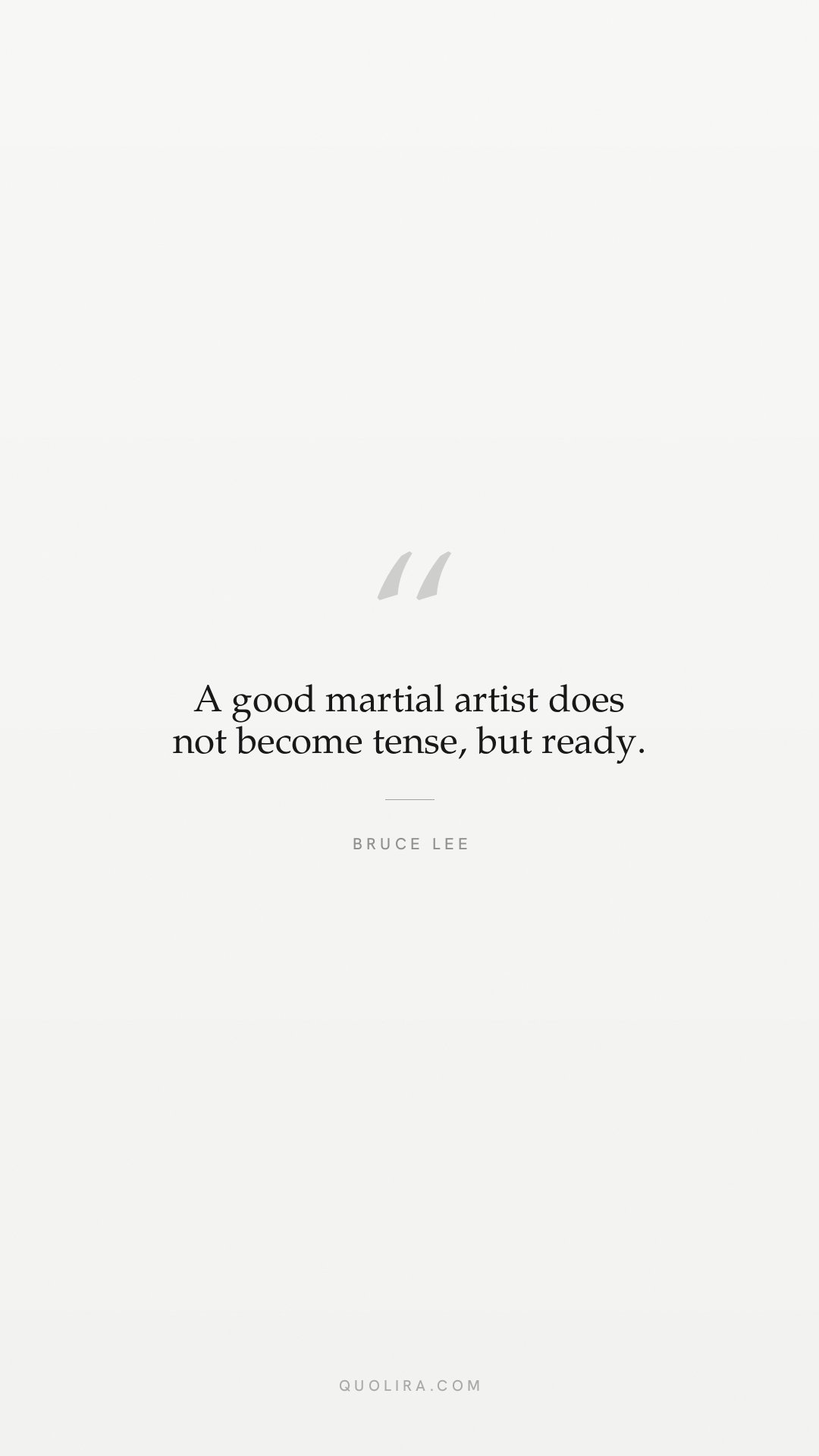
A good martial artist does not become tense, but ready.
Bruce Lee Enter the Dragon (1973)
Lee says this in a conversation with an older temple member. Tense and ready feel similar under pressure, but they lead to very different results. Aim for relaxed alertness before your next big moment.

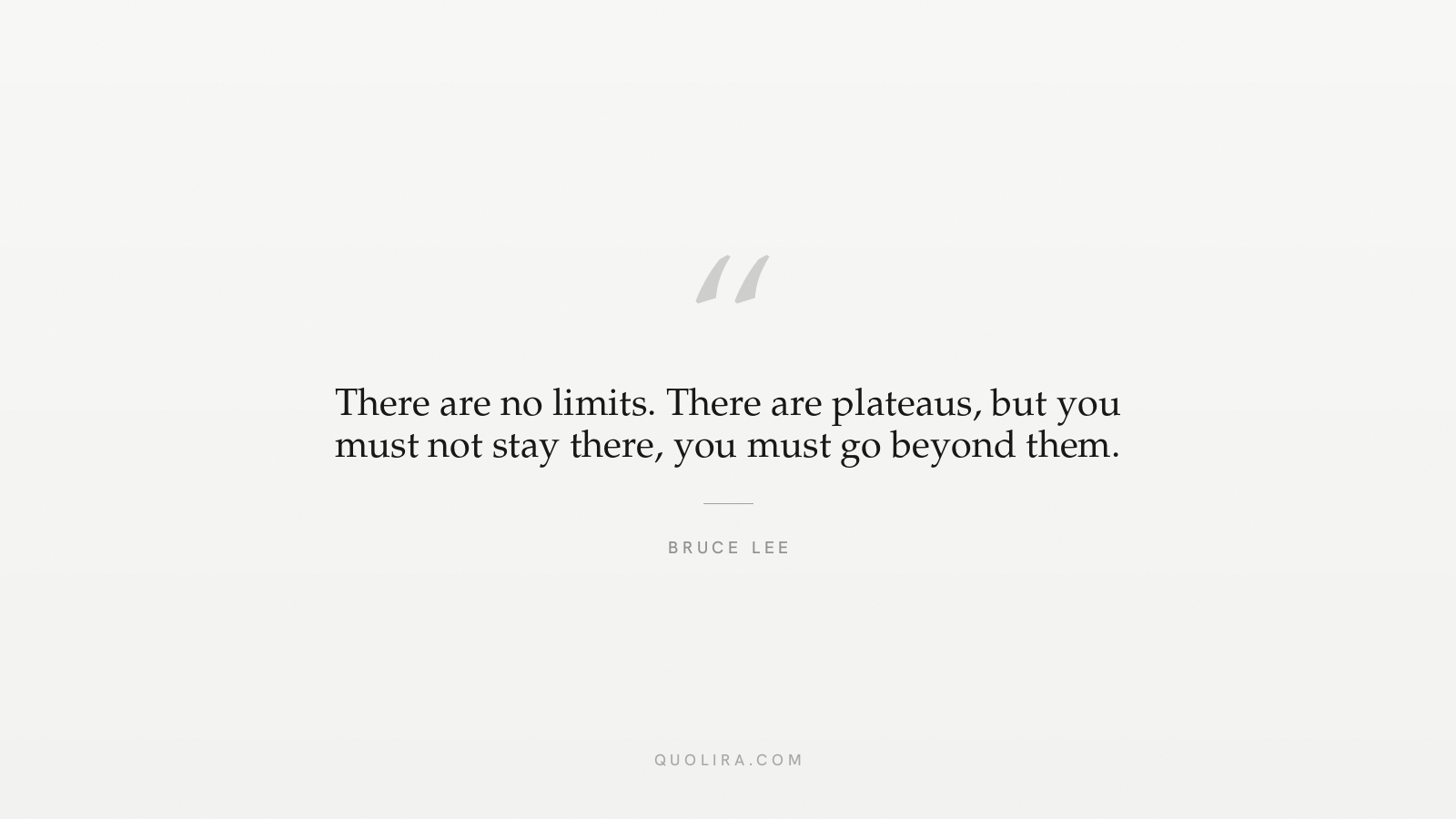
There are no limits. There are plateaus, but you must not stay there, you must go beyond them.
Bruce Lee The Art of Expressing the Human Body (1998), edited by John R. Little
Plateaus are where most people quit, and Lee treats them as a stop on the route rather than the destination. If your progress stalled this month, this is a good line to tape above your desk.
Bruce Lee Quotes on Self and Identity
When I look around, I always learn something: to be always yourself, and to express yourself, to have faith in yourself.
Bruce Lee Radio interview with Ted Thomas (1972)
Lee warned against copying a successful personality. Copying a style gets you a mirror, not a method, so start with your own habits and build from there.

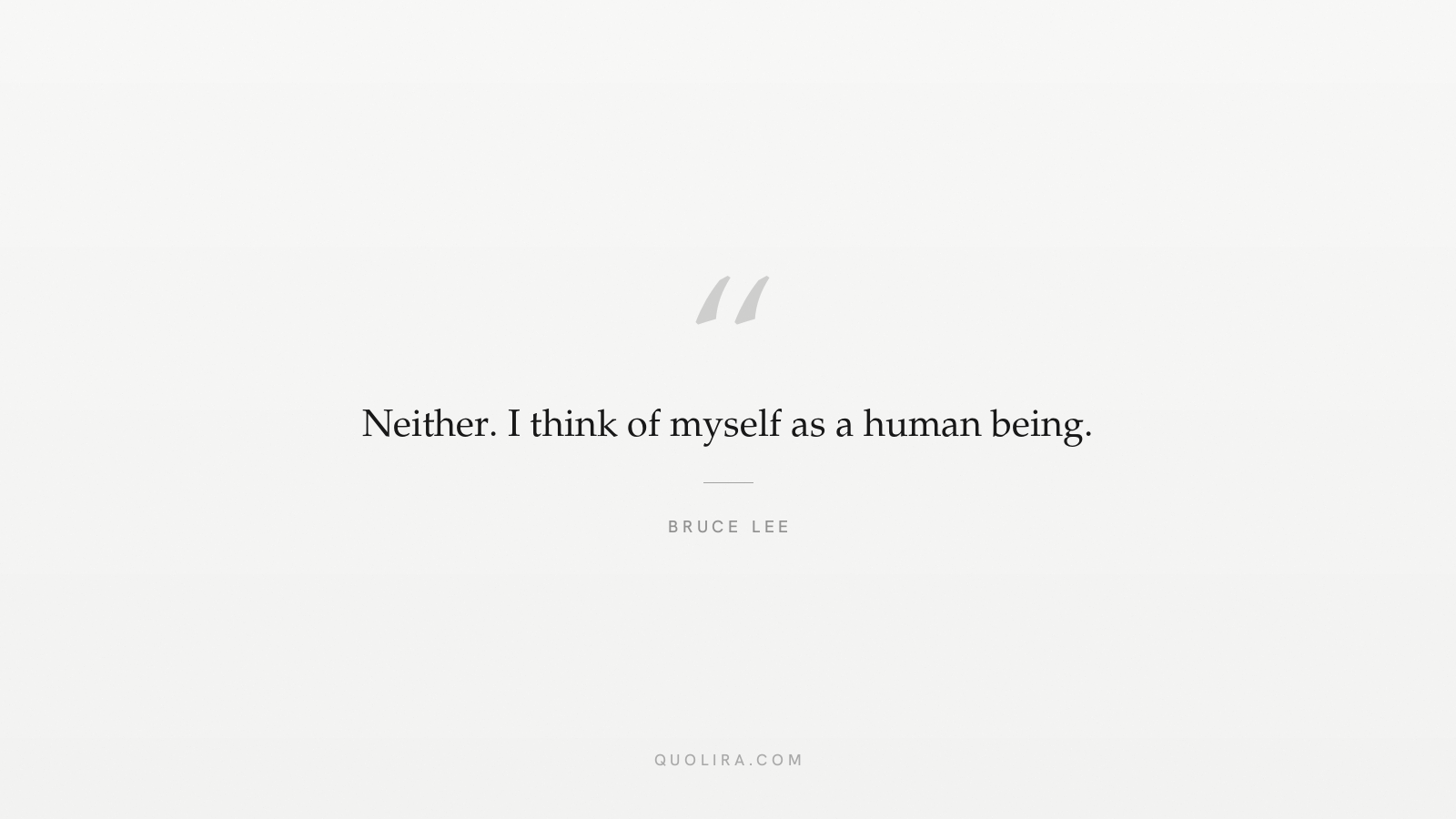
Neither. I think of myself as a human being.
Bruce Lee The Warrior Within (1996), answering whether he thought of himself as Chinese or American
Asked to pick a label, Lee refused the box. Give this answer to anyone who has been asked where they really belong, and notice how much lighter it sounds.
All types of knowledge, ultimately mean self knowledge.
Bruce Lee Bruce Lee: The Lost Interview (1971)
Lee's claim is that every subject loops back to you. Whatever you study, the useful part is what it teaches you about how you think.
Research your own experience; absorb what is useful, reject what is useless and add what is essentially your own.
Bruce Lee Striking Thoughts (2000), edited by John Little, p. 176
This is Lee's rule for borrowing from others. Take what works, drop what doesn't, and add something of your own. It is more work than copying, but it leaves you with a method you can actually use.

Use only that which works, and take it from any place you can find it.
Bruce Lee As quoted in Bruce Lee: Fighting Spirit (1994) by Bruce Thomas
The line sounds casual, but it is a strict filter. Keep the technique that holds up under real pressure, and ignore the ones that only look good in a demonstration.
Bruce Lee Quotes on Training and Discipline
When you're talking about fighting, as it is, with no rules, well then, baby you'd better train every part of your body!
Bruce Lee Bruce Lee: The Lost Interview (1971)
Real fights have no referee, so conditioning, footwork, and breathing all count. Lee's advice applies to any hard challenge: train the whole body, not just the part you like to show off.

Make at least one definite move daily toward your goal.
Bruce Lee Jeet Kune Do (1997), Part 6 "Beyond System"
The advice is small on purpose. One concrete move a day beats a plan you only review. Pick that move tonight, before you talk yourself out of it.
The worst opponent you can come across is one whose aim has become an obsession.
Bruce Lee The Warrior Within (1996), p. 161
Lee argues that obsession beats talent in a fight, and the same is true in business and art. Ask yourself what you would still do if nobody was watching.
An instructor should exemplify the things he seeks to teach.
Bruce Lee Jeet Kune Do (1997), Part 5 "On training in Jeet Kune Do"
Lee holds teachers to a standard of doing, not just talking. It is the same test you can apply to a manager, a coach, or a parent: do they do what they ask?

Don't fear failure. Not failure, but low aim, is the crime. In great attempts it is glorious even to fail.
Bruce Lee Striking Thoughts (2000), edited by John Little, p. 121
Lee says the real failure is aiming too low. A miss on something big teaches you more than a safe win on something small.

Bruce Lee Quotes on Faith and Mindset
Faith is a state of mind that can be conditioned through self-discipline. Faith will accomplish.
Bruce Lee Jeet Kune Do (1997), Part 6 "Beyond System"
Lee treats faith as a habit you train, not a feeling you wait for. If your confidence is shaky, practice the small disciplines that produce it, and the belief tends to follow.

Faith makes it possible to achieve that which man's mind can conceive and believe.
Bruce Lee Jeet Kune Do (1997), Part 6 "Beyond System"
Lee's version is practical: what you can picture clearly and believe in enough has a route to happen. The believing still has to be backed by daily work.
Thoughts are things.
Bruce Lee Jeet Kune Do (1997), Part 6 "Beyond System"
Three words, and Lee is making a claim about action. A thought you rehearse becomes a choice, and a choice becomes a movement. Watch which thoughts you repeat for a week.

Possession of anything begins in the mind.
Bruce Lee Jeet Kune Do (1997), Part 6 "Beyond System"
Lee's order is clear: you own the idea before you own the object. That applies to skills, relationships, and goals. Notice what you have already decided is yours.
What you habitually think largely determines what you will ultimately become.
Bruce Lee Striking Thoughts (2000), edited by John Little, p. 120
This is one of the most quoted ideas in his notes, and it echoes much older proverbs about thinking. The key word is habitually, because it points to repetition, not to one bright idea.

You have choice. You are master of your attitude.
Bruce Lee Striking Thoughts (2000), edited by John Little, p. 120
Lee says this right after telling you to choose the positive. Some days your attitude feels like weather. Lee's point is that you have more say over it than the weather does.
Knowledge will give you power, but character respect.
Bruce Lee Striking Thoughts (2000), edited by John Little, p. 46
Lee separates what you know from who people trust you to be. Skills can get you hired, but character keeps the people around you.
Bruce Lee Quotes on Living in the Moment
Life is never stagnation. It is constant movement.
Bruce Lee Striking Thoughts (2000), edited by John Little, p. 5
Lee sees stillness as an illusion. Even a rest day involves movement if you are paying attention. A plan that never changes is probably already out of date.

If you love life, don't waste time, for time is what life is made up of.
Bruce Lee Striking Thoughts (2000), edited by John Little, p. 10
Lee adapts an older English proverb, and it still hits. Time is the material life is built from, so wasting it is like throwing away the building supplies. Track one hour this week that you would like to take back.

Running water never grows stale. So you just have to 'keep on flowing.'
Bruce Lee The Warrior Within (1996), p. 48
Standing water goes bad, and Lee uses that image to argue for constant small adjustments. Keep moving, and you won't need a dramatic reinvention every few years.
Quotes often misattributed to Bruce Lee
- "Karate punch vs. kung-fu punch" (the iron bar and iron ball comparison): This vivid comparison circulates everywhere. It is tied to a 1965 U.S. screen test exchange as recounted in a 2015 Newsweek special edition, but I have not seen a primary recording, so treat the exact wording as unverified.
- "Minimizing and hacking away the unessential": People often cite this as part of Lee's thank-you letter to producer William Dozier after The Green Hornet was cancelled. The wording traces to a 2020 American Heritage Center blog post about the William Dozier Papers, so check the archive before you quote it.
- "The perfect way is only difficult for those who pick and choose": Lee's name gets attached to this constantly, and it shows up in The Tao of Jeet Kune Do and Striking Thoughts. It is actually from Xinxin Ming, a Zen text credited to the Third Chinese Chan Patriarch Sengcan.
About Bruce Lee
Bruce Lee was a Hong Kong and American martial artist, actor, filmmaker, and philosopher. He is known as the first global Chinese film star and as the founder of Jeet Kune Do.
- Born in 1940 and died in 1973.
- Founded Jeet Kune Do, a hybrid martial arts philosophy built from his unarmed fighting experience.
- Starred in five feature-length martial arts films as an adult.
- Key works cited here include Enter the Dragon (1973) and the Jeet Kune Do commentaries (1997).
- Credited with helping popularize martial arts films in the 1970s and promoting Hong Kong action cinema.
What these quotes have in common
Lee keeps returning to self-knowledge. "Neither. I think of myself as a human being" and "Do not go out and look for a successful personality and duplicate it" come at the same idea from two angles: stop borrowing an identity and build your own. "Use only that which works" applies the same rule to technique, so the test is whether something functions for you, not whether it belongs to a school. If you like the self-reliance angle, the Ralph Waldo Emerson quotes on self-reliance make a good companion to this first group.
The second thread is discipline and action. "Make at least one definite move daily toward your goal" and "Thoughts are things" connect the mind to the body. The mind picks the move, and the body has to make it. "An instructor should exemplify the things he seeks to teach" holds teachers to the same test, which is a useful standard for coaches and managers too. Readers who like strategy will find the same preference for preparation in the Sun Tzu quotes from The Art of War.
The third thread is movement. "Running water never grows stale" and "If you love life, don't waste time, for time is what life is made up of" both use flowing water and passing time as images. Lee's notes keep asking you to stay open to change. "Be water, my friend" is the shortest version of that request, and it works because the image is easy to hold onto on a bad day.
How to use these quotes
These lines work best when they are short enough to read at a glance and specific enough to act on. Pick one per week, then check whether your behavior changed by the end of it. Lee wrote most of them as reminders to himself, so they fit personal use better than a poster on a wall.
- Captions: Pair "Be water, my friend" with a photo of a river or a rain-soaked street.
- Speeches and toasts: Open with "Boards don't hit back" when you want a laugh and a point about real opposition.
- Desk cards: Print "Make at least one definite move daily toward your goal" on an index card and keep it where you work.
- Journaling: Write a week of entries that start with "What you habitually think..." and see which thoughts keep repeating.
- Teaching: Use "Don't think, feel" with beginners to explain why trained reflexes deserve some trust.
- Gifts: Pair "Research your own experience" with a notebook for someone starting a new skill.
Sources
Start with "Be water, my friend" and let the rest follow. Lee wanted people to find their own form, and these lines are a good place to begin looking.
Frequently asked questions
What is Bruce Lee's most famous quote?
Did Bruce Lee really say "The perfect way is only difficult for those who pick and choose"?
Did Bruce Lee say "Boards don't hit back"?
Where can I find authentic Bruce Lee quotes?
What is Jeet Kune Do?
Keep reading
The Mountain Is You: Why Your Biggest Obstacle Lives Inside Your Pattern
Brianna Wiest's argument that your own repeated pattern is the real obstacle, and how to stop blaming outside circumstances.

25 Atomic Habits Quotes That Show How Small Daily Actions Build Who You Are
James Clear's 2018 book argues that tiny, repeated actions shape identity more than big resolutions ever will.
























15 Quotes About Starting Over That Prove It's Never Too Late
These real quotes from writers, athletes, and philosophers make a clean restart feel possible on the hardest days.
Water takes the shape of whatever holds it, and it can also crash. Read that as a reminder to adapt to the situation in front of you, not to the rulebook you memorized.