21 Sun Tzu Quotes from The Art of War on Strategy, Terrain, and Spies
Sun Tzu wrote about winning before the first move, and most of these lines still work as advice for work, conflict, and planning.

Sun Tzu quotes come from one short, sharp book, and the lines below are the ones that still earn their place. I'm pulling them from The Art of War, which runs 13 chapters on planning, terrain, spies, and finance, and every line is copied word for word from Lionel Giles's 1910 translation. The book is traditionally attributed to Sun Tzu and dates from the late Spring and Autumn period, roughly the 5th century BC. For centuries it has shaped Chinese and Western thinking on military strategy, and it still shows up on reading lists today. You'll find plenty about rivers, ground, and secrecy, because that's where the text gets most specific. Some lines sound like battle orders and others sound like advice for a bad week at the office, and that overlap is why they keep getting quoted.
The Most Famous The Art of War Quotes
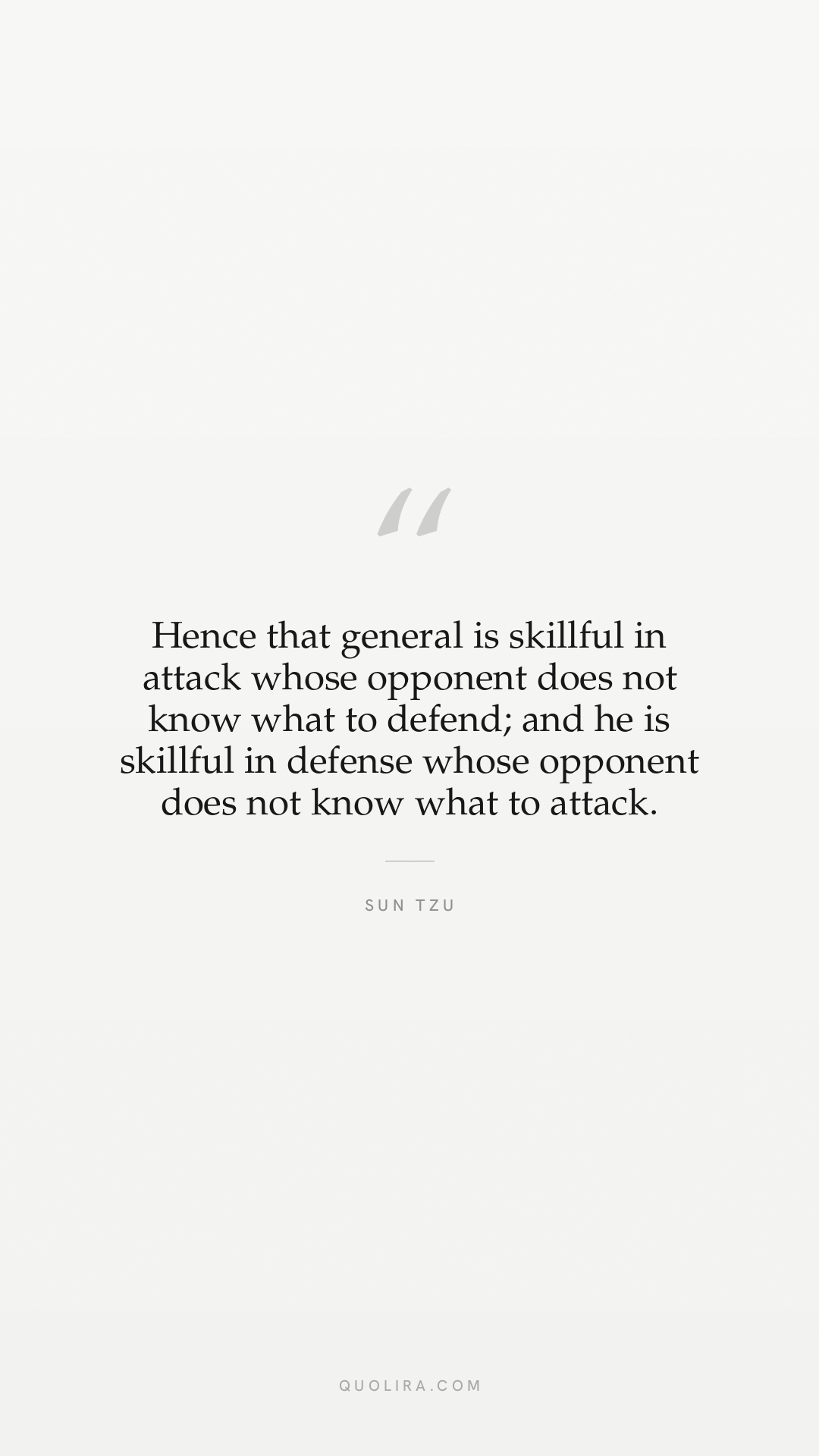
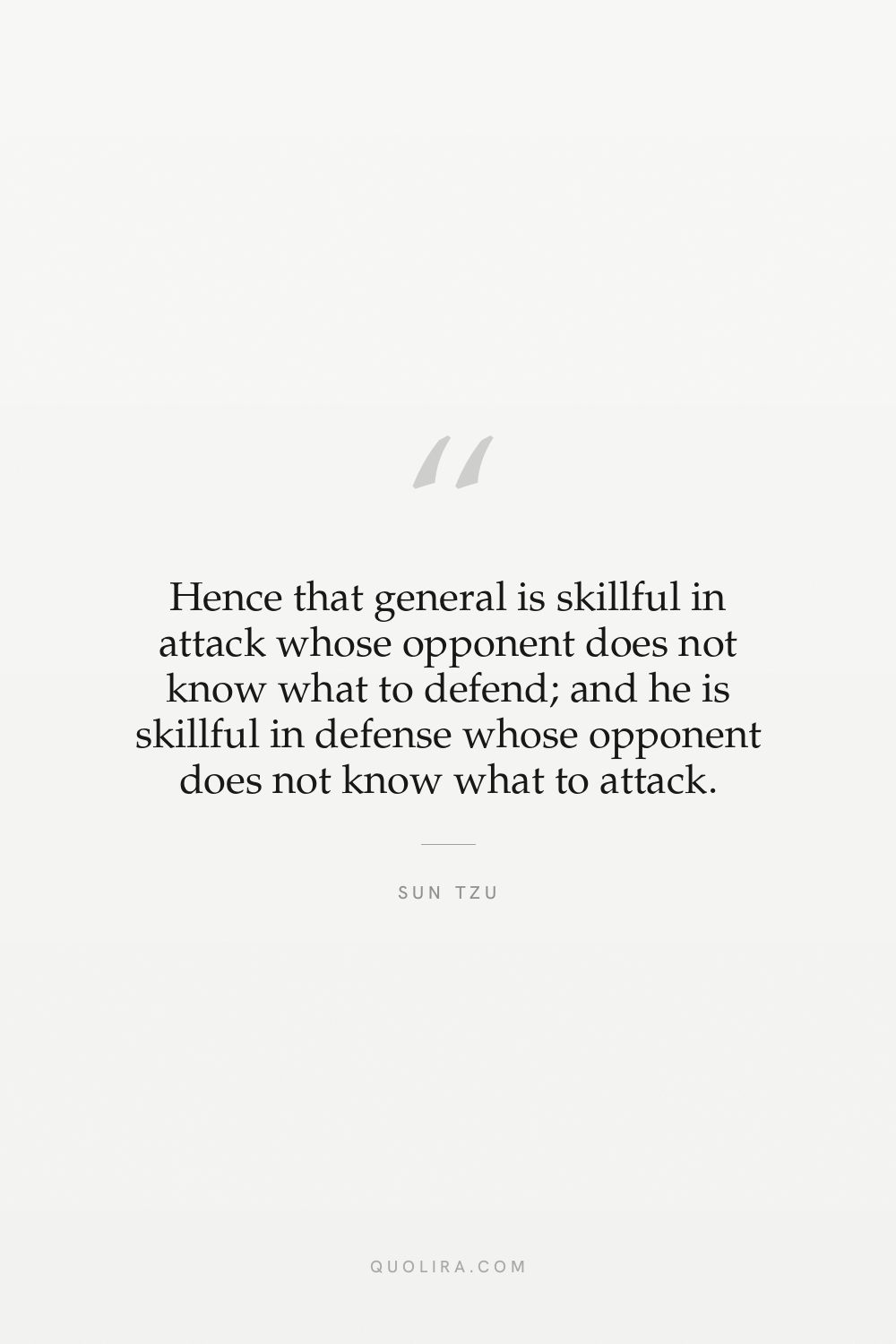
Hence that general is skillful in attack whose opponent does not know what to defend; and he is skillful in defense whose opponent does not know what to attack.

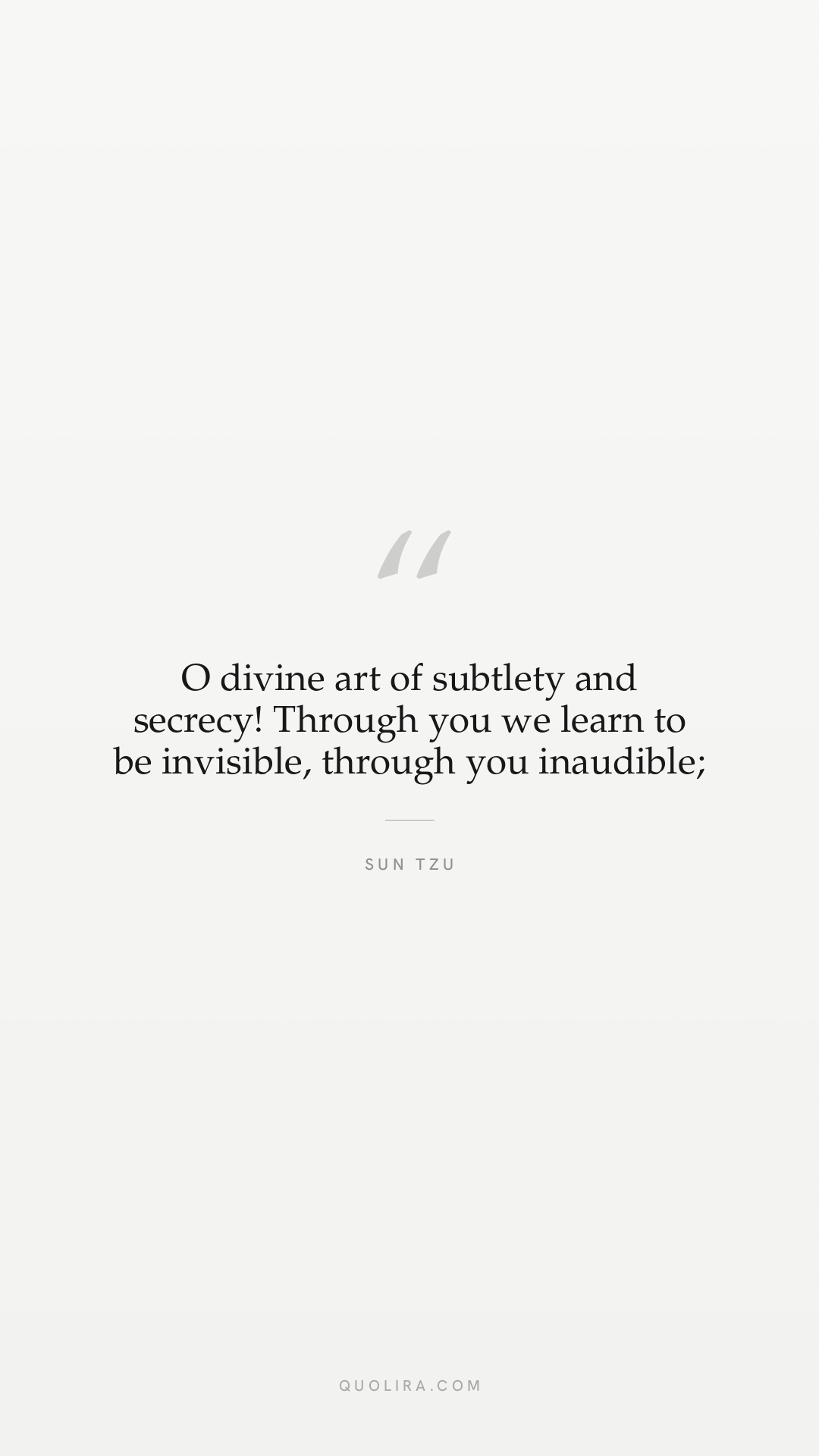
O divine art of subtlety and secrecy! Through you we learn to be invisible, through you inaudible;
Sun Tzu The Art of War, VI. Weak Points And Strong
Sun Tzu breaks into exclamation here, sounding almost thrilled by concealment. He treats secrecy as power, the ability to move without being seen or heard. For anyone who plans quietly, what you withhold can be your strongest move.
You may advance and be absolutely irresistible, if you make for the enemy's weak points; you may retire and be safe from pursuit if your movements are more rapid than those of the enemy.
Sun Tzu The Art of War, VI. Weak Points And Strong
Chapter VI explains how timing and aim make an army either unstoppable or safe. Hit the soft spot and keep moving faster than anyone chasing you. A small team that knows where to press can outlast a bigger one.
The Art of War Quotes on Attack and Defense
If we wish to fight, the enemy can be forced to an engagement even though he be sheltered behind a high rampart and a deep ditch.
Sun Tzu The Art of War, VI. Weak Points And Strong
A strong wall does not guarantee safety, Sun Tzu says, because you can threaten what the defender must protect. When someone digs in, look for the thing they cannot afford to leave unguarded.

The control of a large force is the same principle as the control of a few men: it is merely a question of dividing up their numbers.
Sun Tzu The Art of War, V. Energy
Chapter V opens with a plain answer to a hard problem: break the big thing into smaller parts. Large armies and large projects both fail when nobody owns a piece. Name a leader for each piece and the scale stops feeling impossible.
Maneuvering with an army is advantageous; with an undisciplined multitude, most dangerous.
Sun Tzu The Art of War, VII. Maneuvering
In Chapter VII, Sun Tzu sets a limit on clever movement: it pays with trained troops and goes badly with a mob. Before you add another moving part to a plan, ask whether the people carrying it can execute.

To see victory only when it is within the ken of the common herd is not the acme of excellence.
Sun Tzu The Art of War, IV. Tactical Dispositions
Sun Tzu argues in Chapter IV that winning in plain sight, where everyone already sees it coming, is ordinary. The real skill is foreseeing the result before the first move. Look for the outcome that's still invisible to everyone else.

Thus on the one hand we have ability to protect ourselves; on the other, a victory that is complete.
Sun Tzu The Art of War, IV. Tactical Dispositions
The closing lines of Chapter IV tie defense and attack together, with safety first and a clean win after. Sun Tzu sees protection as groundwork, not the goal. Shore up what you can lose before you chase what you want.

The Art of War Quotes on Terrain and Danger
Concentrate your energy and hoard your strength.
Sun Tzu The Art of War, XI. The Nine Situations
Here Sun Tzu turns to stamina, the unglamorous work of saving force for the moment it counts. Chapter XI treats restraint as a tactic. It's a useful reminder for anyone who burns out by spending everything on day one.

The further you penetrate into a country, the greater will be the solidarity of your troops, and thus the defenders will not prevail against you.
Sun Tzu The Art of War, XI. The Nine Situations
Chapter XI explains why an invader grows stronger as he moves deeper: the army draws together under pressure. Unity often grows when people have nowhere else to go. Isolation can bind a team, for better or worse.

Make forays in fertile country in order to supply your army with food.
Sun Tzu The Art of War, XI. The Nine Situations
In Chapter XI, Sun Tzu tells the invader to feed the army from the land it crosses rather than hauling everything along. That's practical advice for anyone running short on resources. Find what's already available around you before you order more.
On serious ground, I would try to ensure a continuous stream of supplies.
Sun Tzu The Art of War, XI. The Nine Situations
This is Sun Tzu's view of contested ground in Chapter XI, where supply decides the outcome. Long projects die the same way, so a steady trickle of resources beats one big push. Keep the flow going before you go all in.

On hemmed-in ground, I would block any way of retreat.
Sun Tzu The Art of War, XI. The Nine Situations
Chapter XI describes the trap where retreat is closed, and the advice sounds harsh. Sun Tzu wants the soldiers to commit because there is nowhere to run. Remove the easy exit when you need full effort, though you won't always get to choose.

On desperate ground, I would proclaim to my soldiers the hopelessness of saving their lives.
Sun Tzu The Art of War, XI. The Nine Situations
The commander tells his soldiers plainly that survival depends on fighting hard. Sun Tzu values candor here, even when the news is grim. Honest stakes sometimes focus people better than comfortable promises.
The Art of War Quotes on Rivers and Movement
When the enemy is close at hand and remains quiet, he is relying on the natural strength of his position.
Sun Tzu The Art of War, IX. The Army On The March
Chapter IX reads silence as a signal: an enemy who waits nearby trusts his ground. Stillness usually means something. When a rival goes quiet, check what they're leaning on before you assume weakness.
After crossing a river, you should get far away from it.
Sun Tzu The Art of War, IX. The Army On The March
Sun Tzu's rule in Chapter IX is blunt: once across a river, don't linger on the bank. Distance protects you from a counterattack at the worst moment. Getting clear of a risky moment fast is often the wisest choice.

When an invading force crosses a river in its onward march, do not advance to meet it in mid-stream.
Sun Tzu The Art of War, IX. The Army On The March
Chapter IX describes a classic move: wait until the invaders are halfway across, then strike. Sun Tzu prefers to hit an enemy while the enemy is divided. Partial progress is the moment to act.

While we keep away from such places, we should get the enemy to approach them; while we face them, we should let the enemy have them on his rear.
Sun Tzu The Art of War, IX. The Army On The March
This line from Chapter IX asks you to make the enemy stand where you want. Sun Tzu's logic is that you choose the ground and force your opponent onto its bad side. Good planning often means deciding where the fight happens.
If you are anxious to fight, you should not go to meet the invader near a river which he has to cross.
Sun Tzu The Art of War, IX. The Army On The March
Sun Tzu warns against meeting an invader at a river they must cross, because you'd be doing their hardest work for them. Don't rush to the place where your opponent is strongest. Wait for the moment that gives you the edge.
The Art of War Quotes on Spies and Secrecy
Spies cannot be usefully employed without a certain intuitive sagacity.
Sun Tzu The Art of War, XIII. The Use Of Spies
Chapter XIII treats spying as a skill that needs judgment, not just access. Sun Tzu knows an informant can lie, so information is only useful when you can separate truth from bluff. That's still true of news feeds and gossip.

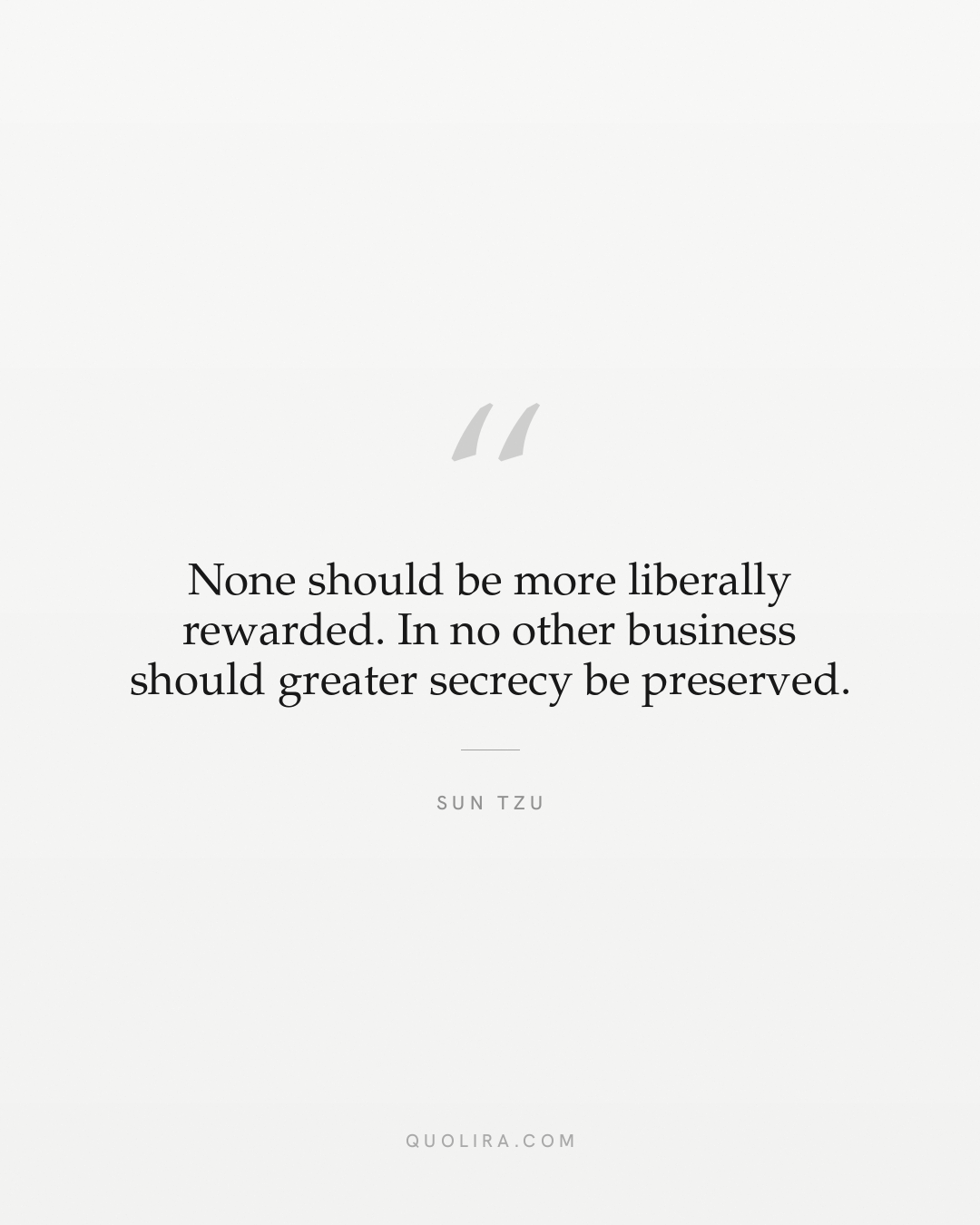
None should be more liberally rewarded. In no other business should greater secrecy be preserved.
Sun Tzu The Art of War, XIII. The Use Of Spies
The chapter on spies insists that the people who gather intelligence be rewarded well and kept quiet. Sun Tzu ties both to the value of the work. Anyone who handles sensitive information should treat secrecy as part of the job.
About The Art of War
The Art of War is a 5th-century BC Chinese military treatise attributed to the strategist Sun Tzu. Its 13 chapters cover planning, terrain, spies, and finance.
- 13 chapters, each covering a different set of skills tied to warfare and strategy
- Formalized as one of the Seven Military Classics by Emperor Shenzong of Song in 1080
- Served as the lead text of that anthology for almost 1,500 years
- Attributed to Sun Tzu and dating from the late Spring and Autumn period
- The quotes here come from Lionel Giles's 1910 translation
What these quotes have in common
The big idea running through these lines is that the fight is decided before the fight starts. Sun Tzu keeps pushing you to read the enemy's blind spots (see the first quote in the list, and the one about seeing victory early) and to hide your own, as in the lines about secrecy. Winning, in his telling, comes from preparation and information, which is why the book reads more like a planning guide than a war story.
Terrain and movement come next. The lines about rivers and high ground treat geography as a tool you can use or ignore at your peril. The ground types in Chapter XI show the same thinking: you pick where the fight happens, which is why the line about forcing the enemy onto bad ground matters more than it first appears.
Spies and secrecy tie it together. The two quotes from the spy chapter show that intelligence is a discipline with real rules, not a shortcut. The book keeps returning to the idea that information and discipline decide more than raw numbers, and Sun Tzu makes that plain in the line about dividing a large force.
How to use these quotes
These lines work best when they sit next to a real decision. Pick one per week and write down what it changes about your next move. Sun Tzu's ideas on timing pair well with the patience quotes collection, and the Confucius quotes page covers another ancient voice on self-discipline.
- Slide captions for a strategy or planning deck, one line per slide
- Opening lines for a team meeting before a big launch
- Index cards on a desk for a hard week
- Journaling prompts such as where am I giving away my plan?
- Teaching material for a class on decision-making
Common misunderstandings
People often read Sun Tzu as a case for deception at any cost. The text does praise concealment, but it also stresses knowing your own side, the terrain, and the people you lead. Secrecy works best when it sits on top of good information.
Another mistake is treating every line as a command. Many passages describe conditions rather than orders. The line about hemmed-in ground, for example, describes a specific situation a commander faces. Reading it as general permission to corner people misses the context entirely.
Some readers also assume the book is only about war. The lines on supply, division of labor, and timing apply to projects, teams, and households just as well. The translation matters too. Giles's wording is formal and older in tone, so a modern paraphrase can change the feel of a line. Check the chapter before you share one.
Reading a chapter in context
Pick one chapter and read it straight through. Chapter VI, Weak Points And Strong, holds the attack and defense lines from the opening of this list, along with the line about secrecy. Read them together and the pattern shows up: Sun Tzu keeps asking where the other side is exposed and where you are exposed.
Chapter IX moves from water to ground to watching the enemy. Chapter XI moves from ground types to supply to the mindset of an army. Chapter XIII brings the book back to information. A short reading order: start with Chapter IV for the idea of visible and invisible victory, then Chapter VI for weak points, then Chapter XIII for spies. That sequence gives you the book's logic without needing every page.
A practical example
Say a small team is preparing a product launch. Sun Tzu's ideas map onto the plan. Find the competitor's weak point, such as a slow support team or a crowded pricing tier, and aim there. Break the launch into named owners for each piece, since the line about dividing numbers suggests that scale becomes manageable when each part has a leader. Keep a steady supply of attention and budget flowing rather than spending everything in the first week. Check that the people carrying the plan can actually execute before you add another moving part.
The same logic works well outside a battlefield, because the plan is terrain you have to understand before you cross it.
Sources
- The Art of War by Sun Tzu, translated by Lionel Giles (1910)
- Wikipedia: The Art of War
Pick one line from this list and test it against your next hard decision. If it changes your move, you've found your answer, and the full book is still waiting on your shelf.
Frequently asked questions
What is The Art of War's most famous quote?
Did Sun Tzu really say 'Keep your friends close and your enemies closer'?
Which translation do these Art of War quotes come from?
How many chapters does The Art of War have?
Is Sun Tzu a real historical person?
Keep reading

25 Atomic Habits Quotes That Show How Small Daily Actions Build Who You Are
James Clear's 2018 book argues that tiny, repeated actions shape identity more than big resolutions ever will.

25 Ralph Waldo Emerson Quotes on Self-Reliance, Nature, and Living Boldly
Emerson's sharpest lines on independence, nature, and the nerve to live on your own terms.





















25 Famous Kindness Quotes That Prove Small Acts Matter
Real lines from Shakespeare, the Dalai Lama, and Kurt Vonnegut explain why a small kind act never really disappears.
Sun Tzu treats the enemy's blind spots as the real target, and this is the cleanest version of his whole argument. The lesson carries well beyond battle: learn what your rival guards, then move somewhere else.