“The funniest things are the forbidden.”
Mark Twain · Notebook 18 (February to September 1879), Mark Twain's Notebooks & Journals, Vol. 2 (1975)
 quolira
.com
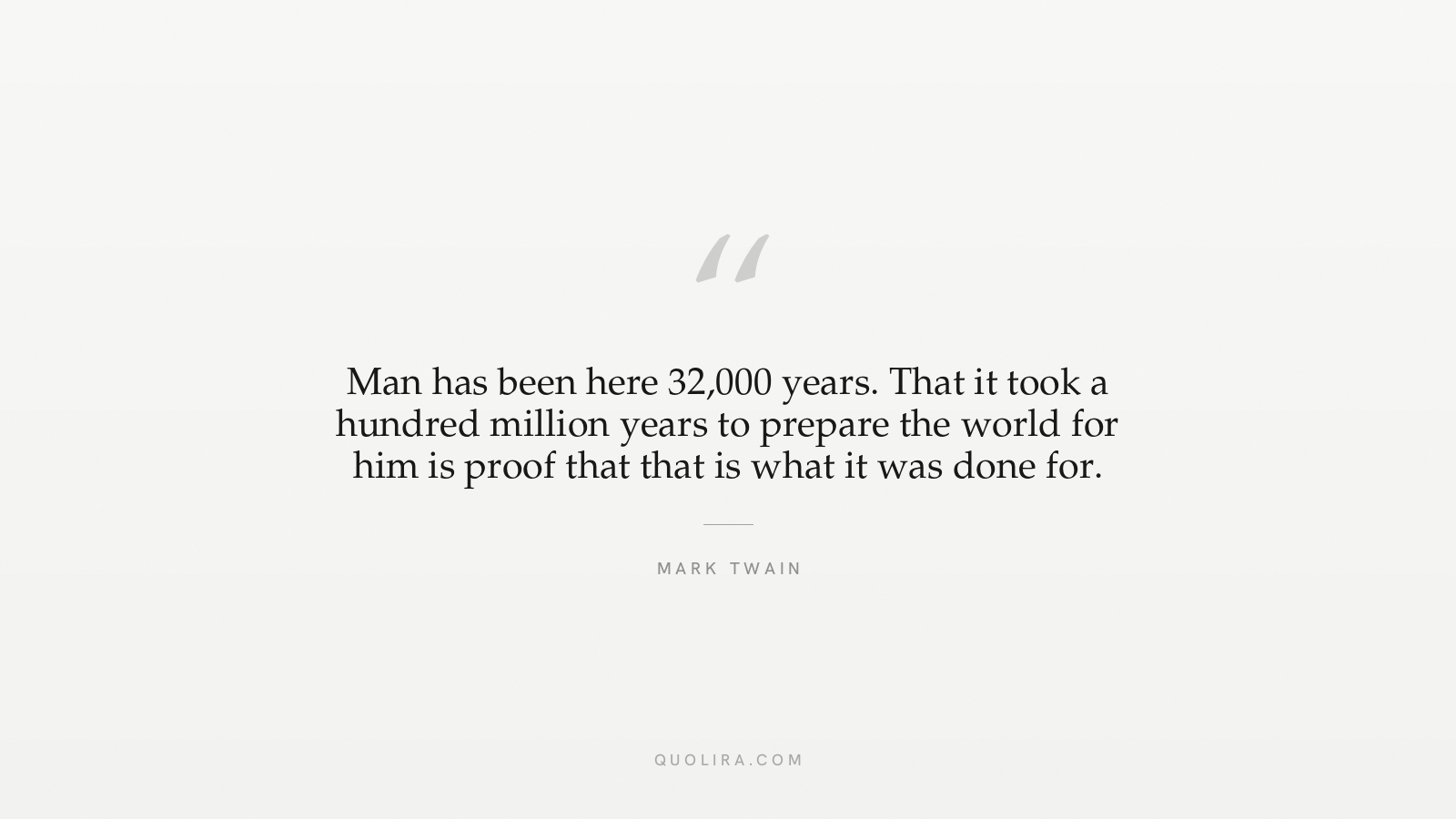
Mark Twain said it, in Was the World Made for Man? (1903).
Twain's Eiffel Tower comparison makes the argument with a joke, and it is still a sharp way to puncture human self-importance. Our share of the world's history is thinner than we like to think. That is an argument for humility.
From the collection: 25 Mark Twain Quotes That Still Land Sharp and Funny · More Mark Twain quotes
The quote means that Twain mocks the idea that the universe was shaped for humanity, pointing out that a long natural history followed by a short human presence does not prove purpose. His sentences turn the logic of design arguments against themselves. The effect is to suggest that assuming human importance as the cause of everything is an unsupported and self-flattering conclusion.
The passage comes from an essay titled Was the World Made for Man?, which is dated 1903 in the source listed for this quote. The piece was written in the early twentieth century and reflects Twain's skepticism toward religious and anthropocentric explanations of creation. Because the essay circulated in a limited way during his lifetime, readers should be cautious about claims regarding its reception. The quote stands out for its compact reasoning, which compresses an argument about timing and purpose into a single pointed sentence.
Mark Twain was the pen name of Samuel Langhorne Clemens, an American writer and humorist known for fiction, travel books, and essays. Throughout his later career he wrote openly about faith, science, and human vanity, often with a sardonic edge. His critics and admirers have long debated how far his irony went, but his skepticism toward grand claims is consistent across his work. This passage shows that skepticism at its most direct, using arithmetic of time to puncture a flattering idea.
“The funniest things are the forbidden.”
Mark Twain · Notebook 18 (February to September 1879), Mark Twain's Notebooks & Journals, Vol. 2 (1975)
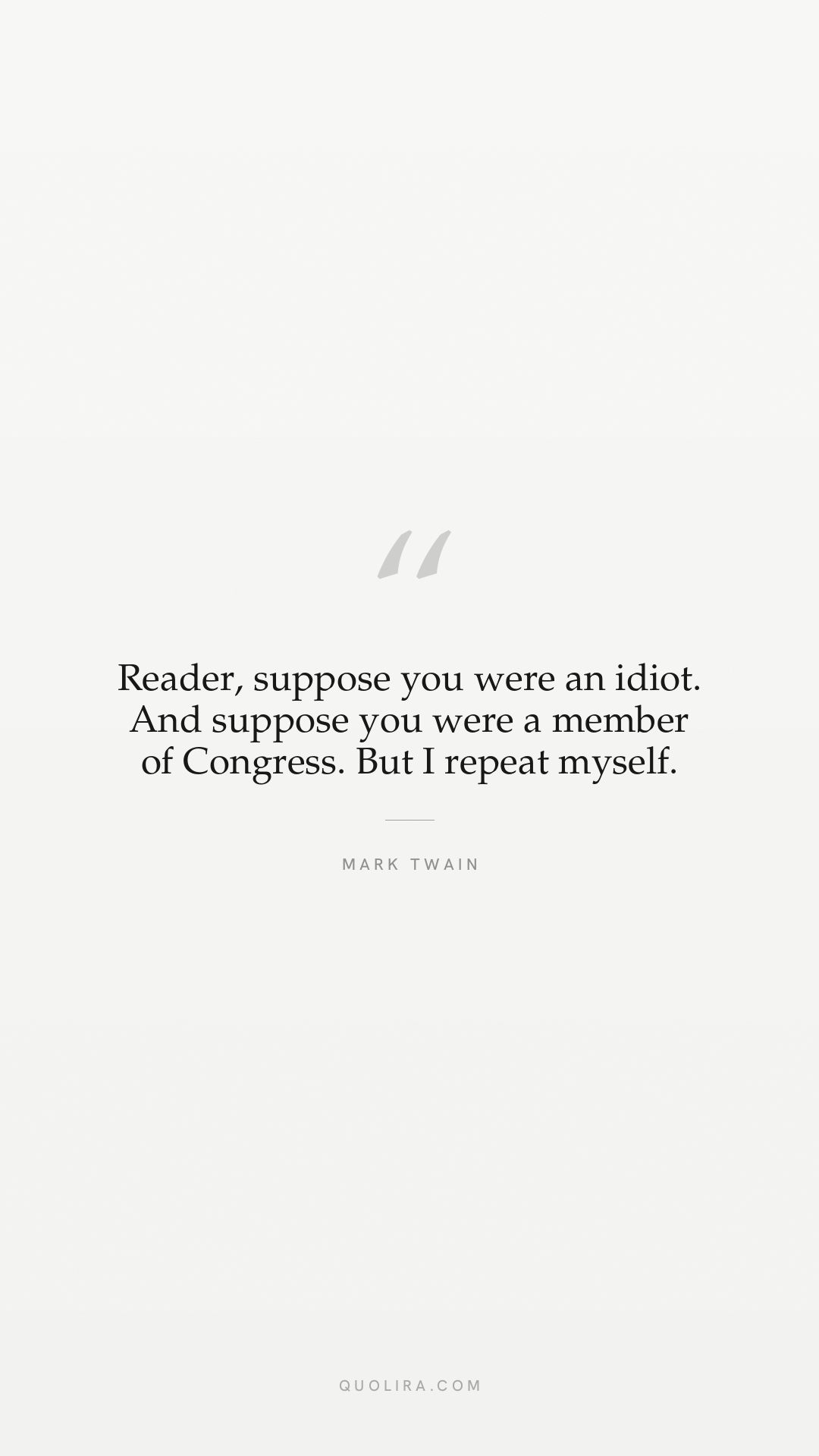
“Reader, suppose you were an idiot. And suppose you were a member of Congress. But I repeat myself.”
Mark Twain · Draft manuscript, c. 1881, quoted by Albert Bigelow Paine in Mark Twain: A Biography (1912)
“Be respectful to your superiors, if you have any.”
Mark Twain · 'Advice to Youth,' speech to The Saturday Morning Club, Boston (15 April 1882)
“Thunder is good, thunder is impressive; but it is lightning that does the work.”
Mark Twain · Letter to an Unidentified Person (1908)
“Clothes make the man. Naked people have little or no influence on society.”
Mark Twain · More Maxims of Mark (1927), edited by Merle Johnson
“Always acknowledge a fault frankly. This will throw those in authority off their guard and give you opportunity to commit more.”
Mark Twain · More Maxims of Mark (1927), edited by Merle Johnson
“Always do right. This will gratify some people, and astonish the rest.”
Mark Twain · Address to the Young People's Society, Greenpoint Presbyterian Church, Brooklyn (16 February 1901)
“Virtue never has been as respectable as money.”
Mark Twain · The Innocents Abroad (1869), ch. 54
“Wheresoever she was, THERE was Eden.”
Mark Twain · Eve's Diary
“Principles have no real force except when one is well-fed.”
Mark Twain · Extracts From Adam's Diary (1906)
“It is not worth while to try to keep history from repeating itself, for man's character will always make the preventing of the repetitions impossible.”
Mark Twain · Mark Twain in Eruption: Hitherto Unpublished Pages About Men and Events (1940)
“It is curious that physical courage should be so common in the world, and moral courage so rare.”
Mark Twain · Mark Twain in Eruption: Hitherto Unpublished Pages About Men and Events (1940)