“Our patience will achieve more than our force.”
Edmund Burke · Reflections on the Revolution in France (1790)
 quolira
.com
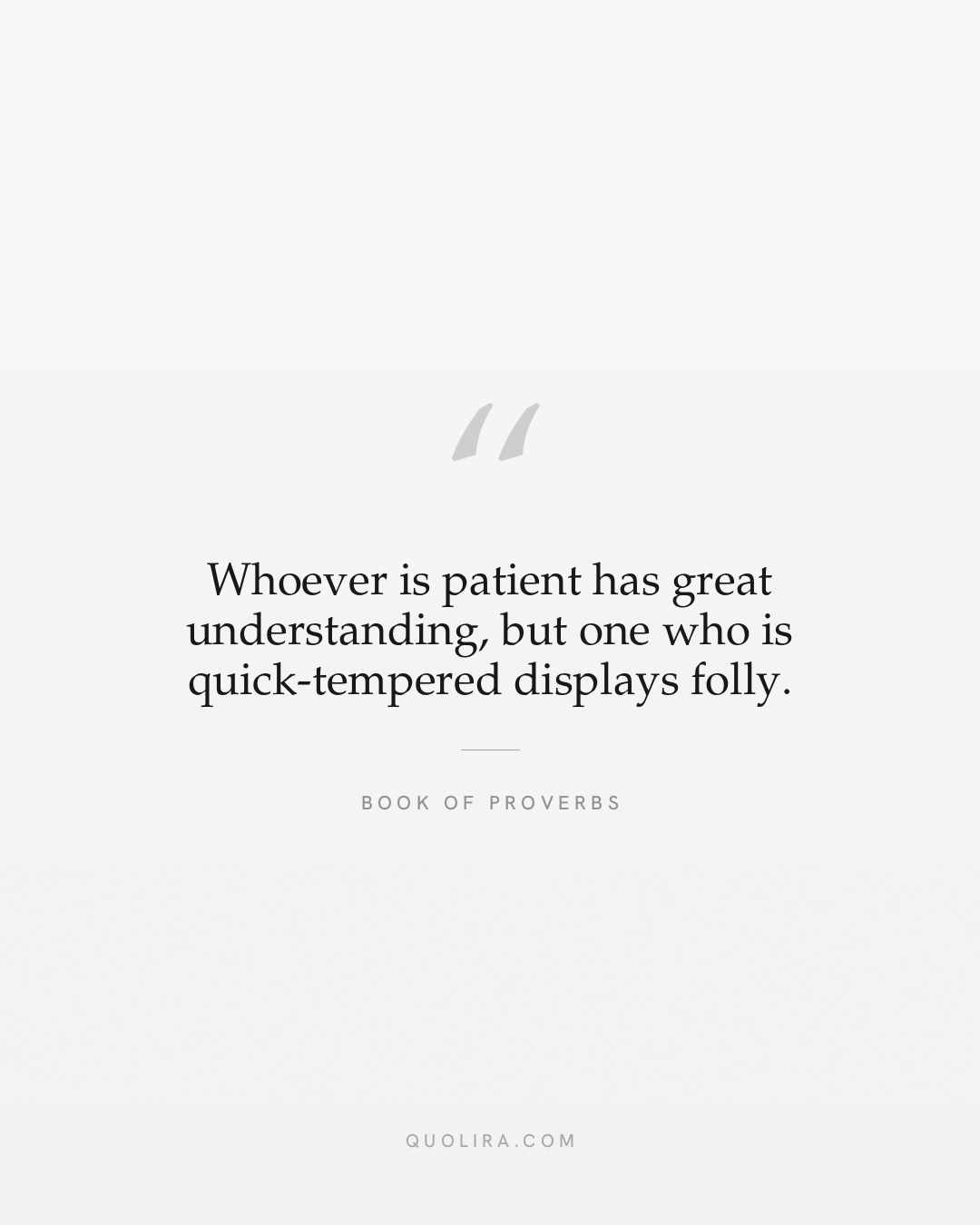
Book of Proverbs said it, in Proverbs 14:29 (New International Version).
This verse pairs patience with understanding and sets it against a hot temper. The contrast is blunt: the patient person shows understanding, and the quick-tempered one shows folly. Next time you want to fire off a reply, wait and let the proverb do its work.
From the collection: 25 Quotes on Patience That Teach You to Wait · More Book of Proverbs quotes
This verse means that a person who controls anger shows understanding, while a person who reacts hastily reveals poor judgment. The contrast is the point: self-control is presented as a mark of wisdom, and a quick temper as a sign of folly. Patience is therefore linked to good sense rather than to weakness.
This verse is from the Book of Proverbs, a collection of wisdom sayings traditionally associated with King Solomon, though the book was compiled over a long period and reached its final form later. Proverbs is written largely in parallel couplets, so the verse sets patience against quick temper in a deliberate contrast. Its audience is practical: the sayings aim at how to live well in families, work, and community. The New International Version is a modern English translation of the Hebrew text.
Proverbs has no single named author in the way a modern book does. It belongs to the wisdom literature of the Hebrew Bible, and Jewish and Christian readers have treated it as scripture. Its sayings are attributed within the text to various figures, with Solomon named most prominently, but scholars generally view the collection as the product of many hands and traditions. The site lists the book as the source, which reflects this communal and traditional authorship.
“Our patience will achieve more than our force.”
Edmund Burke · Reflections on the Revolution in France (1790)
“Patience is a necessary ingredient of genius.”
Benjamin Disraeli · Contarini Fleming (1832), Part IV
“Patience and diligence, like faith, remove mountains.”
William Penn · Some Fruits of Solitude
“Patience is the art of hoping.”
Marquis de Vauvenargues · Reflections and Maxims (1746)
“Patience is a narcotic for the weak.”
Edgar Pangborn · A Mirror for Observers (1954)
“Or arm th' obdured breast with stubborn patience as with triple steel.”
John Milton · Paradise Lost (1667), Book II
“Sufferance is the badge of all our tribe.”
William Shakespeare · The Merchant of Venice (late 1590s), Act I, scene 3
“How poor are they that have not patience! What wound did ever heal but by degrees?”
William Shakespeare · Othello (c. 1603), Act II, scene 3
“Superanda omnis fortuna ferendo est.”
Virgil · Aeneid, Book V (29-19 BC)
“Patience makes lighter what sorrow may not heal.”
Horace · Odes, Book I, poem 24
“The conclusion is, not that hardships are desirable, but that virtue is desirable, which enables us patiently to endure hardships.”
Seneca the Younger · Moral Letters to Lucilius, Letter 67 (translated by Richard Mott Gummere)
“She sat like patience on a monument, smiling at grief.”
William Shakespeare · Twelfth Night (c. 1601-02), Act II, scene 4