“The most beautiful thing we can experience is the mysterious. It is the source of all true art and science.”
Albert Einstein · What I Believe, 1930
 quolira
.com
quolira
quolira.com
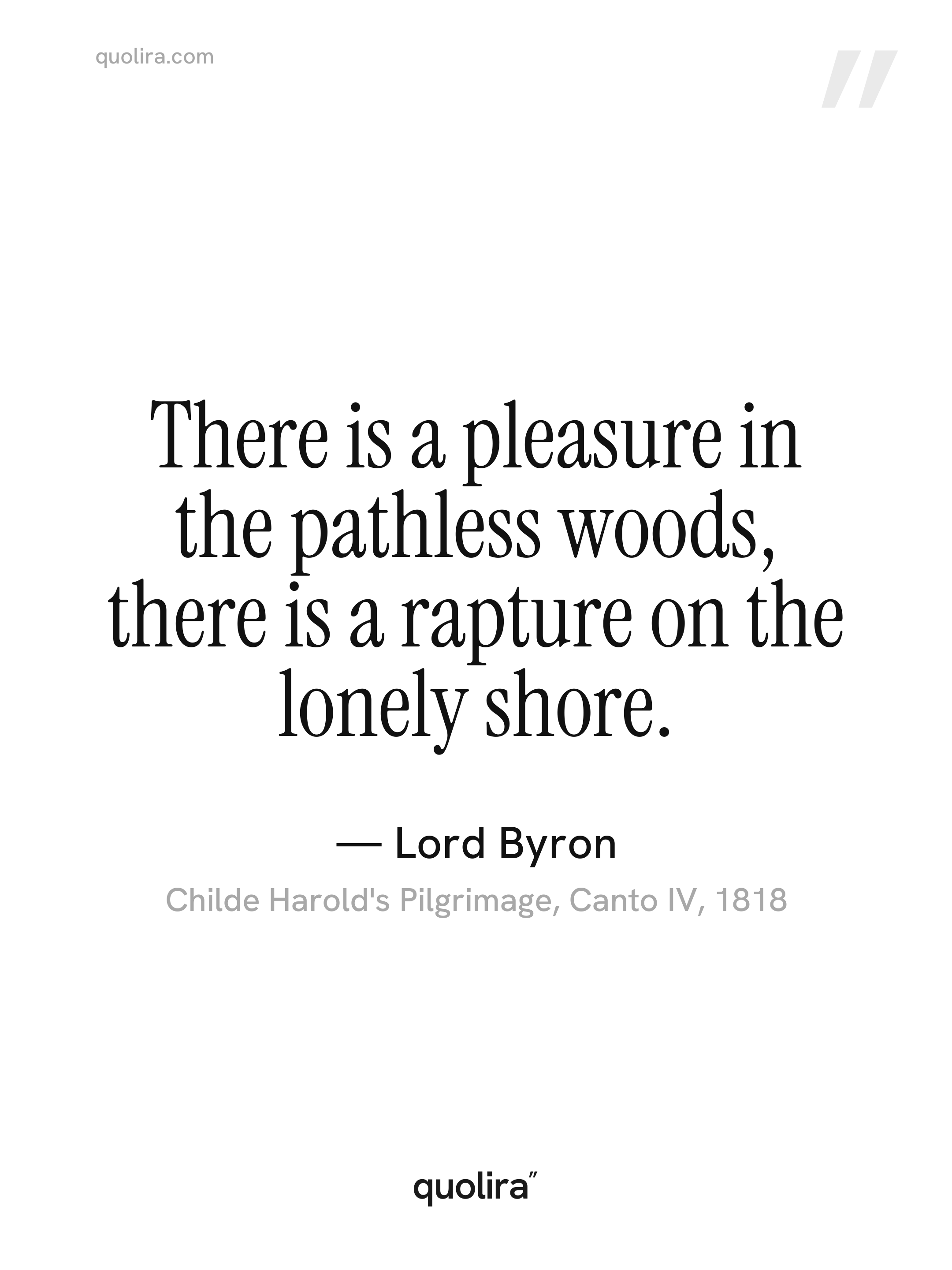
Byron is celebrating the emotional intensity that comes from encounters with untamed nature and solitude. The words "pleasure" and "rapture" signal something beyond mild enjoyment: these are deep, almost overwhelming feelings that only certain kinds of places and moments can produce. He is pointing to an experience that many people recognize but rarely name clearly, the way that wilderness and aloneness can feel not desolate but profoundly alive.
These lines appear in the fourth and final canto of Childe Harold's Pilgrimage, published in 1818. The poem traces a wandering, melancholy protagonist through European landscapes, and by the fourth canto Byron's own voice and that of his fictional hero had become nearly indistinguishable. The passage reflects the broader Romantic fascination with nature as a source of sublime feeling, something that stands apart from and in contrast to the crowded, rule-bound world of society.
Lord Byron was an English poet who lived from 1788 to 1824 and was one of the most prominent figures of the Romantic movement. He was celebrated across Europe during his lifetime for works including Don Juan and Childe Harold's Pilgrimage, and his personal life attracted as much attention as his writing. He spent much of his later life abroad, eventually traveling to Greece to support its struggle for independence, where he died of fever at the age of thirty-six. His influence on later poetry and on the cultural idea of the brooding, passionate artist was immense.
“The most beautiful thing we can experience is the mysterious. It is the source of all true art and science.”
Albert Einstein · What I Believe, 1930
“Take rest; a field that has rested gives a bountiful crop.”
Ovid · Ars Amatoria, Book II
“Finish each day and be done with it. You have done what you could. Some blunders and absurdities no doubt crept in; forget them as soon as you can.”
Ralph Waldo Emerson · Letter to his daughter, 1865
“One must maintain a little bit of summer, even in the middle of winter.”
Henry David Thoreau · Journal
“Sunday clears away the rust of the whole week.”
Joseph Addison · The Spectator, 1711
“Rest is not idleness, and to lie sometimes on the grass under trees on a summer's day, listening to the murmur of the water, or watching the clouds float across the sky, is by no means a waste of time.”
John Lubbock · The Use of Life, 1894
“An early-morning walk is a blessing for the whole day.”
Henry David Thoreau · Journal, 1856
“Many will call me an adventurer, and that I am, only one of a different sort: one of those who risks his skin to prove his platitudes.”
Che Guevara · Letter to his parents, 1965
“Do not shoot! I am Che Guevara and worth more to you alive than dead.”
Che Guevara · October 8, 1967, upon capture in Bolivia
“A revolutionary must become a cold killing machine motivated by pure hate.”
Che Guevara · Letter to his parents, 1965
“Silence is argument carried out by other means.”
Che Guevara
“Remember that the revolution is what is important, and each one of us, alone, is worth nothing.”
Che Guevara · Letter to his children, 1965