“Out of the bosom of the Air, Out of the cloud-folds of her garments shaken, Over the woodlands brown and bare, Over the harvest-fields forsaken, Silent, and soft, and slow Descends the snow.”
Henry Wadsworth Longfellow · The Snow-Flakes (1863)
 quolira
.com
John Greenleaf Whittier said it, in Snow-Bound (1866).
Whittier describes a family sealed inside a farmhouse while the storm rages outside. The image of people gathered close to one fire is probably the coziest idea in this whole list.
From the collection: 16 Cozy Winter Quotes for the First Cold Weeks of December · More John Greenleaf Whittier quotes
This line describes a family gathered indoors around the hearth, sheltered from a heavy winter storm that has cut them off from the outside world. The sentence means that shared warmth and closeness become most visible when the world beyond the walls is cold and unavailable. It presents the home as a place of safety and togetherness.
The line opens Snow-Bound, published in 1866, a long narrative poem that recalls a New England farmhouse evening during a winter storm. The poet looks back on his boyhood and portrays the household, its routines, and the glow of the fire with affectionate detail. The poem is often read as a winter idyll and as a memorial to family life in a rural past. Its scenes move slowly, letting the snowbound interior feel both intimate and timeless.
John Greenleaf Whittier was an American poet and abolitionist who grew up in Haverhill, Massachusetts, on a farm. He was raised in the Religious Society of Friends, and his faith shaped his commitment to social reform, including the abolition of slavery. Much of his poetry addresses moral questions, rural memory, and the everyday lives of ordinary people. Snow-Bound is among his best-known works and remains a respected example of nineteenth-century American domestic and seasonal verse.
“Out of the bosom of the Air, Out of the cloud-folds of her garments shaken, Over the woodlands brown and bare, Over the harvest-fields forsaken, Silent, and soft, and slow Descends the snow.”
Henry Wadsworth Longfellow · The Snow-Flakes (1863)
“I will honour Christmas in my heart, and try to keep it all the year.”
Charles Dickens · A Christmas Carol (1843)
“If Winter comes, can Spring be far behind?”
Percy Bysshe Shelley · Ode to the West Wind (1820)
“The woods are lovely, dark and deep, But I have promises to keep, And miles to go before I sleep.”
Robert Frost · Stopping by Woods on a Snowy Evening (1923)
“In the midst of winter, I found there was, within me, an invincible summer.”
Albert Camus · Return to Tipasa, in Summer (1954)
“I also am other than what I imagine myself to be. To know this is forgiveness.”
Simone Weil · Void and Compensation, in Gravity and Grace (1947)
“Let opinion be taken away, and no man will think himself wronged.”
Marcus Aurelius · Meditations, Book IV, section 7 (Casaubon translation)
“Forgive others often, yourself never.”
Publilius Syrus · Maxims (Latin: Ignoscito sæpe alter, nunquam tibi)
“There comes a day when, for someone who has persecuted us, we feel only indifference, a weariness at his stupidity. Then we forgive him.”
Cesare Pavese · This Business of Living
“Bear and forbear.”
Epictetus · See Aulus Gellius, Attic Nights, Book XVII, chapter 6
“One should forgive one's enemies, but not before they are hanged.”
Heinrich Heine · Statement of 1848, as quoted in The Cynic's Lexicon (1984) by Jonathon Green
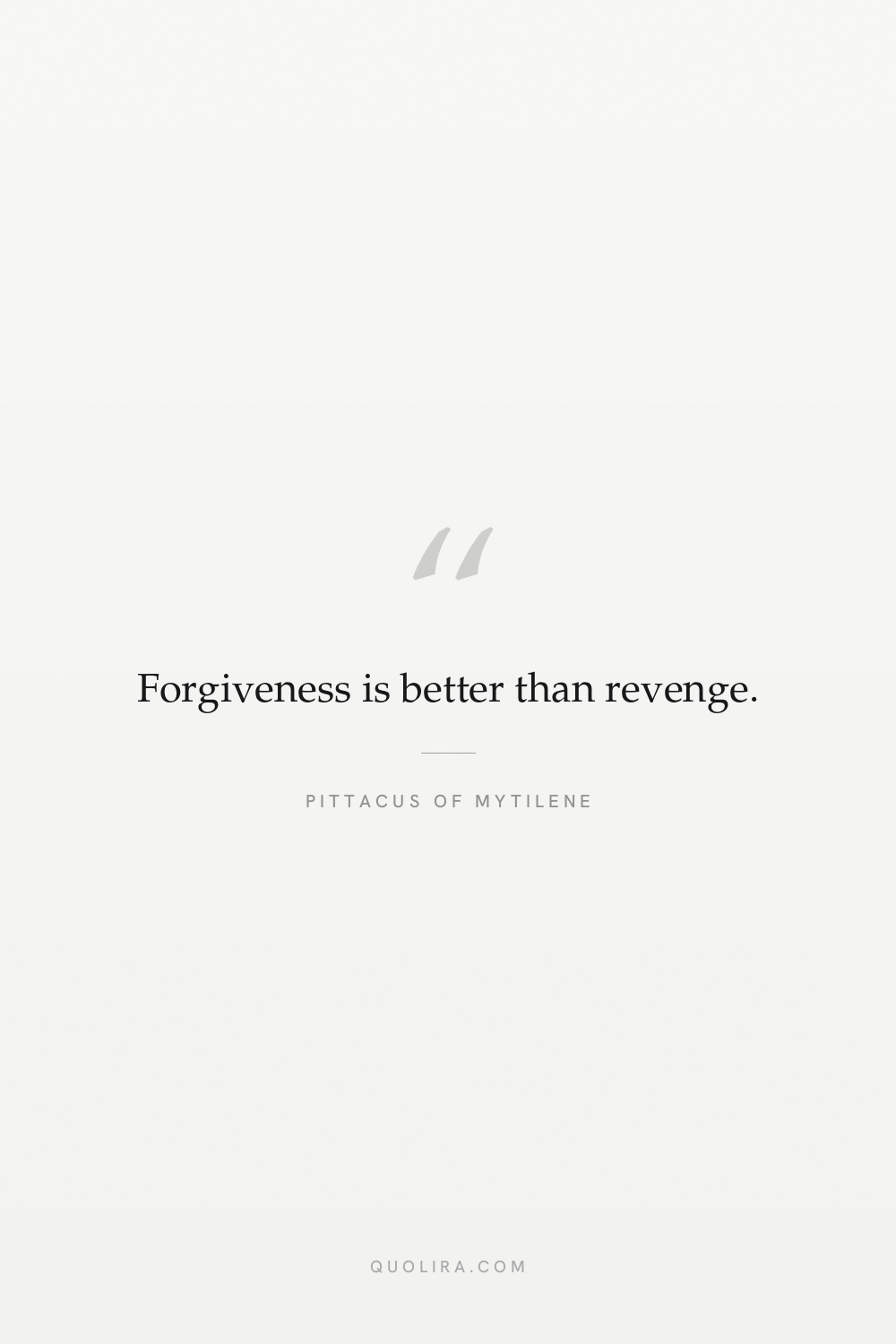
“Forgiveness is better than revenge.”
Pittacus of Mytilene · As quoted by Diogenes Laërtius, Life of Pittacus