“Give all to love; obey thy heart.”
Ralph Waldo Emerson · Give All to Love, Poems (1847)
 quolira
.com
Ralph Waldo Emerson said it, in The American Scholar (1837).
Emerson delivered this address before the Phi Beta Kappa Society in Cambridge, Massachusetts, in 1837. He wanted scholars to think for themselves instead of repeating other people's ideas. The phrase still works as a dare: read widely, then reach your own verdict.
From the collection: 25 Ralph Waldo Emerson Quotes on Self-Reliance, Nature, and Living Boldly · More Ralph Waldo Emerson quotes
This quote means that the ideal scholar is a whole, independent thinker who uses his own mind rather than repeating what others have said. Emerson describes a person in the right condition of mind, able to think original thoughts and act on them. The phrase presents thinking as a human power that belongs to anyone willing to engage it fully.
The line comes from The American Scholar, an address Emerson delivered to the Phi Beta Kappa Society at Harvard in August 1837. In the speech he argues that American intellectual life should not simply imitate European models but should develop its own independent voice. He wants scholars to draw on experience, nature, and books while keeping their own judgment at the center. The address is often cited as an early statement of American cultural independence.
Ralph Waldo Emerson (1803 to 1882) was an American essayist, lecturer, and poet who lived in Concord, Massachusetts. He was a leading voice of the Transcendentalist movement, which stressed individual intuition, nature, and moral self-reliance. Trained as a Unitarian minister, he left the pulpit and became one of the most sought-after public speakers of his era. His essays and addresses remain central to discussions of American thought and literary independence.
“Give all to love; obey thy heart.”
Ralph Waldo Emerson · Give All to Love, Poems (1847)
“if eyes were made for seeing, then beauty is its own excuse for Being.”
Ralph Waldo Emerson · The Rhodora, Poems (1847)
“I become a transparent eye-ball; I am nothing; I see all.”
Ralph Waldo Emerson · Nature (1836)
“A foolish consistency is the hobgoblin of little minds, adored by little statesmen and philosophers and divines.”
Ralph Waldo Emerson · Essays: First Series (1841), Self-Reliance
“For kindness begets kindness evermore.”
Sophocles · Ajax, line 522
“Wherever there is a human being, there is an opportunity for a kindness.”
Seneca the Younger · De Vita Beata, Chapter 24 (translation of 'Ubicumque homo est, ibi beneficio locus est')
“Kindness has converted more sinners than either zeal, eloquence, or learning.”
Frederick William Faber · Spiritual Conferences (1859)
“Remember there's no such thing as a small act of kindness. Every act creates a ripple with no logical end.”
Scott Adams · 'A Kind Word,' DNRC Newsletter #9 (December 1995)
“Too often we underestimate the power of a touch, a smile, a kind word, a listening ear, an honest compliment, or the smallest act of caring, all of which have the potential to turn a life around.”
Leo Buscaglia · Quoted in Words from the Wise (2007) by Rosemarie Jarski
“Life is made up, not of great sacrifices or duties, but of little things, in which smiles and kindnesses and small obligations, given habitually, are what win and preserve the heart, and secure comfort.”
Humphry Davy · Reported in Josiah Hotchkiss Gilbert, Dictionary of Burning Words of Brilliant Writers (1895)
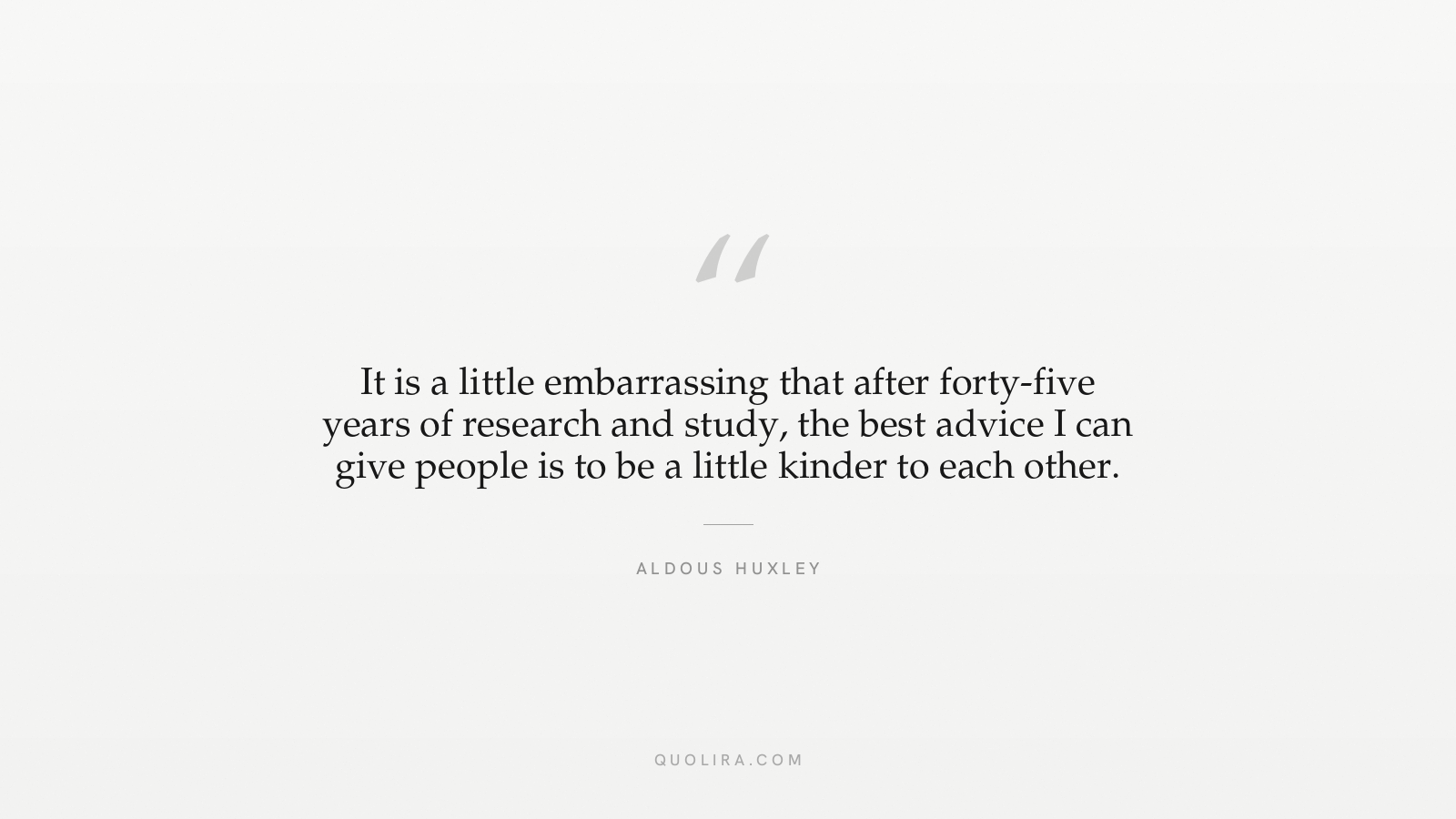
“It is a little embarrassing that after forty-five years of research and study, the best advice I can give people is to be a little kinder to each other.”
Aldous Huxley · This Timeless Moment (1968), by Laura Archera Huxley
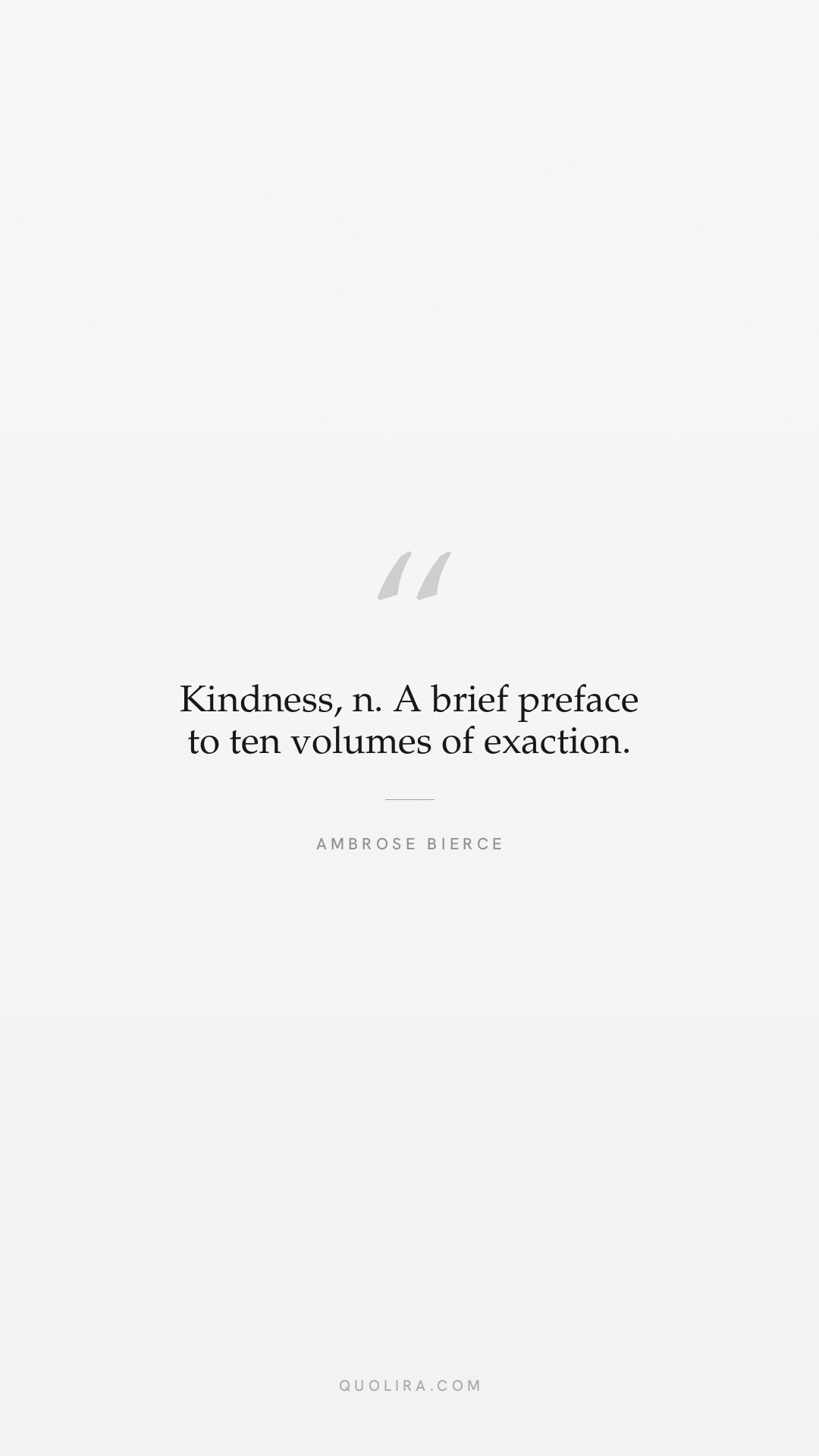
“Kindness, n. A brief preface to ten volumes of exaction.”
Ambrose Bierce · The Cynic's Word Book (1906), republished as The Devil's Dictionary (1911)