What a Right Triangle Knows
The oldest equation in the room still has something to say about how we carry weight.
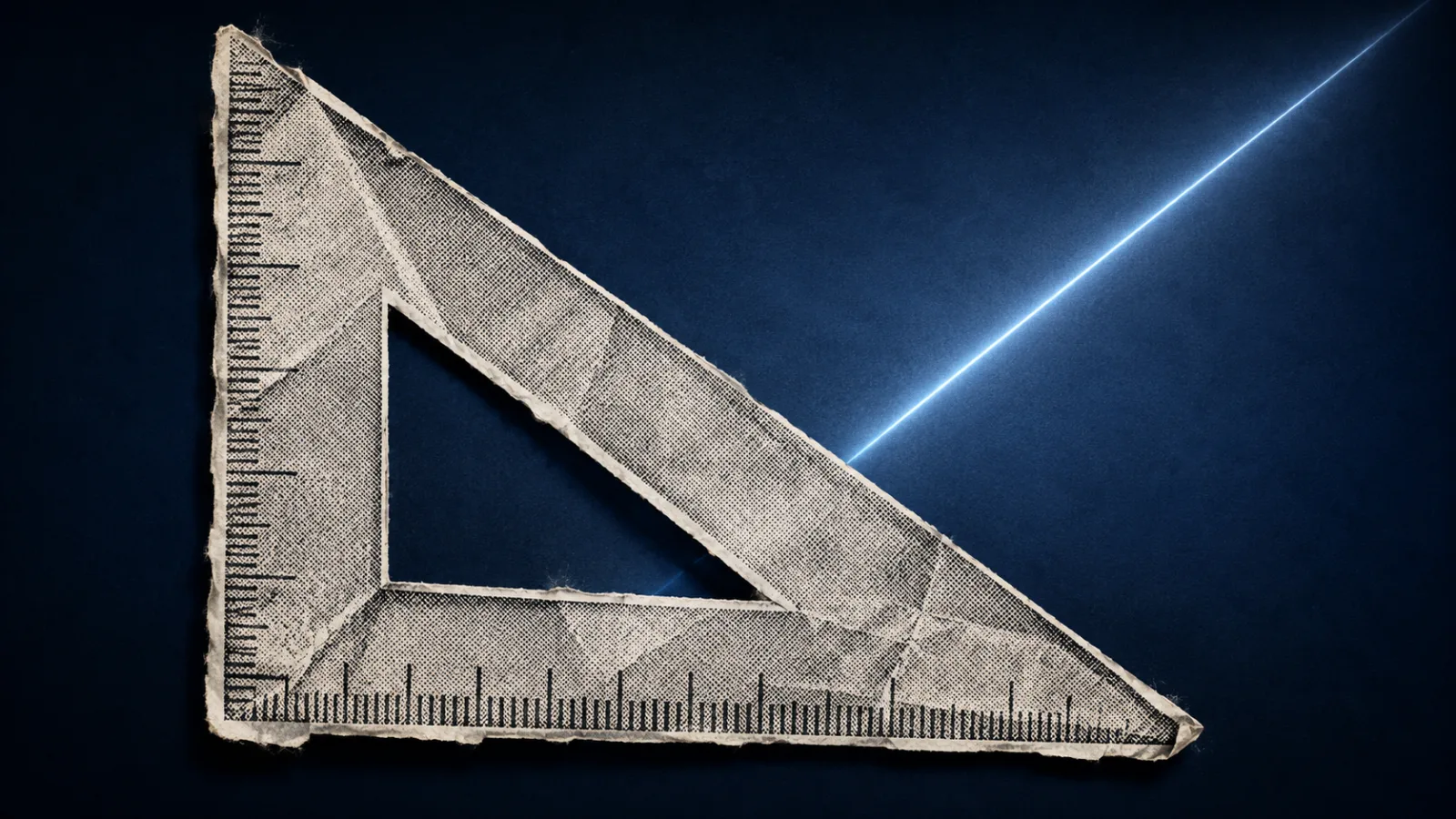
The Pythagorean theorem wisdom that sticks with me isn't the formula itself, it's what the formula assumes: that the longest side of a struggle can be measured by the two shorter ones you already have. This is a quiet lesson in geometry and a strange kind of comfort in ancient mathematics. Most of us memorized a squared plus b squared equals c squared, then forgot it. But the idea underneath kept working whether we paid attention or not.
Measure the two sides you can see, and the one you fear is already accounted for.
I think the Pythagorean theorem survived 2,500 years not because it's useful (though it is) but because it tells the truth in a way that feels almost rude.
Give it two sides. It hands you the third. No debate, no negotiation. The hypotenuse is whatever the math says it is.
That used to annoy me as a kid. Now it kind of moves me.
pythagorean theorem wisdom in plain sight
Here's the line everyone half-remembers: a squared plus b squared equals c squared. In a right triangle, the longest side is locked in by the other two.
Think about what that means. The hardest stretch, the one cutting diagonally across, isn't random. It's determined. Completely. By the parts you could already point to.
Your base. Your height. The honest stuff.
I find that strangely calming. So much of life feels like the hypotenuse, the long uncertain distance you have to cross. But the theorem says that distance was never a mystery. It was always a function of where you actually stood.
The Pythagorean Theorem: A 4,000-Year History
Measure the two sides you can see, and the one you fear is already accounted for.
the part Babylon knew first
We call it Pythagorean, but clay tablets from Babylon, dated around 1800 BC, list these triangles centuries before Pythagoras was born. The relationship existed before anyone signed their name to it.
That's its own kind of lesson. The truth didn't wait for credit. It just sat there in the stone, correct, until someone got curious enough to write it down.
A lot of wisdom works like that. It's available long before we're ready to hear it.
And when we finally do, we act like we invented it.
what the right angle asks of you
Euclid's Elements
The whole thing only works if there's a right angle. Ninety degrees. A clean corner.
Tilt the triangle even slightly and the formula breaks. You need a sturdy base meeting a true vertical for the math to behave.
Maybe that's the quiet demand. Build square first. Get your foundation honest and your rise honest, and the rest follows in a way you can trust.
I'm not saying geometry is a religion. But there's something in that corner worth sitting with.
We spend so much energy worrying about the long diagonal, the outcome, the destination. The theorem keeps redirecting us back to the two legs we control.
Get those right. The hypotenuse will sort itself out.
And if it comes out longer than you hoped? That's not the triangle being cruel. That's just the sum of how far you reached on each side, made visible.
The oldest equation in the classroom is really a note about effort. Tend to your measurable sides. The hard distance is already decided by them.
The truth sat in the clay for a thousand years before anyone gave it a name.
The triangle doesn't ask you to be perfect. It just asks you to be honest about your two sides, and then it tells you the rest.
Frequently asked questions
Who discovered the Pythagorean theorem?
What does the Pythagorean theorem actually say?
Why is the Pythagorean theorem still relevant today?
Keep reading
12 Steven Pinker Quotes on Progress That Reframe How You See the World
A cognitive scientist makes the slow, unglamorous case that things have actually gotten better.

The Hawthorne Effect: The Watched Clock
Being observed changes how we work, and maybe who we are.